
Cold calling vs cold emailing is a choice about your audience, feedback needs and operating workflow. Calls let you ask follow-up questions during a conversation. Email lets the recipient respond asynchronously. Compare both against the same outcome, such as a qualified meeting that actually takes place.
I recommend starting with a small, defined audience and a clear acceptance rule. A dial, an email, a reply and a booked meeting are different events. Neither channel is universally faster, cheaper or better at closing business.
📌 Summary For Those In a Rush
Choose a channel you can operate and review consistently. Compare list preparation, execution time, response handling and completed outcomes before scaling.
- Input: A suitable prospect segment and explicit calling or email criteria.
- Output: Conversations and reviewed next steps, measured with the same meeting definition. The calculations below are hypothetical, not observed conversion benchmarks.
Which One Generates More Leads in One Day?
Volume alone cannot answer this question. Keep separate counts for attempted contacts, successful connections, responses, positive responses, bookings, attendance and qualification. One person may also receive several touches, so count unique prospects separately from attempts.
Cold Call Metrics (based on 100 calls)
For illustration, assume 28% of dials connect and 10% of connections book a meeting. Then 100 × 0.28 × 0.10 = 2.8 expected bookings. This is an assumption-driven estimate, not a claim that your first 100 calls will produce that result.
A connection rate must state what connected means: a human answer, the intended prospect or a substantive conversation. Use the same definition throughout the report and exclude wrong-number outcomes from qualified conversations.
Cold Email Metrics (based on 250 prospects contacted)
For a separate illustrative email model, assume a 4.32% reply rate, 27.13% positive replies among replies and 40% booking among positive replies. Then 250 × 0.0432 × 0.2713 × 0.40 = 1.172016 expected bookings.
The 27.13% denominator is replies, not all prospects. Do not multiply the initial list by it as if that were an independent overall conversion rate. Keep negative replies, opt-outs and automated responses separate from positive human interest.

The original illustrations show the channel comparison. They do not establish current conversion rates or a measured advantage for either channel.
Which One Generates Faster Leads
Time Investment to First Meeting:
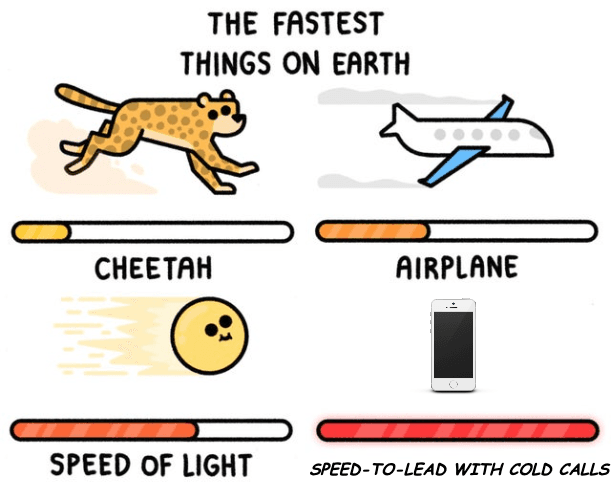
A phone conversation can provide immediate feedback when you reach the intended person. That does not mean a meeting will be booked on the first day. Email may wait for delivery and a reply, and follow-ups can extend the observation period.
Pick a complete observation window before comparing results. A calling day and an email campaign still awaiting replies are not equivalent samples. Record elapsed time to the first useful response alongside the labor needed to produce it.
Learning Curve:
Calls require listening, clear questions and responding to objections in real time. Email requires list preparation, clear writing, sender setup and careful response handling. Your existing experience and audience affect both. There is no fixed number of weeks after which either method is mastered.


Technical Setup and List Building:
For calling, check numbers, audience suitability, local time, exclusions and your ability to record outcomes. For email, check the address and identity, sending setup, relevant message, opt-out handling and who will answer replies. A dialer or sending platform can support execution; neither makes a weak list suitable.
Datablist can help prepare and review prospect rows before the channel-specific step. Keep a stable contact ID, account ID, source and review decision. Do not deduplicate several people just because they share an employer. Use lead scoring only with rules and evidence you can inspect.
Check the rules for your audience and jurisdiction before testing. For UK B2B marketing, the ICO guidance distinguishes live-call and email requirements, including screening applicable calling preference registers and respecting previous objections. A B2B label does not settle every permission question.
Cold Calling vs. Cold Emailing: Costs Per Meeting
Use the same currency, period and outcome. The numbers below are hypothetical budget inputs, not current vendor quotes or measured results. Include preparation, execution and response handling in your actual time log.
Cold Calling Calculations
Assume 150 calls per day across 20 working days. That gives 3,000 calls. Applying the illustrative 28% connection and 10% booking rates gives 3,000 × 0.28 × 0.10 = 84 expected bookings.
At eight hours per day, the monthly time allowance is 160 hours, not 180. Use your measured task time if calls occupy only part of the day. Do not add unrelated administration to one channel while excluding it from the other.
Cold Calling Costs
At an assumed labor rate of $20 per hour, 160 hours costs $3,200. Add illustrative tool allowances of $30, $49 and $59, totaling $138. The combined budget is $3,338.
Cold Calling: Cost Per Meeting
$3,338 / 84 = $39.74 per expected booked meeting, rounded at the end. This is a cost calculation, not ROI: revenue, margins and closed business are not included.

Cold Emailing Calculations
Assume 5,000 unique prospects over the same monthly period, with follow-ups tracked separately. Applying the example reply and booking rates gives:
5,000 × 0.0432 × 0.2713 × 0.40 = 23.44032 expected bookings.
Do not count 5,000 follow-ups as another 5,000 unique people. Deduplicate the audience before the campaign, preserve response and exclusion history, and wait for the chosen response window to close before comparing observed results.
Cold Emailing Costs:
The illustrative time budget is 22 hours at $20 per hour: $440. The example tool allowances are $94, $6.25, $80, $99, $30, $49 and $59. These sum to $517.25, giving $957.25 total.
Your actual email workflow may require more preparation, troubleshooting and reply handling. These allowances are example inputs, not prices for named products or a guarantee that 22 hours is enough.
Cold Emailing: Cost Per Meeting
$957.25 / 23.44032 = $40.84 per expected booked meeting. Keep full precision until the final result; rounding the expected count too early changes the unit cost.
| Hypothetical monthly model | Calling | |
|---|---|---|
| Labor allowance | $3,200 | $440 |
| Tool allowance | $138 | $517.25 |
| Total | $3,338 | $957.25 |
| Expected bookings | 84 | 23.44032 |
| Cost per booked meeting | $39.74 | $40.84 |
These inputs do not establish a universal winner. Different labor, contact quality or booking assumptions can reverse the comparison. If one channel produces meetings that attend or qualify at a different rate, cost per booking also hides that difference.
Include attendance and qualification
For illustration, apply 80% attendance and 50% qualification among attendees to both models. Calling gives 84 × 0.8 × 0.5 = 33.6 expected qualified held meetings, costing $99.35 each. Email gives 23.44032 × 0.8 × 0.5 = 9.376128, costing $102.09 each.
These fractional counts are planning estimates, not possible observed event counts. Track actual booked, held and qualified meetings separately. Define qualification before the test, such as an agreed need and relevant role, rather than changing it after seeing which channel performed better.

Which one is better for you based on your skills
Essential Skills for Cold Calling
Practice concise introductions, listening, useful follow-up questions and recording what the prospect actually said. Let a clear rejection end the contact rather than turning persistence into repeated unwanted attempts.
Essential Skills for Cold Emailing:
Practice list review, clear writing, relevant evidence, sending operations and handling responses. A plausible personalized line is not useful when it refers to the wrong company. Keep the research source with the contact so another person can check it.
Skills You Need for Both
Define the audience, verify identifiers, record exclusions and choose a sensible next action. If you use hiring signals, check the job date, employer and actual role before treating a posting as a reason for contact.

Pro’s and Con’s
Pros of Cold Calling
You can ask clarifying questions during a connected conversation and hear objections directly. This can be valuable when the offer needs explanation or the audience prefers the phone.
Cons of Cold Calling:
You need suitable numbers, timing, list screening and time for unsuccessful attempts. Direct feedback is useful, but wrong-person connections and repeated attempts consume capacity too.

Pros of Cold Emailing
Recipients can read and respond asynchronously, and a written message can make the proposed next step easy to review. One operation can support many contacts when the audience and sending requirements are suitable.
Cons of Cold Emailing:
Delivery, identity quality, response delays and exclusion handling affect the result. Larger sending volume can increase problems instead of useful conversations. Keep someone responsible for replies and troubleshooting.
Which One Is The Winner?
Choose calling when live discussion fits the audience and you can support list quality, screening and conversation time. Choose email when asynchronous communication fits and you can maintain relevant messages, sending operations and response handling.
Compare the same completed outcome
Test one defined segment with the same accepted outcome. If using both channels, keep a shared contact history and suppression list so separate workflows do not contradict each other. Compare qualified held meetings and downstream results before increasing the budget.
FAQ
Is cold emailing better than cold calling?
Neither is universally better. In this hypothetical model, calling costs $39.74 per expected booking and email $40.84. Those figures illustrate the method; your inputs and actual outcomes decide the comparison.
Does cold emailing work anymore?
Evaluate it on a suitable, reviewed audience with clear response and qualification rules. Do not use open rate or sending volume alone as proof of a successful sales conversation.
What are the advantages and disadvantages of cold calling?
Calling provides live feedback when you reach the right person, while unsuccessful attempts, timing and screening consume time. Measure connected conversations and accepted outcomes separately.
What are the advantages and disadvantages of cold emails?
Email supports asynchronous replies and written context, but delivery and response handling need active attention. Count unique prospects, completed observation windows and actual positive responses.
What tools do I need to start with cold email outreach?
Use suitable contact data, a correctly configured sending service and a process for replies, exclusions and CRM handoff. Add research or automation tools only where they solve a specific part of that workflow.
What tools do I need to start cold calling?
Use a checked calling list, a way to make and log calls, appropriate screening and a shared record of outcomes. A power dialer is an optional operating choice, not a guarantee of additional meetings.