

These six cold email examples show different ways to open a relevant conversation: a hiring signal, a specific question, two possible problems, a direct offer, a task-based message, and a problem-agitation-solution structure. Choose the one that fits what you actually know about the recipient, then replace every placeholder with a checked fact.
I know this because before joining Datablist, I ran a lead generation agency focused on cold emails. When I first started, I struggled to find good resources and had to do the trial and error myself.
The examples are illustrative templates, not measured campaign results. Do not send the named companies, figures, or case-study claims unless they are true for your own business.
What You'll Learn From This Guide
- Six cold email templates for different situations.
- Cold email examples for different use cases.
- The psychological reasoning why these templates work.
- How to personalize and check a template before sending.
Before We Begin
Pick one template based on a specific signal or task. Before sending it, check four things:
- Recipient: Is this person responsible for the problem you mention?
- Evidence: Can you verify the hiring post, website detail, or other reason for reaching out?
- Proof: Are any customer names, results, or numbers real and approved for use?
- Ask: Can the recipient answer your question without committing to a meeting?
For example, replace “I noticed you're hiring” with the role and source you actually found. If you have no verifiable signal, use a simpler direct offer instead of inventing one. Then choose a template below.
Cold Email Template 1 – Hiring Signals For Recruiter
{{Soft CTA}}
Example 1 – Hiring Signals for recruiter
Why it works
- It names the role and a requirement from a real posting.
- It asks about one specific hiring problem.
- It offers a small next step instead of assuming a meeting.
This cold email template is perfect for recruiters, staffing firms, and temporary workforce companies.
Cold Email Template 2 – Poke The Bear
With many {{job title}} still relying on {{current solution 1}} or {{current solution 2}} for their {{task}}, I wanted to ask: {{poke the bear question}}
{{Our solution}} recently helped {{similar_customer}} {{achievement}} through {{system or method}} resulting/leading in {{benefit 1}} and {{benefit 2}}.
Example 2 – Poke The Bear
I was on your website noticed you specialize in the disposal of hazardous materials for medical research facilities.
With many fleet managers still relying on Hamzat Box or McNeilus trucks for their daily routes, I wanted to ask: How do you measure whether your current trucks are delivering the highest ROI per route?
If route efficiency is on your agenda, I can send a short comparison of how our trucks handle stops and fuel use.
Can I send you more information about the new trucks?
Why It Works
- Challenges current solution.
- Offers a concrete comparison without an unverified customer claim.
- Is personalized.
- Uses Soft CTA.
- Is short.
Cold Email Template 3 – The Two Reasons
{{Problem statement}} {{Source if possible}}.
Usually, {{reason1}} or {{reason2}}.
Does this sound familiar?
I saw on {{source of data, your target audience is X}} if we can help you {{outcome}}, would you be open to chat?
Example 3 – The Two Reasons
Your team is expanding outbound into two new regions.
Usually, they are not getting responses on their outbound activities, while others aren't getting enough contact data of qualified prospects.
Does this sound familiar?
I saw on your website, your work mostly with operation leaders if we can help you find and connect with more COO’s like Alex from Storage Kings, would that be helpful?
Why it works:
- Shows you know their pain
- Doesn’t commit them to anything
- Shows you know who they are targeting.
- Is personalized.
- Uses Soft CTA.
- Is short.
Cold Email Template 4 – Straight to the Point
Example 4 – Straight to the Point
Why it works?
-
Goes straight to the point
-
Includes risk reversal
-
Strong social proof
-
Short and scanable
-
Uses Yes/No CTA
Cold Email Template 5 – I know Exactly What Your Pain Is
{{Inbox_Slider}}
Since {{their task}}, you are certainly familiar with {{Problem}}.
Imagine {{incredible solution}}
This is where {{our company}} comes in, because with {{our solution provides advantages}}
Would you like to see how we {{improved situation}} for {{Case study name}}
Example 5 – I know Exactly What Your Pain Is
Since you're probably the one managing customer purchase data, you've probably hit Excel's limits when trying to analyze patterns in 50,000+ orders - especially when filtering by purchase date, customer location, and product categories simultaneously.
Imagine quickly finding exactly what you need without spreadsheet performance issues or complex lookup formulas.
This is where Datablist comes in, providing spreadsheet simplicity with powerful database-like search and filtering — making large datasets manageable again.
Would a short example of filtering an order list by date, location, and category be useful?
Why it works:
- This version describes their task super specific.
- Makes it super relatable.
- Names specific data points his company analyzes.
- Mentions a concrete number of records (50,000+ orders).
- Describes a real scenario they face.
This template works best for software companies — service-based businesses should use templates 2-4 or 6 instead
Cold Email Template 6 - The PAS Framework
Is {{company_name}}'s {{team}} still {{bad_and_current_solution}} and trying to {{desired_outcome}}?
On average, this approach takes up to {{time_cost}} and leads to {{pain_point_1}}, and {{pain_point_2}}.
We helped {{case_study_company}} {{solution_implementation}}, resulting in {{benefit_1}} and {{benefit_2}}.
Would you be open to see how {{your_company}} {{get_value}}?
P.S {{success_metric}} since {{benefit_1}} and {{benefit_2}}.
Cold Email Example 6 – The PAS Framework
Is Future Destination's marketing team still manually juggling their social media accounts and trying to maintain consistent posting times?
On average, this manual approach takes up to 10 hours per week and leads to missed posts and limited performance tracking.
I can show you one way to centralize the scheduling workflow and review the time spent on it.
Would you be open to seeing how Social Buddy simplifies social media management?
P.S. I can send a one-page workflow example if that is easier to review.
Why it works
- Identifies a specific operational pain point
- Quantifies the problem's impact
- Can include a verified case study when you have one
- Uses a clear, time-bound call to action.
What is the PAS Framework?
The PAS Framework is a classic copywriting structure that works well for cold emails because it follows a natural psychological progression.
Here’s how to use it:
- Problem: Point out a specific challenge they're facing
- Agitation: Highlight the negative impact of this problem
- Solution: Present your solution with a concrete case study and clear results.
This framework is particularly effective because it demonstrates you understand their situation before pitching your solution.
The 80/20 Rule for Cold Email.
The 80/20 split is a planning heuristic, not a measured rule. Spend enough time checking your prospect list and the details in each message before polishing the copy.
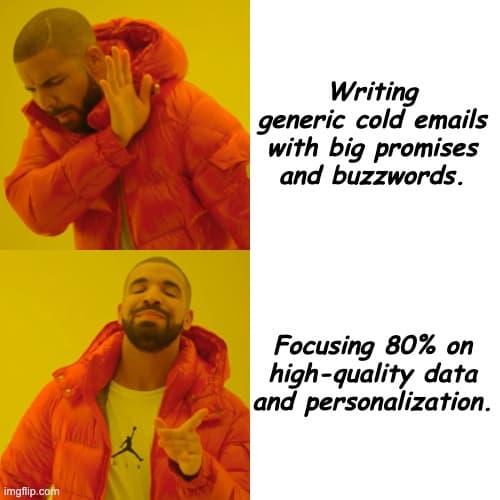
Why you Should Follow the 80/20 Rule:
The simple truth is that you need good contact data to reach your prospects.
Let me share 3 key reasons why data matters:
- It makes writing much easier because you'll know who you're writing for.
- You can send personalized cold emails that will make you stand out in the crowd.
- You can avoid sending a message built on a wrong name, role, or company detail.
Datablist is an AI-Copilot built for data enrichment that makes it perfect for gathering all sorts of prospection data to build, personalize and scale cold email campaigns effortlessly.

Conclusion
Cold email works best when you combine high quality data with genuine personalization. While volume matters, sending generic messages to unqualified prospects won't get you far.
Focus on reaching the right people with relevant, personalized messages that show you understand their needs. This approach will help you stand out and get better results from your outreach efforts.
FAQ
What is the 30 30 50 rule for cold emails?
To be honest, I've never heard of this rule even though I am a member of multiple cold email communities. There might be others who try to invent their own definitions to sound like experts, but I prefer being straightforward about it.
How do you write a good cold email?
Know your customer and keep it human in the age of AI. Executives are getting 10 times more cold emails than they used to, and most are exhausted by them. You can easily stand out by simply keeping your approach human—this is the most actionable advice I can give you.
Does cold emailing really work?
It can generate conversations when the recipient is relevant, the offer is clear, and the message is delivered. Do not assume a benchmark reply rate for your own campaign; measure replies, bounces, and opt-outs for each audience segment.
Is cold emailing illegal?
Rules depend on the recipient's location and the type of message. In the United States, the FTC's CAN-SPAM guide covers commercial email, including business-to-business messages, and explains sender identity, subject lines, postal address, and opt-out requirements. In Europe, national electronic marketing rules also apply; for example, France's CNIL distinguishes consumer and professional prospecting. Check the rules for each market before using a template.
How many cold emails per day?
There is no universal safe or effective daily number. Start with a small, relevant sample, check delivery and responses, and follow your email provider's sending requirements. Increase volume only when your targeting and sending setup are working.
How to structure a cold email?
While there's no single "correct" way to structure a cold email, here's my recommended format:
- Start with a relevant, personalized line that addresses the prospect's pain point.
- Present your offer.
- Include social proof.
- Add a soft call-to-action (CTA).
- End with a P.S. line to add a human touch.