
What Is the WTTJ Jobs Scraper?
The Welcome To The Jungle Jobs Scraper turns job postings into account data. It scans the Welcome To The Jungle job board to identify companies hiring for roles such as sales, marketing, and business development.
Hiring activity can reveal company intent: team growth, market expansion, or new operational needs. Use the scraper for lead generation, market research, and competitor analysis.
Step-by-step guide
Step 1: Create an account on Datablist
Datablist helps you build, store, and enrich lead lists.
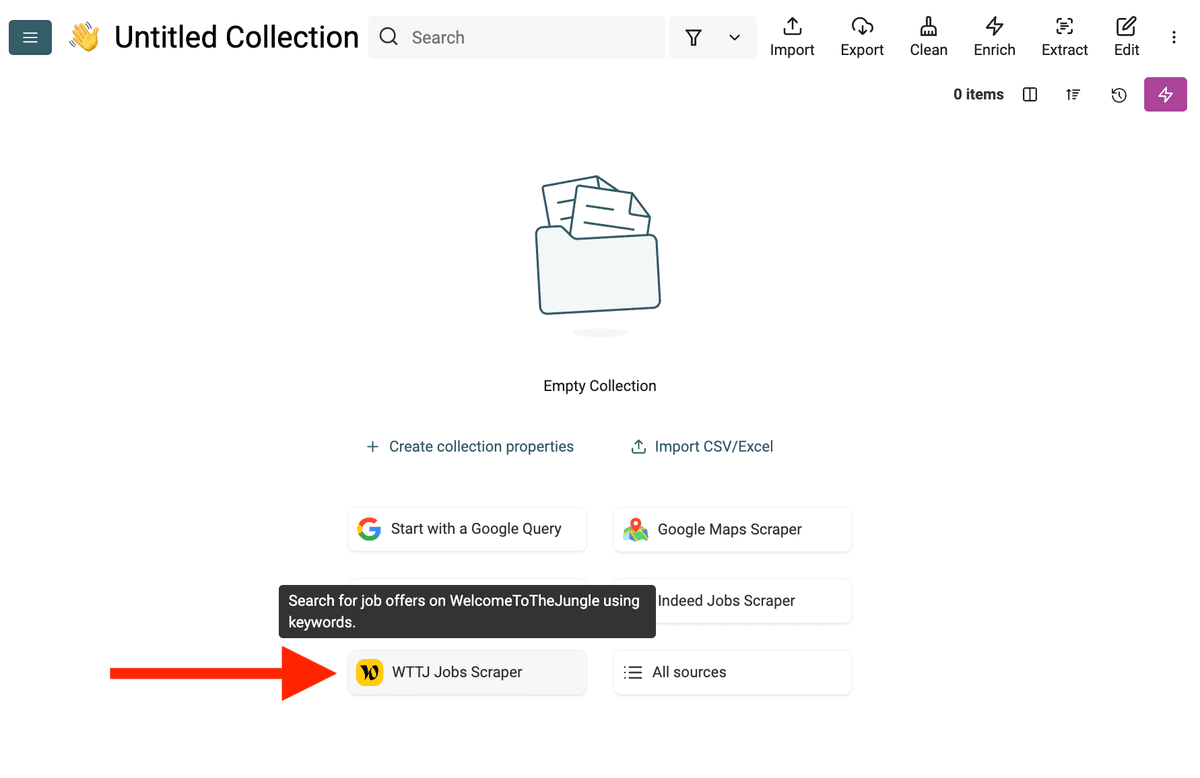
Step 2: Select the "WTTJ Jobs Scraper" data source
Create a new collection using the "+" icon in the sidebar. Then select "WTTJ Jobs Scraper" in the highlighted sources. Or select it from the "Import" -> "Import from data sources" menu in the header.
Step 3: Define keywords
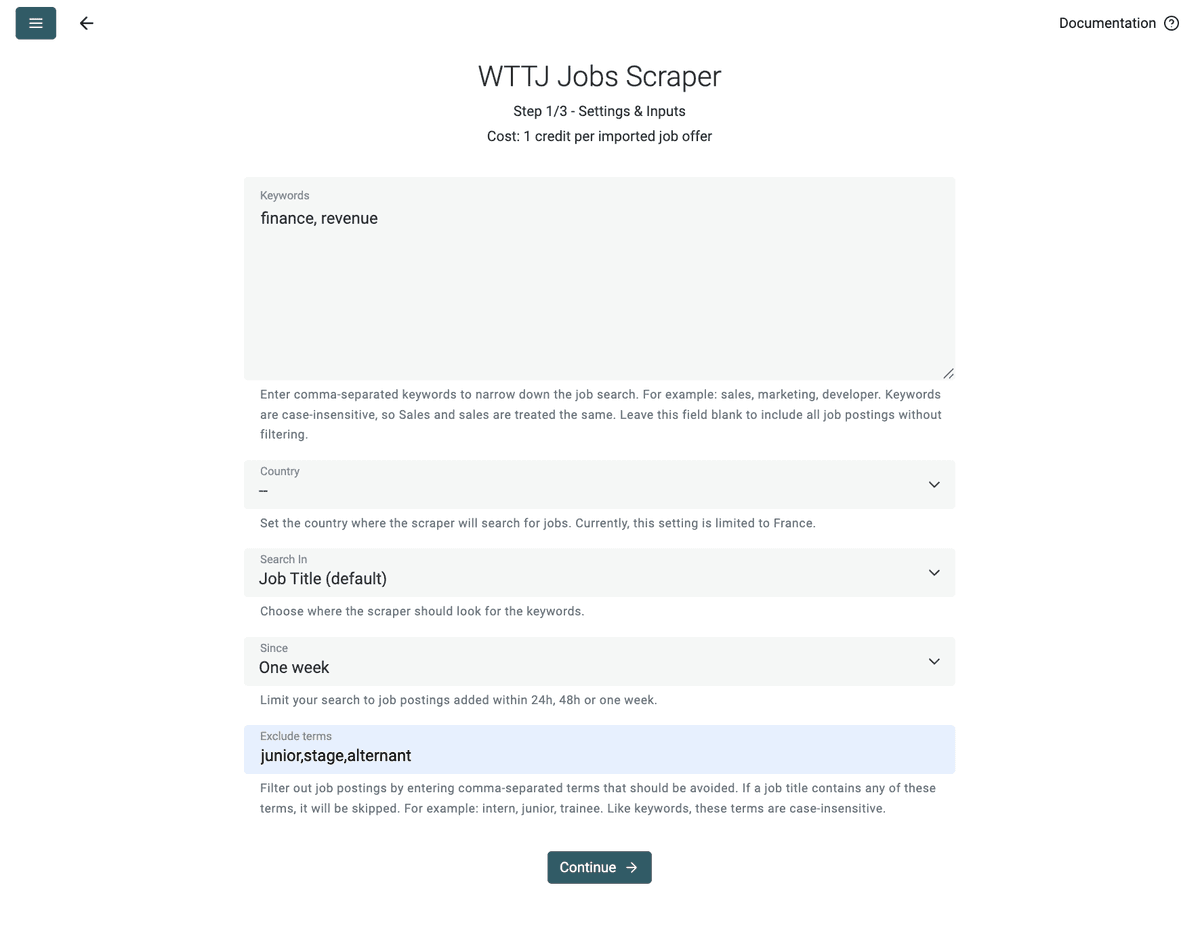
Define the keywords to filter job offers, or leave the keywords setting blank to include all job postings.
Additional settings allow you to specify where to search for the keywords (job titles, descriptions, or both) and provide a list of terms to exclude from the results.
Step 4: Run the data source
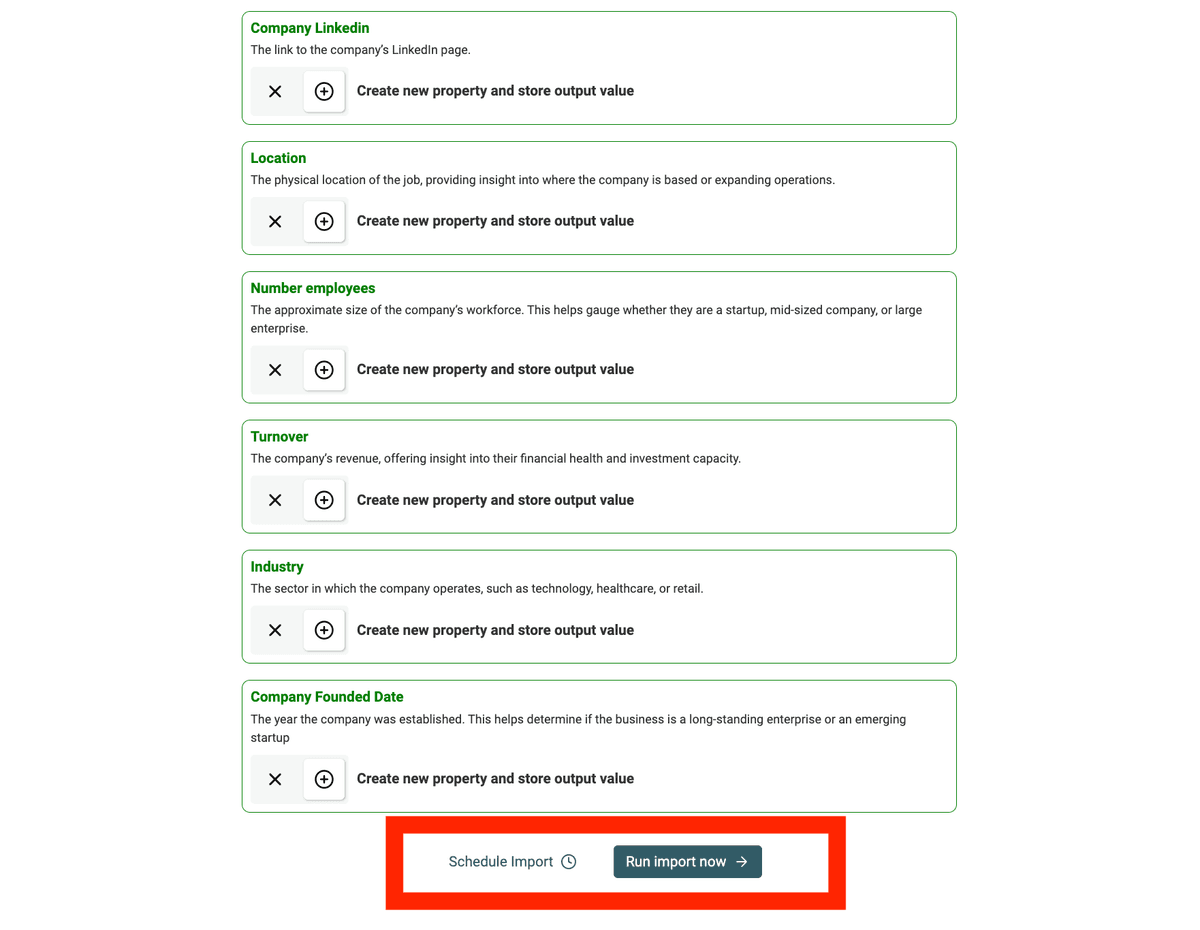
The final step is to review the output properties (create new properties or map the outputs with existing properties if you run the scraper in a collection with existing data).
Once your output properties are set, click "Run import now" to start the task. You can schedule the scraper to run at intervals and keep a fresh lead source.
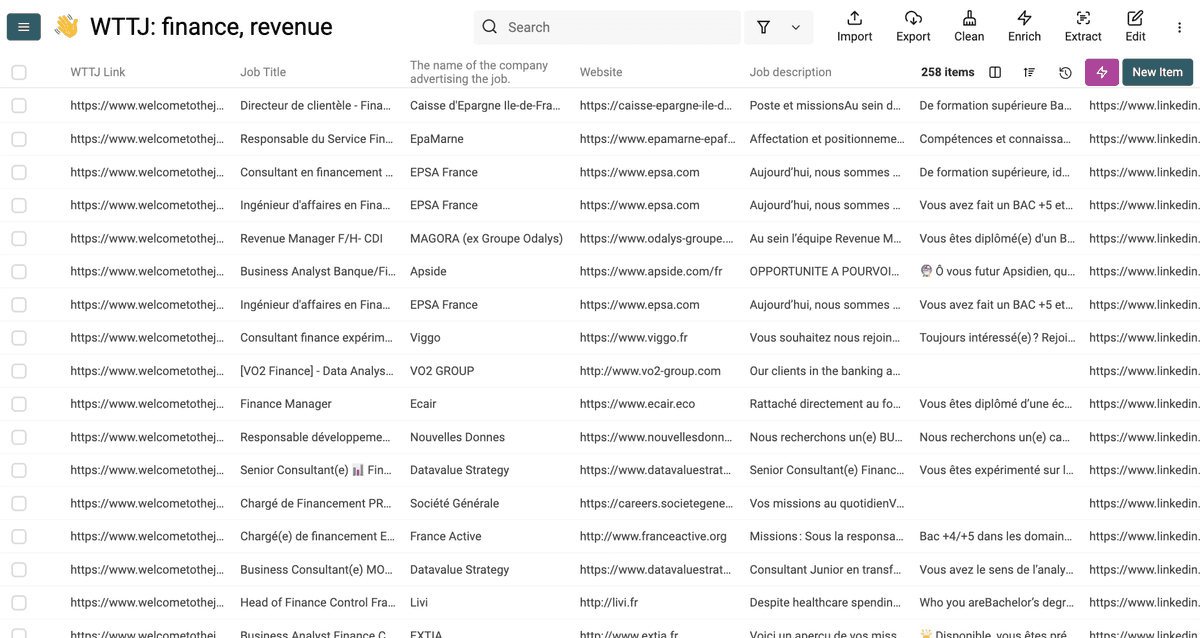
The task will run for a few seconds or minutes depending of the number of job offers to import.
Step 5: Find contacts at the recruiting companies
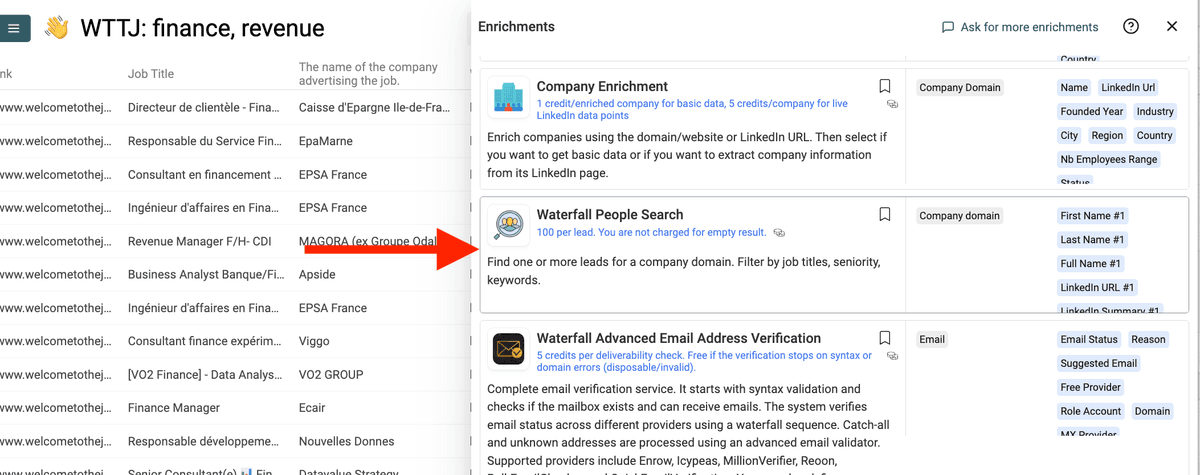
Once you have the companies that are recruiting, use the "Waterfall People Search" enrichment (from the "Enrich" menu) to search profiles and get their email addresses.
How much does it cost to scrape Welcome To The Jungle job offers?
Datablist Data Sources work with a credit system. You receive credits with your monthly plan and you can buy non-expiring credits with top-ups.
The Welcome To The Jungle jobs scraper costs 1 credit per importer job offer.
A $20 top-up gives you 20,000 credits. The scraping of one job offer costs $0,001. You can scrape 20,000 job offers with a $20 top-up.
A $150 top-up gives you 200,000 credits (25% discount). The scraping of one profile costs $0,00075. You can scrape 200,000 job offers with a $150 top-up.
Learn more about the Datablist Credits System.
Examples and Use Cases for the Welcome To The Jungle Jobs Scraper
1. Identifying Companies Ready to Invest in Marketing Services
A digital marketing agency wants to target companies actively hiring marketing professionals. They use the scraper with the following settings:
- Keywords: marketing, growth, social media
- Exclude Terms: junior, intern
The scraper delivers a list of companies hiring marketing managers, growth leads, and social media specialists. These companies are clearly focused on customer acquisition and brand building, making them ideal clients for the agency’s services.
2. Finding SaaS Startups Hiring Sales Teams
A CRM software provider is looking for startups that need tools to manage growing sales pipelines. They configure the scraper as follows:
- Keywords: sales, business development
- Exclude Terms: intern, assistant
The output reveals startups hiring sales executives and business development managers. These companies are likely scaling sales operations and may need a CRM solution.
3. Generating Leads for HR and Recruitment Services
An HR consultancy wants to offer recruitment solutions to growing companies. They search for firms hiring across multiple roles. The scraper is set up with:
- Keywords: human resources, recruitment, talent acquisition
The results highlight companies expanding their HR teams or adding recruiters. This shows a need for HR solutions, whether it’s recruitment support, training, or employee onboarding tools.
4. Spotting Competitors' Growth Strategies
A sales enablement platform wants to monitor competitors’ hiring trends. They use the scraper to track job postings from competing companies by filtering specific industry-related keywords:
- Keywords: sales enablement, customer success, sales operations
- Exclude Terms: entry-level
The output provides insights into the roles competitors are prioritizing, giving the team an edge in adjusting their own growth strategies.
5. Targeting Startups Scaling Operations
A coworking space provider wants to find startups expanding their teams. They search for companies hiring across departments with:
- Keywords: operations, product management, marketing
The scraper reveals startups rapidly adding staff, signaling they might need flexible office spaces. This data enables the provider to craft tailored outreach for these companies.
6. Researching Market Trends for Investment Firms
A venture capital firm wants to track hiring trends in tech startups to spot potential investment opportunities. Using the scraper, they set:
- Keywords: AI, machine learning, software engineering
The results show startups focusing on cutting-edge technology roles, indicating areas of innovation and growth. This helps the firm identify promising companies to explore further.
7. Uncovering Demand for Training Programs
A corporate training provider looks for companies hiring large teams, which often signals the need for employee development. They configure the scraper to:
- Keywords: operations, project management, leadership
- Exclude Terms: intern, assistant
The scraper highlights businesses actively expanding management roles, signaling a strong need for leadership and operational training programs.
Why These Use Cases Work
The Welcome To The Jungle Jobs Scraper is a lead generation engine. By targeting hiring activity, it helps businesses:
- Predict client needs based on their hiring focus.
- Spot growth opportunities in specific industries.
- Save time by identifying only relevant prospects.
It turns job postings into outreach and sales signals.
Best Inputs for WTTJ Job Scraping
Use WTTJ Jobs Scraper when you want French hiring signals from Welcome To The Jungle.
Good settings include:
- Keywords such as
sales,marketing,developer, orgrowth - Search location in job title only, or job title and description
- Exclude terms such as
intern,junior, ortrainee - Freshness filters such as 48 hours, one week, or two weeks
Leave keywords empty when you want to import all recent job postings available through the source.
Cold Outreach Workflow from WTTJ Job Posts
The linked cold email workflow uses WTTJ jobs as account intent data.
- Search for job posts that match your product or service. For example, sales roles for CRM offers, data roles for automation offers, or marketing roles for agencies.
- Keep company fields, job title, job description, location, posting date, website, and LinkedIn company URL.
- Score accounts with AI using the job context, industry, company size, and role being hired.
- Find decision makers with Waterfall People Search.
- Personalize the first message around the open role, the team being built, or the operational problem implied by the job description.
This turns a job board into a fresh lead source for French and European companies that are actively hiring.
FAQ
Can I scrape Welcome To The Jungle jobs by keyword?
Yes. Enter comma-separated keywords and choose whether Datablist should search job titles only or both titles and descriptions.
What data does the WTTJ Jobs Scraper return?
It can return the job link, title, hiring company, website, posting date, job description, preferred experience, company LinkedIn URL, location, employee count, turnover, industry, and founded date when available.
What is this useful for?
Use WTTJ hiring data to find companies that are growing, identify recruiting signals, monitor competitors, or build account lists for sales and recruiting workflows.
What should I do after importing WTTJ jobs?
Use company domains or LinkedIn company pages to find decision makers with Waterfall People Search, then enrich contacts with email or phone data.
How do WTTJ jobs help cold email?
A job post gives you a concrete reason to contact the company. It shows what team they are building, which roles matter now, and which business problem you can reference in outreach.