
Datablist's Waterfall Email Finder finds professional email addresses in bulk from a CSV or Excel file. You can start with a person's name and company name, a person's name and company domain, or a standard LinkedIn profile URL.
It uses a waterfall approach: instead of querying one email provider and stopping there, Datablist tries several sources until it finds a result. This improves coverage and avoids the usual single-provider problem where a valid prospect is marked as "not found" too early.
Use it when you have a lead list with names and companies, even if the company domain is missing. Datablist can resolve the likely domain internally before checking the email providers in the waterfall.
Find work emails without company domains
Most work email finders expect a person's name and a company domain. Datablist also accepts the company name directly.
For a row containing a person's name and a company name, Email Finder first checks Datablist's company datasets for a likely domain. It validates candidate websites and uses a domain only when the available data does not conflict. It then sends the person's name and company information through the email-provider waterfall.
This domain-resolution step is included inside Email Finder. You do not need to run the separate Company Name to Domain enrichment first, and the internal lookup does not add a separate action-credit charge.
A known domain remains the most precise input. Company names can be ambiguous, especially for subsidiaries, regional companies, and businesses with generic names. When Datablist cannot select a safe domain, it keeps the original company name and lets compatible providers continue the search instead of inventing a domain.
Step-by-step guide
Step 1: Load your CSV or Excel file on Datablist
Create a free account and import your data file. Datablist is a powerful CSV editor, perfect for opening large lead lists, CRM exports, and prospecting files.
Create a new collection and import your file.
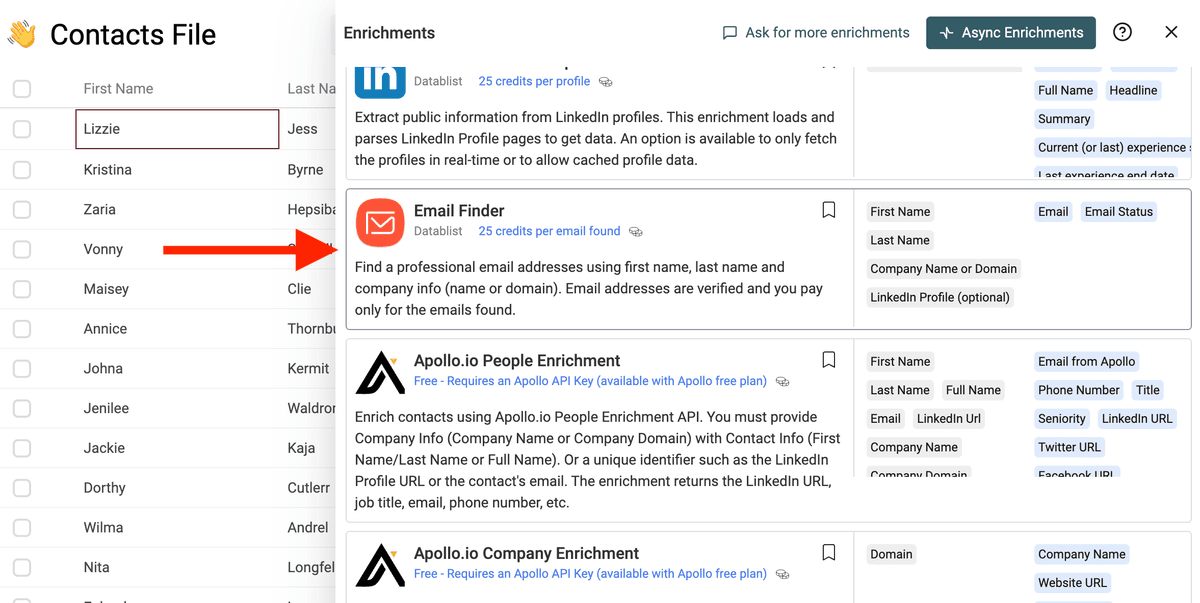
Step 2: Select the "Email Finder" enrichment
Click Enrich and search for Email Finder.
Step 3: Choose the email search method
The enrichment supports two search methods.
By Name and Company
Use this mode when your file contains the person's name and company information.
Required inputs:
- First Name and Last Name, or Full Name if you enable the "Use Full Name" setting
- Company Name or Domain
Optional input:
- LinkedIn Profile - Helps the waterfall providers identify the right person when you have it.
Map a company-name column directly when no domain is available. Datablist tries to resolve a supported company name to a validated domain before running the waterfall. If you already know the domain, use it because it removes company-name ambiguity.
By LinkedIn URL
Use this mode when your file contains LinkedIn profile URLs.
Required input:
- LinkedIn Profile
The URL must be a standard LinkedIn profile URL such as https://www.linkedin.com/in/profile-id. Sales Navigator profile URLs are not supported by this enrichment.
This mode is useful when your list comes from LinkedIn scraping, Sales Navigator workflows, event attendee research, or manual prospecting.
Step 4: Configure the inputs
Map the enrichment inputs to the matching columns in your collection.
Examples:
First Name-> your first-name columnLast Name-> your last-name columnCompany Name or Domain-> your company domain or company name columnLinkedIn Profile-> your LinkedIn URL column
If your file has a single Full Name column, enable Use Full Name in the settings and map that column instead of first name and last name.
Step 5: Select the outputs
The Email Finder returns three useful fields:
- Email - The work email address found for the contact.
- Email Status - Deliverability information for a found email, such as
verifiedorunverified. - MX Provider - The email provider behind the mailbox, such as Google, Microsoft, Proofpoint, Mimecast, or another provider.
The enrichment run status identifies rows with no result, missing source data, or invalid data. Click the + buttons to create output columns in your collection, then run a preview before processing the full file.
Step 6: Run the enrichment in bulk
After the preview looks good, run the enrichment on all rows.
Datablist keeps a run status for each row. You can filter rows where no email was found, fix missing inputs, and rerun only those records.
Why Use a Waterfall Email Finder?
Single email finder tools usually query one database or one algorithm. If that provider does not have the person, the result is "not found."
A waterfall email finder works differently. It tries several providers in sequence and stops when one returns a usable email. This is why waterfall enrichment usually finds more emails than a single provider.
This is useful for:
- Sales prospecting
- Recruiting outreach
- Lead list building
- CRM enrichment
- Agency list building
- Event attendee enrichment
For a deeper comparison of email finding methods, read The Best Methods to Find Someone's Email Address.
Finding Emails From LinkedIn Profile URLs
Many email finders require a first name, last name, and company domain. Datablist's name-and-company method also accepts a company name, while its second method starts from a LinkedIn profile URL.
Datablist can also find work emails from a LinkedIn profile URL. Choose By LinkedIn URL in the "Email Search Method" setting, map your LinkedIn profile column, and run the enrichment.
This workflow is useful when:
- You scraped LinkedIn profiles
- Your lead source only provides profile URLs
- You do not trust the company name in your source file
- You want to avoid scraping extra profile details before searching for emails
Read the full guide: How to Find Emails From LinkedIn Profile URLs.
Custom Waterfall With Your Own API Keys
If you already have subscriptions to email providers, enable Custom Waterfall.
This lets you configure your own provider sequence and API keys. Supported custom providers include:
- Icypeas
- Enrow
- Prospeo
- Wiza
- Findymail
- LeadMagic
- TryKitt
- Enrich.so
- FullEnrich
When using your own provider API keys, Datablist runs the waterfall with your configured providers instead of the default Datablist credit system.
Custom Waterfall is available for the By Name and Company search method.
How Much Does It Cost?
The Email Finder costs 25 Datablist credits per work email found when using Datablist's default waterfall.
You pay for successful results. Rows with missing inputs, invalid data, or no email found are marked with a status so you can review them.
Example:
- 1,000 found emails -> 25,000 credits
- A $20 credit pack gives you 20,000 credits
- 20,000 credits can find up to 800 work emails
If you use Custom Waterfall with your own provider API keys, provider usage is billed through your provider accounts.
Input Quality Tips
Better input data gives better email finding results.
- Use the company name directly when the domain is missing. You do not need a separate domain-finding step.
- Prefer a known company domain when you have one because it removes ambiguity.
- Keep company names specific. Add the legal or commercial name instead of a generic label such as
Marketing Agency. - Split full names into first name and last name when possible.
- Use Use Full Name only when your file has one combined name column.
- Avoid passing directory URLs, LinkedIn company URLs, or generic website pages as the company domain.
- Use standard LinkedIn profile URLs for the LinkedIn mode.
- Keep the original source columns so you can debug rows with
missing_source_dataorinvalid_data.
What To Do After Finding Emails
Finding the email is only one step in a clean outreach workflow.
After running the Email Finder, you can:
- Filter to keep only
verifiedemails. - Review
unverifiedemails before sending. - Run email verification on older lists before outreach.
- Use Datablist's AI enrichments to personalize cold emails.
- Export the clean list to your CRM or outreach tool.
If you are working with an old list, read Email List Cleaning before sending any campaign.
Best Inputs for Bulk Email Finding
Email Finder works best when each row has enough identity and company context.
For the By Name and Company mode, use:
- First name and last name, or one full name column
- Company name or company domain
- LinkedIn profile URL as an optional disambiguation signal
For the By LinkedIn URL mode, use standard LinkedIn profile URLs. This is useful when your list comes from LinkedIn scraping, Sales Navigator workflows, event research, or manual prospecting.
FAQ
Can I find emails from a CSV file?
Yes. Import your CSV into Datablist, map the name and company columns or the LinkedIn profile URL column, and run Email Finder in bulk.
Can I find a work email from a person's name and company name?
Yes. Choose By Name and Company, map the person's name, and map the company-name column to Company Name or Domain. A company domain is not required. Datablist attempts to resolve a validated domain internally before running the email-provider waterfall.
Do I need to find the company domain first?
No. Run a separate company-name-to-domain enrichment only when you need the domain as an output for other workflows. Email Finder can use the company name directly. Its internal resolution step does not add a separate action-credit charge.
What happens when a company name is ambiguous?
Datablist does not select a domain when its company datasets return conflicting candidates or when the candidate website cannot be validated. The original company name remains available to compatible email providers. For difficult rows, provide the known domain or a standard LinkedIn profile URL when available.
Can I find work emails from LinkedIn profile URLs?
Yes. Choose the LinkedIn URL search method and map the column with standard LinkedIn profile URLs. Sales Navigator URLs are not supported by this enrichment.
What does waterfall email finder mean?
A waterfall email finder tries several providers in sequence and stops when one returns a usable email. This improves coverage compared with relying on one database.
Do I pay when no email is found?
With the default Email Finder waterfall, the page pricing states a cost per work email found. Rows with no result keep a status so you can review and rerun them later.
Should I verify emails after finding them?
Use the returned email status first. For old lists or risky campaigns, run email verification before sending outreach.