
Need to run the same ChatGPT prompt on hundreds or thousands of rows?
Datablist's Ask ChatGPT/OpenAI enrichment runs a prompt on each row of a CSV or Excel file. You write one prompt, insert variables from your columns, and Datablist sends one request per row.
Use it to clean data, translate text, summarize descriptions, draft messages, extract fields, or fill several columns from one prompt.
What This Enrichment Does
Ask ChatGPT/OpenAI connects your spreadsheet data to ChatGPT.
You can:
- Use values from each row inside your prompt
- Add a system prompt
- Choose from GPT models, including GPT-5.6 Luna, Sol, and Terra
- Use your OpenAI API key
- Use Datablist credits instead of your own API key
- Cache repeated prompts for 48 hours
- Define structured outputs for several columns
- See which models are Flex compatible
- Adjust reasoning effort and response verbosity on compatible models
- Use Flex mode on supported models
For each row, Datablist returns the ChatGPT result and a processed status. If a row fails, you can filter it and retry it later.
Why Use Datablist Instead of the ChatGPT Interface?
ChatGPT's web interface works well for one prompt. It is not built for running the same prompt on a file with many rows.
Datablist gives you the spreadsheet workflow around the OpenAI API:
- Import CSV and Excel files
- Insert row values into prompts
- Process rows in batches
- Handle rate limits and retries
- Track errors per row
- Skip rows already processed
- Export the final file
This is useful when you need repeatable work, not a one-off chat.
Example Prompts
Clean Company Names
Prompt:
Clean this company name. Return only the legal or commercial name: {{Company Name}}
Input:
Datablist Inc. - CRM for CSV files
Output:
Datablist
Translate Text
Prompt:
Translate this text to French. Keep the meaning and return only the translation: {{Description}}
Summarize Product Descriptions
Prompt:
Summarize this product description in one sentence: {{Product Description}}
Draft Personalized Emails
Prompt:
Write a short first email to {{First Name}}. Mention their company, {{Company}}, and this context: {{Notes}}.
Extract Fields from Text
Prompt:
Extract the job title, seniority, and department from this profile headline: {{Headline}}
Use structured outputs to save each value in its own column.
Structured Outputs
For supported GPT models, Datablist can ask ChatGPT to return a structured response.
Instead of saving one block of text, you define output columns such as:
- Summary
- Category
- Sentiment
- Confidence
- Clean company name
- Extracted job title
Datablist stores each value in a separate column.
Structured outputs help when you want clean data, not prose. They work well for extraction, classification, normalization, and scoring.
Cache Repeated Prompts
You can enable Cache Results to reuse identical requests for 48 hours.
If two rows produce the same prompt with the same settings, Datablist reuses the first response. This helps when your CSV or Excel file contains duplicate descriptions, company names, reviews, or product text.
Example:
- 500 rows contain the same product description
- Datablist sends the first prompt to OpenAI
- Matching rows reuse the cached response
This avoids paying for the same OpenAI request several times.
OpenAI API Key or Datablist Credits
You can run this enrichment in two ways.
Use your own OpenAI API key
You provide the API key, and OpenAI bills your account.
Use Datablist credits
Datablist uses its OpenAI account and charges your Datablist credits. This can help if you do not want to manage an OpenAI key or rate limits.
Flex Mode
OpenAI Flex mode uses lower token rates in exchange for slower, less predictable response times. It works well for large, non-urgent files where cost matters more than speed.
Datablist labels supported models as flex compatible in the model selector. After you select one, open Advanced Settings and enable Use Flex Mode. The option stays hidden for models that do not support Flex.
The default Flex timeout is 360 seconds, or 6 minutes. You can set it from 30 to 1,500 seconds, with a hard limit of 25 minutes. A longer timeout gives OpenAI more time to find capacity, but does not guarantee that capacity will be available.
If a Flex request times out or OpenAI has no Flex capacity, Datablist marks that row as failed and continues processing the other rows. You can then retry the failed rows with Flex, increase the timeout, or switch those rows to the Standard service tier.
Read the guide to OpenAI Flex mode for CSV processing for pricing examples, setup screenshots, and advice on choosing Flex or Standard.
Step-by-Step Guide
Step 1: Import Your CSV or Excel File
Create a free account and import your file into Datablist.
Datablist works as a CSV editor, so you can open large CSV files without spreadsheet row limits.
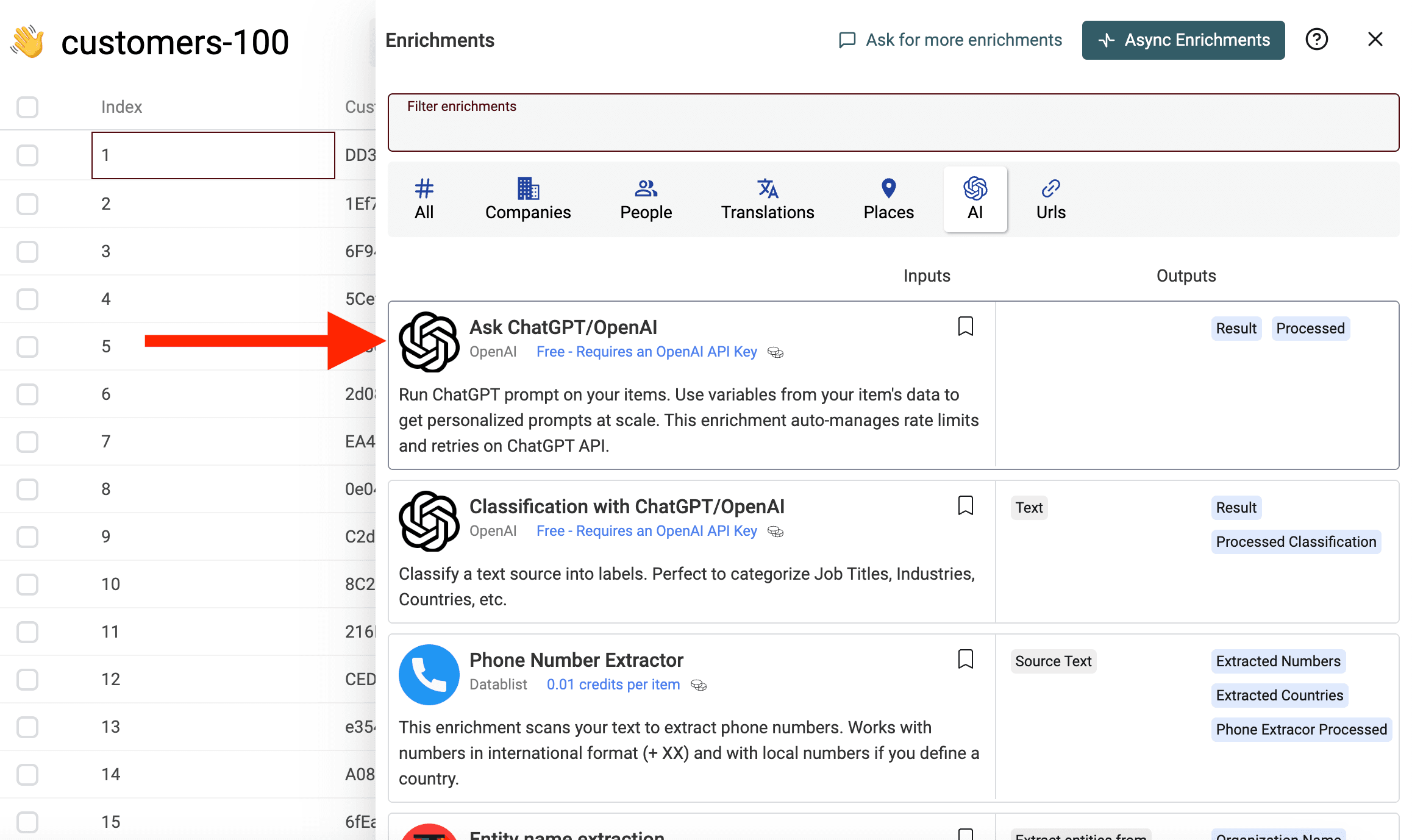
Step 2: Select "Ask ChatGPT/OpenAI"
Click Enrich and search for Ask ChatGPT/OpenAI.
Step 3: Write Your Prompt with Variables
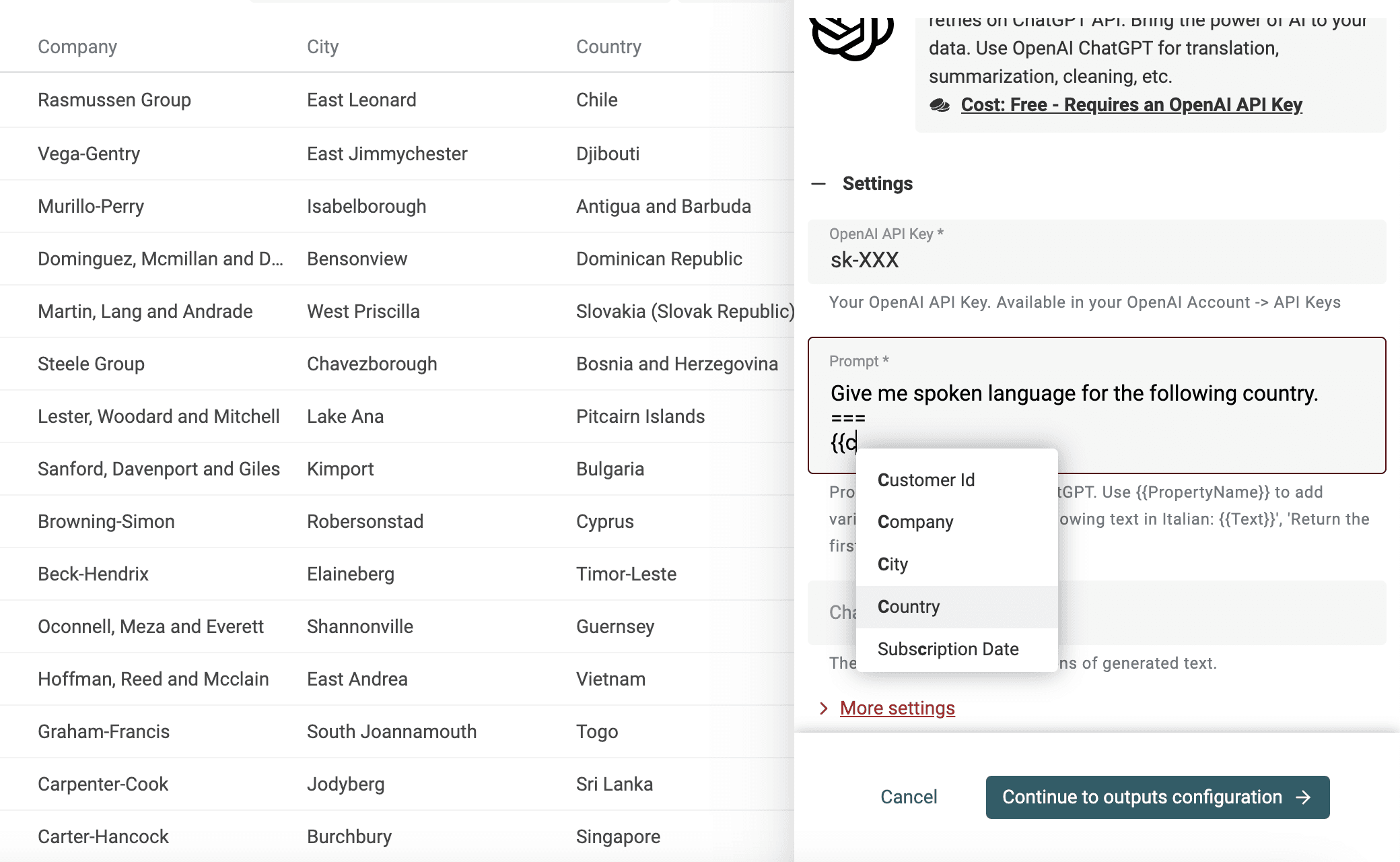
Write your prompt and insert variables from your columns.
Type {{ or / to select a column. Datablist replaces the variable with the value from each row.
Example:
Summarize this company in one sentence: {{Company Description}}
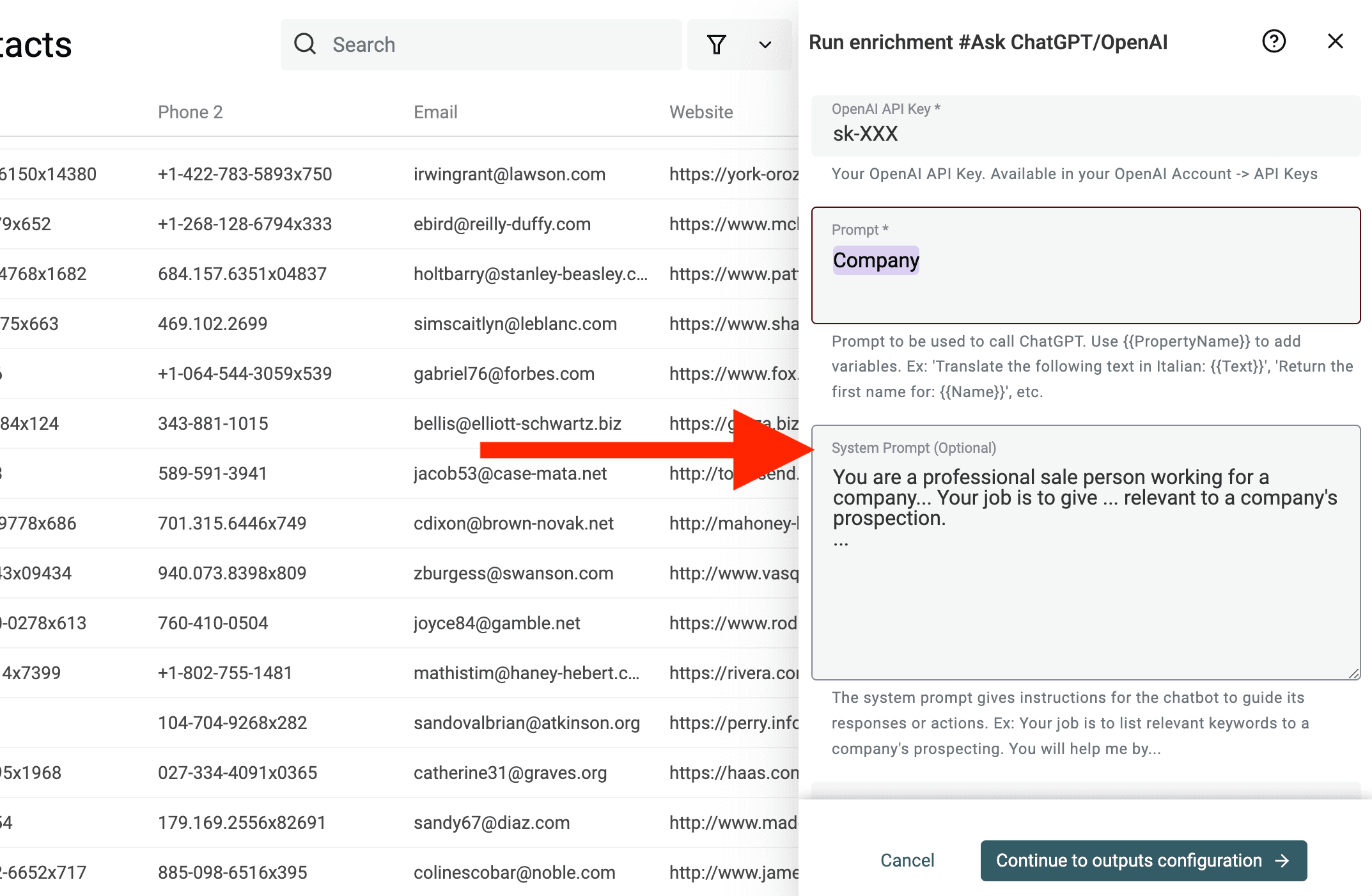
You can add a system prompt to control format, tone, or rules.
Step 4: Choose Output Columns
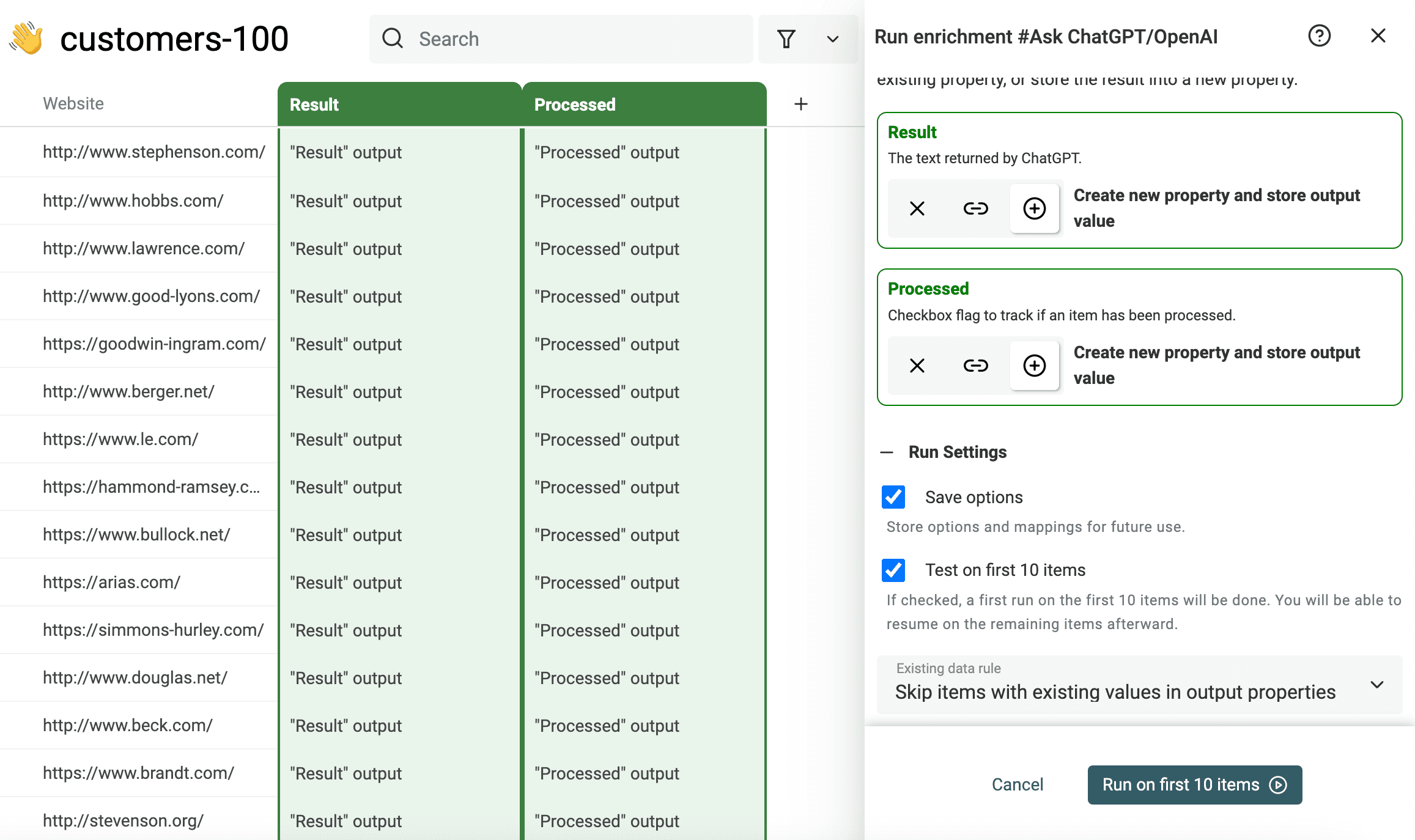
Use one output when you need one text result.
Use structured outputs when you want several fields, such as category, summary, and score.
Step 5: Choose Optional Settings
You can choose:
- The GPT model, including GPT-5.6 Luna, Sol, and Terra
- Max tokens
- Max concurrent calls
- Cache results
- Reasoning effort on compatible models: Low, Medium, or High. The default is Medium.
- Response verbosity on compatible models: Low, Medium, or High. The default is Medium.
- Flex mode and its timeout on supported models
- Datablist credits or your own OpenAI API key
Keep concurrency low if your OpenAI account hits rate limits.
Step 6: Test on a Small Batch
Run a small sample first. Check the output, adjust your prompt, then run the full file.
Datablist tracks processed rows, so you can avoid running the same rows twice.
Good Use Cases
Data Cleaning
Clean company names, normalize job titles, fix casing, remove extra text, and standardize messy fields.
Translation
Translate product descriptions, reviews, messages, or support replies into another language.
Summarization
Summarize long descriptions, notes, transcripts, reviews, or scraped website text.
Lead Research
Turn company descriptions, LinkedIn snippets, or notes into useful fields for sales and recruiting lists.
Email Drafting
Generate first drafts for personalized outreach using names, companies, roles, and notes from each row.
Extraction
Extract names, titles, dates, categories, sentiment, keywords, or scores from free text.
Tips for Better Results
- Use clear prompts with one task.
- Add examples when the output format matters.
- Use structured outputs for multiple fields.
- Set a max token limit for short answers.
- Use cache when duplicate rows may exist.
- Use Flex for large runs that do not need immediate results.
- Test on 10 to 20 rows before a large run.
- Filter failed rows and retry after fixing the prompt or input data.
Pricing
The enrichment is free to use in Datablist when you use your own OpenAI API key. OpenAI bills your account for API usage.
You can also use Datablist credits. In that mode, Datablist uses its OpenAI account and charges credits based on token usage.
Warning
If you use your own OpenAI API key, your OpenAI account must have API billing or credits. A free OpenAI account without API credits will not work.
FAQ
Can I run ChatGPT on a CSV file?
Yes. Import your CSV into Datablist, write a prompt with variables, and run Ask ChatGPT/OpenAI on each row.
Can I run ChatGPT on an Excel file?
Yes. Datablist supports Excel files. Upload the file, run the enrichment, then export the results.
Do I need an OpenAI API key?
No. You can use Datablist credits instead. If you prefer direct OpenAI billing, add your own OpenAI API key.
Can ChatGPT fill several columns at once?
Yes. Use structured outputs to define several fields. Datablist saves each field in its own column.
Does Datablist cache ChatGPT results?
Yes, when you enable Cache Results. Identical prompts with the same settings reuse the previous response for 48 hours.
What happens if OpenAI rate limits my run?
Datablist manages retries and concurrent calls. If your account still hits limits, lower the max concurrent calls or use Datablist credits.
Can I retry failed rows only?
Yes. Datablist stores a processed status for each row. Filter rows with errors, fix the issue, and rerun only those rows.
Which GPT-5.6 models are available?
The model selector includes GPT-5.6 Luna, GPT-5.6 Sol, and GPT-5.6 Terra. Datablist adds a flex compatible label when a model supports OpenAI Flex mode.
What happens when a Flex request times out?
Only that row fails. Datablist continues processing the rest of the file, so you can filter and retry the failed row later. See the OpenAI Flex mode guide for timeout and retry recommendations.
What are structured outputs best for?
Use structured outputs when you need clean columns, such as category, sentiment, score, summary, or extracted fields.
Can I use this for SEO or lead research workflows?
Yes. Combine scraped website text, company descriptions, search snippets, or CRM notes with a ChatGPT prompt. Datablist can classify, summarize, score, or extract fields for every row in the spreadsheet.