
Claygent runs solid AI research, but the cost of the tool is becoming unjustifiable. Since March 2026, every run burns Data Credits plus an Action, and that's before the $185/mo Clay platform fee even shows up [1].
Everyone knows that ranking tools by vibes doesn't help anyone, so we built a scoresheet. Five tools, 9 criteria built from Claygent's own feature set, plus cost. The outcome: scores from 5/9 to 9/9, and entry prices between $25 and $165/mo.
📌 Summary For Those In a Rush
The pick: Datablist is the best of the Claygent alternative for teams that want full-scope research without Clay’s exorbitant pricing.
If you want to run bulk AI research at scale on a budget, Datablist is the clearest fit because it matches Claygent's entire research scope and earns a bonus point for cost control, making it a perfect Claygent alternative.
Also evaluated: SyncGTM, Databar.ai, Persana AI, and Cargo, each with trade-offs covered below.
Bottom line: Pick Datablist for full research scope at a fraction of the cost; look at the runners-up only if one specific feature matters more than completeness.
The Best Claygent Alternatives At A Glance
| Criteria | Datablist | SyncGTM | Databar.ai | Persana AI | Cargo |
|---|---|---|---|---|---|
| Bulk Research | ✅ (100k rows) | ✅ | ✅ (10k batch) | ✅ | ✅ (workflows) |
| Live Web | ✅ | ✅ | ✅ | ✅ | ✅ |
| Website Extraction | ✅ | ✅ | ✅ | ✅ | ❌ |
| Multistep | ✅ | ❌ | ❌ | ❌ | ✅ |
| Structured Outputs | ✅ | ✅ | ❌ | ❌ | ✅ |
| Model Choice | ✅ | ✅ | ✅ | ✅ | ❌ |
| Transparency | ✅ (confidence scores) | ❌ | ✅ (citations + reasoning) | ❌ | ❌ |
| Scalability & Limits | ✅ | ✅ | ❌ | ✅ | ✅ |
| Cost Control & Affordability | ✅ | ⚠️ | ⚠️ | ⚠️ | ❌ |
| Entry Price | $25/mo | $99/mo | $99/mo | $85/mo | $165/mo |
| Score | 9/9 | 6.5/9 | 5.5/9 | 5.5/9 | 5/9 |
What This Comparison Covers (And What It Skips)
This comparison only covers agentic AI research tools that run web research row by row on a list: AI research agents, AI search tools, and spreadsheet AI agents.
AI SDR and outreach-automation tools like Coldreach, AiSDR, Artisan, and 11x are excluded. They automate messaging, not research, even though you might notice that they dominate the "claygent alternatives" search results.
- Raw search APIs, like Tavily or Exa's developer API, don't qualify either; they return search results, not direct answers.
- One-search-at-a-time chatbots don't qualify; Claygent's whole value is running the same research across an entire list.
Claygent Features And Pricing: What You Actually Pay For
Before comparing alternatives, it's worth knowing exactly what Claygent does and what it costs, since every alternative here gets measured against this baseline.
What Claygent Does (The Feature Set)
Claygent is Clay's built-in AI research agent, and its eight capabilities are the benchmark every alternative in this comparison gets scored against [2].
- Bulk row-by-row AI research on a table
- Live web search
- Website browsing and extraction, including visiting and navigating real pages
- Multistep agentic tasks that follow links and chain steps
- Structured, typed outputs across multiple columns
- Model choice, mixing Claygent's own tiers with external LLMs
- "Show your work" reasoning attached to results
- High row counts per run
The most important feature here is the live web search, because if you can’t run ChatGPT search on a spreadsheet out of the raw API alone, since the model has no way to browse the web on its own.
Claygent Pricing And The Dual-Currency Problem
Until March 2026, a Claygent run only spent Data Credits. Since then, every run spends Data Credits AND an Action at the same time, so the same task now draws down two separate balances instead of one.
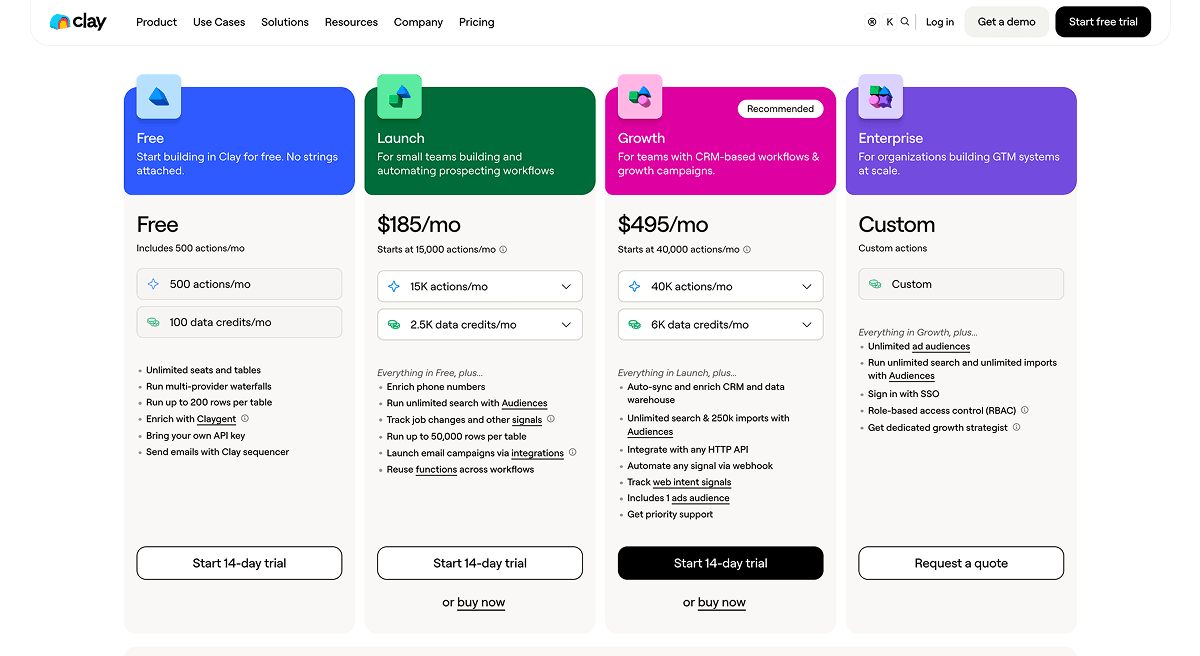
Clay’s pricing plans [1]:
- Launch: $185/mo for 2,500 Data Credits and 15,000 Actions
- Growth: $495/mo
- Enterprise: custom pricing for larger teams
The token-based billing didn't sit well with customers, so Clay responded with in-house models[3] priced at a fixed credit rate per row:
- Helium: 1 credit per row
- Neon: 2 credits per row
- Argon: 3 credits per row
Frontier models like GPT-5.1 and Claude 4.6 Sonnet still bill by actual token consumption [4], so identical prompts can land at different costs row to row.
What To Look For In A Claygent Alternative
With Claygent's own scope and cost problem clear, here's what actually separates a real alternative capable of scaling AI search from a tool that only does a little research on the side.
The Five Buying Criteria That Actually Matter
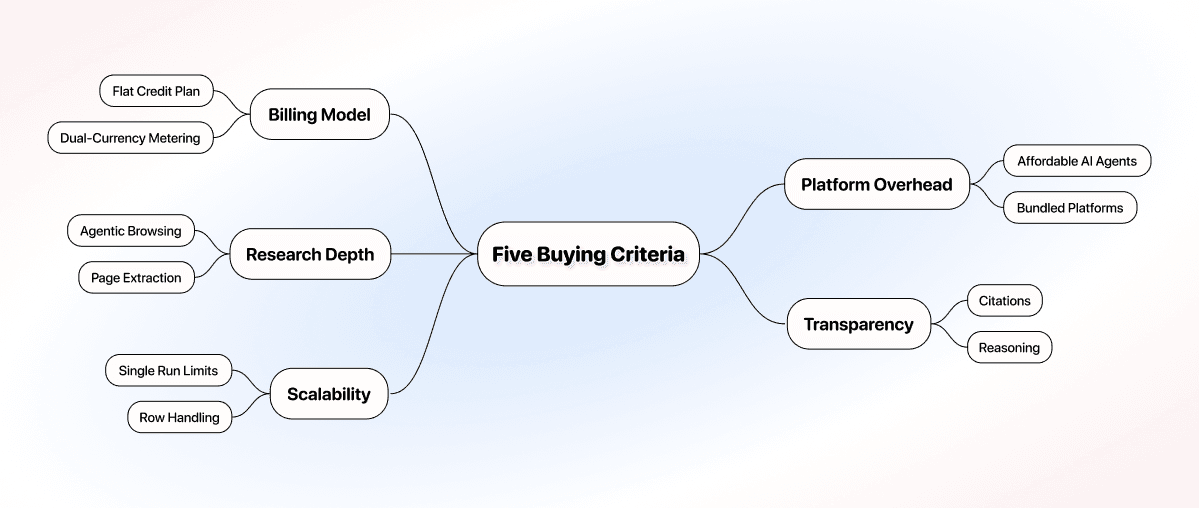
Five criteria decide whether a tool can genuinely replace Claygent for research at scale.
- Billing model: a flat credit plan you can predict, versus dual-currency or token-variable metering that moves every time you run it
- Platform overhead: An affordable AI research agent is better than one bundled inside a $185+/mo platform
- Research depth: agentic browsing and page extraction, versus a tool that just generates text from an API
- Transparency: citations, reasoning, or confidence scores you can audit.
- Scalability: how many rows a single run can actually handle before you reach a limit
How We Scored Each Tool: The 9-Point Benchmark Explained
Each tool starts at zero and earns one point for each of Claygent's eight capabilities it matches, plus one combined point for cost.
The cost point works on a sliding scale: full credit for a documented per-run iteration cap paired with an affordable plan and non-expiring credits, half credit for an affordable plan with rollover but no cost lever, and zero for a high entry price + metering that moves with every run.
Nine points is the maximum any tool can earn. Claygent's own feature set defines the eight capability points, and cost is the one criterion that we put on top of that since that’s the reason why most GTM teams start looking for a Claygent alternative in the first place.
The 5 Best Claygent Alternatives For AI Research At Scale
Here's how these five Claygent competitors break down individually, starting with the only one that matches Claygent's full scope.
Datablist: The Only Full-Scope Claygent Alternative
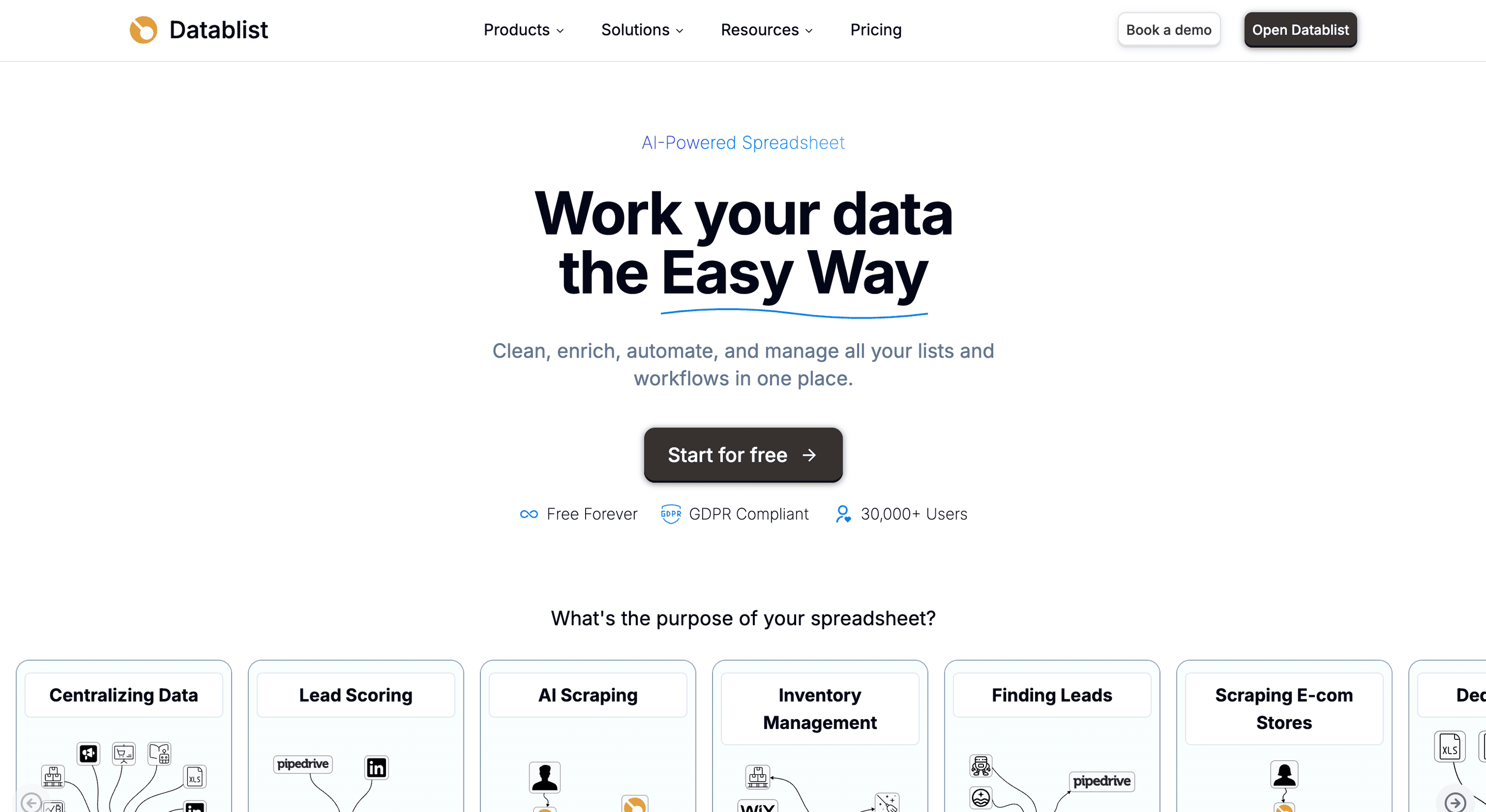
Datablist's AI Research Agent runs ChatGPT-like research row by row on a spreadsheet: it searches Google and Google News, visits websites, paginates, and calls APIs, across lists of up to 100,000 records [5].
Datablist's AI Research Agent Features
It matches Claygent's full research scope and adds the pieces Claygent misses. The parts that matter most:
- Confidence scores on every row: each result carries a 0-100 score, so weak or wrong answers get flagged for review instead of hiding in a clean-looking table.
- Isolated context per row: every row runs in its own research context, so one record's findings never bleed into the next across a large list.
- Context-aware answers: give it an industry or location, and it tells same-named companies apart, then answers the real question instead of returning raw text.
- Ready-made templates: start from templates for common jobs like finding a company's ICP fit, segmenting accounts, and scraping case studies at scale.
- Render-HTML reading: for scroll-based or JavaScript-heavy pages, it scrolls and loads the full page, reading what a basic scraper would miss.
Claygent Alternatives - Datablist Show Case
Claygent Alternatives - Datablist Show Case
Datablist Pricing
Datablist’s pricing is simple: The AI Research Agent runs on a usage-based metric based on token consumption and tool usage (tools like web scraping, rendering HTML, using proxies, etc.)
Datablist’s AI Research Agent also has a Maximum Iterations setting that lets you configure a cap on how many attempts the agent can make to better control how many credits a single run can use.
Datablist Plan’s
- Starter runs $25/mo (5,000 credits/month) or $240/year (20% off, 60,000 credits upfront)
- Growth runs $50/mo (20,000 credits/month) or $480/year (20% off, 240,000 credits upfront) [6]
- Top-up credits scale from $20 for 20,000 credits up to $650 for 1,000,000 credits (35% discount) [7] and never expire, even after you cancel.
Considerations:
- Has fewer data providers and marketplace integrations than Clay
- Bring-your-own API keys are reserved for Enterprise plans (only for the AI research agent; all other tools can be used with your own key)
🆚 Datablist's Claygent Alternative Score
- Score: 9/9
- Pricing: Starter at $25/mo (5,000 credits); free tier with 500 credits; top-ups never expire
- Best for: teams that want Claygent-grade research at scale with predictable cost and confidence scores
SyncGTM: Strong Research, Thin On Transparency (6.5/9)
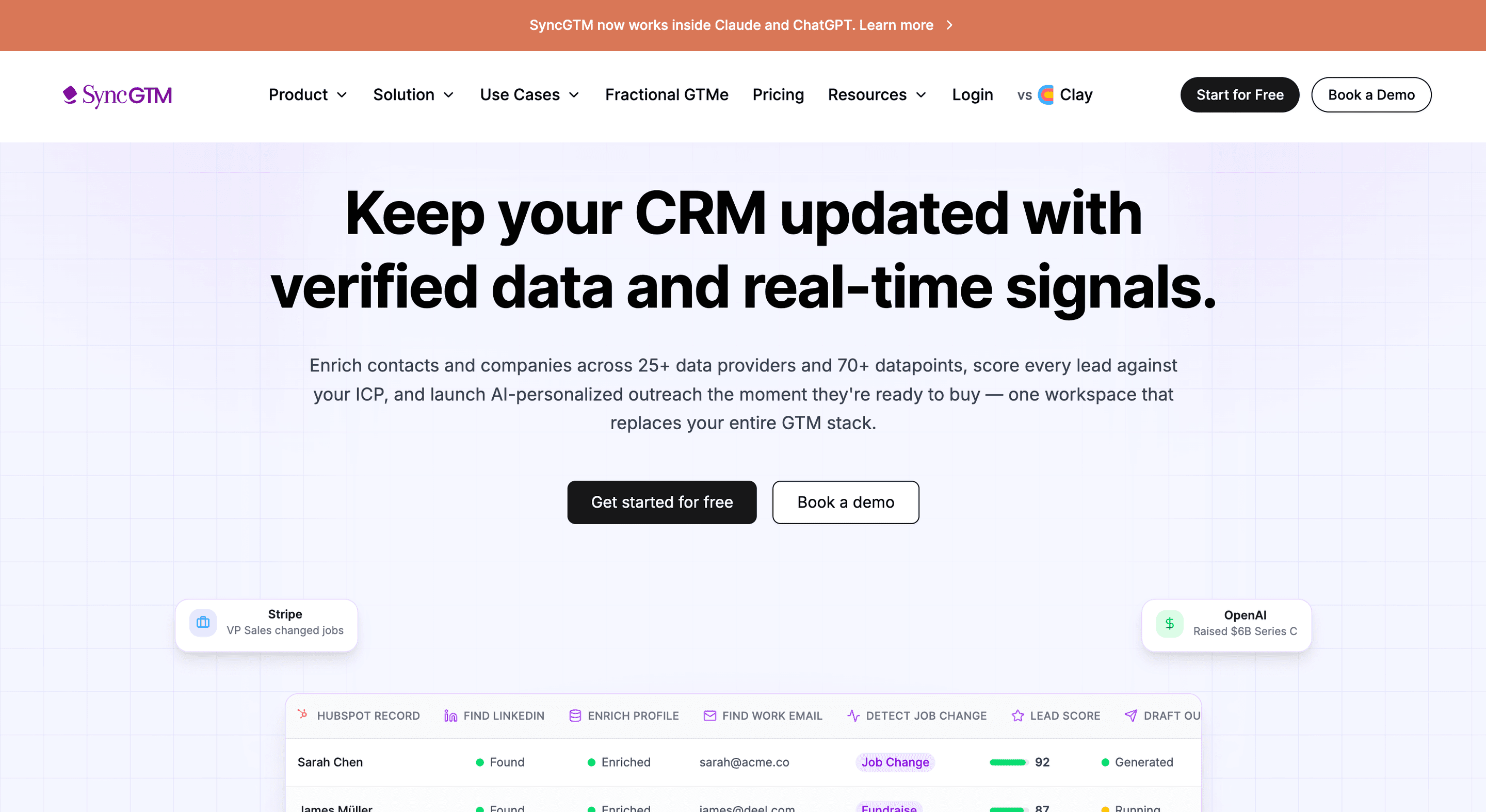
SyncGTM's AI Research Agents crawl websites, pricing pages, review sites, and news to return structured data on hundreds of accounts at once, with your own API key supported from the Starter plan [8].
What it misses is multistep agentic tasks and any documented result transparency, so there's no citation trail or confidence score to check before you act on a result.
Considerations:
- Starter runs $99/mo with a 3-month credit rollover [9] but no per-run cost cap
- The $99/month gets you only 2000 AI research actions [10]
🆚 SyncGTM's Claygent Alternative Score
- Score: 6.5/9
- Pricing: Starter from $99/mo
- Best for: teams that want structured account research with model choice from an entry tier
- Skip if: you need multistep agentic tasks or auditable result transparency
Databar.ai: Best For Cited, Explainable Results (5.5/9)
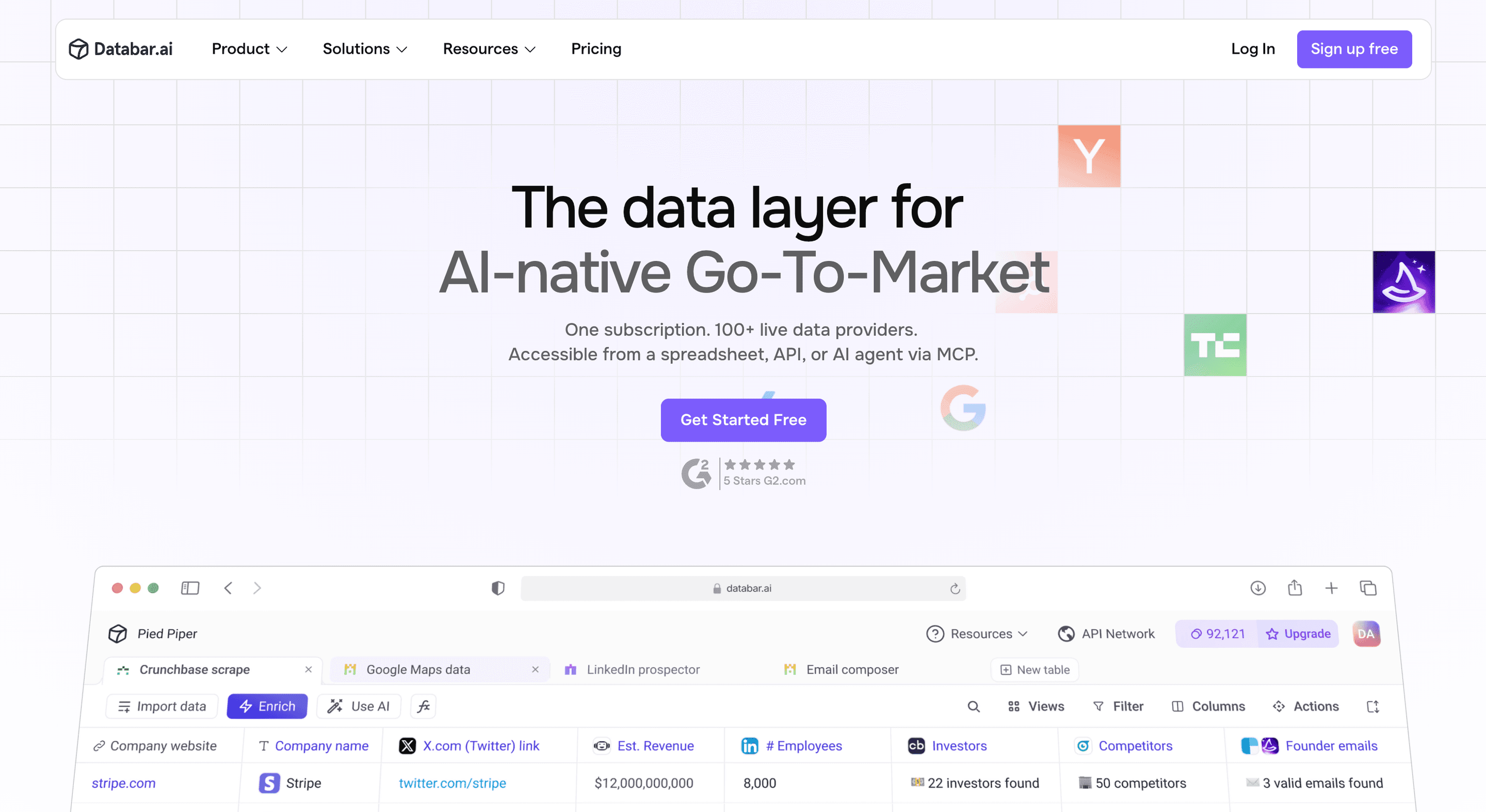
Databar.ai's real-time AI Researcher pairs every result with citations and reasoning [11], the strongest transparency pitch on this list next to Datablist.
Databar skips multistep tasks and verified multi-column outputs, and batch enrichment tops out at 10,000 rows on its Build plan, the lowest paid tier available.
Its citation-and-reasoning output draws on a wide base of data providers [12], and that the Build plan costs $99/mo [13], well short of the 100k row ceiling Datablist offers.
Considerations:
- Entry pricing starts at $99/mo (Build) with rollover credits
- The jump from Build to the $495/mo Scale plan is a 5x leap with nothing in between [14]
- The 10,000-row batch ceiling is the max available, even on Build, the cheapest plan Databar offers
🆚 Databar's Claygent Alternative Score
- Score: 5.5/9
- Pricing: Build at $99/mo; Scale at $495/mo; rollover credits
- Best for: teams that want cited and explainable results
- Skip if: you need multistep research or 10,000+ rows per table
Persana AI: Research Plus Signals, Opaque Pricing (5.5/9)
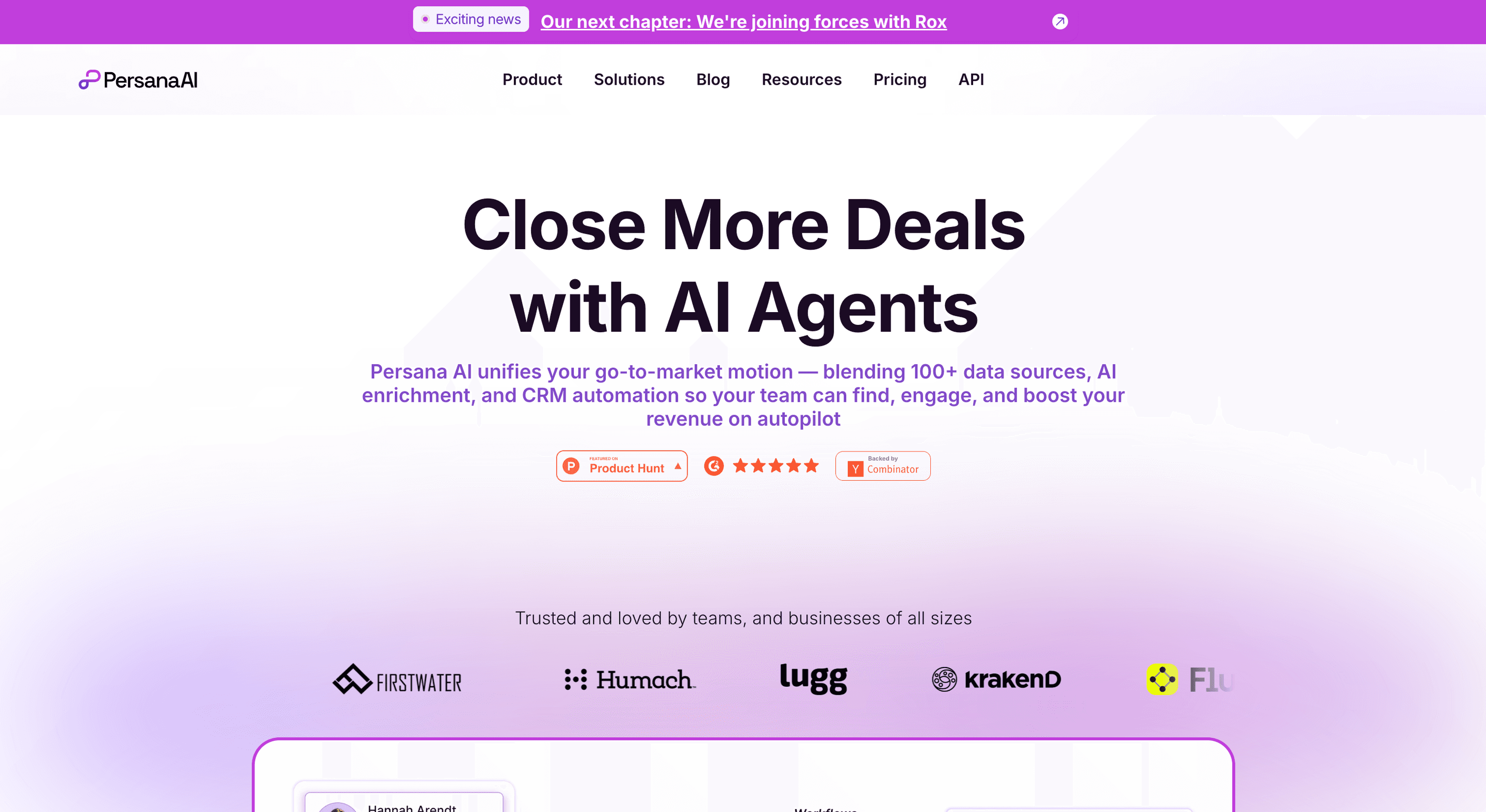
Persana AI's Quantum Agent researches lists at scale and scrapes company sites for revenue, pricing, competitor, and ad-activity signals, with your own API key available from the Growth plan.
Multistep tasks, structured outputs, and result transparency aren't documented, and entry pricing runs $85/mo [15] with rollover but no per-run cost lever.
Scale tops out at 30,000 records on the Pro plan (7k on Starter, 20k on Growth), a fraction of Datablist's 100k ceiling, and none of those tiers add a way to check a result before acting on it.
Considerations:
- Persana is joining forces with Rox [16], which raises a fair question about platform continuity
- CRM access is locked behind the $400/mo Pro plan
🆚 Persana AI's Claygent Alternative Score
- Score: 5.5/9
- Pricing: $85/mo entry; Pro from $400/mo; rollover credits, no per-run cap
- Best for: teams that want list research paired with revenue, pricing, and competitor signals
- Skip if: you need multistep research, structured outputs, or predictable pricing
Cargo: Research As A Workflow Node (5/9)
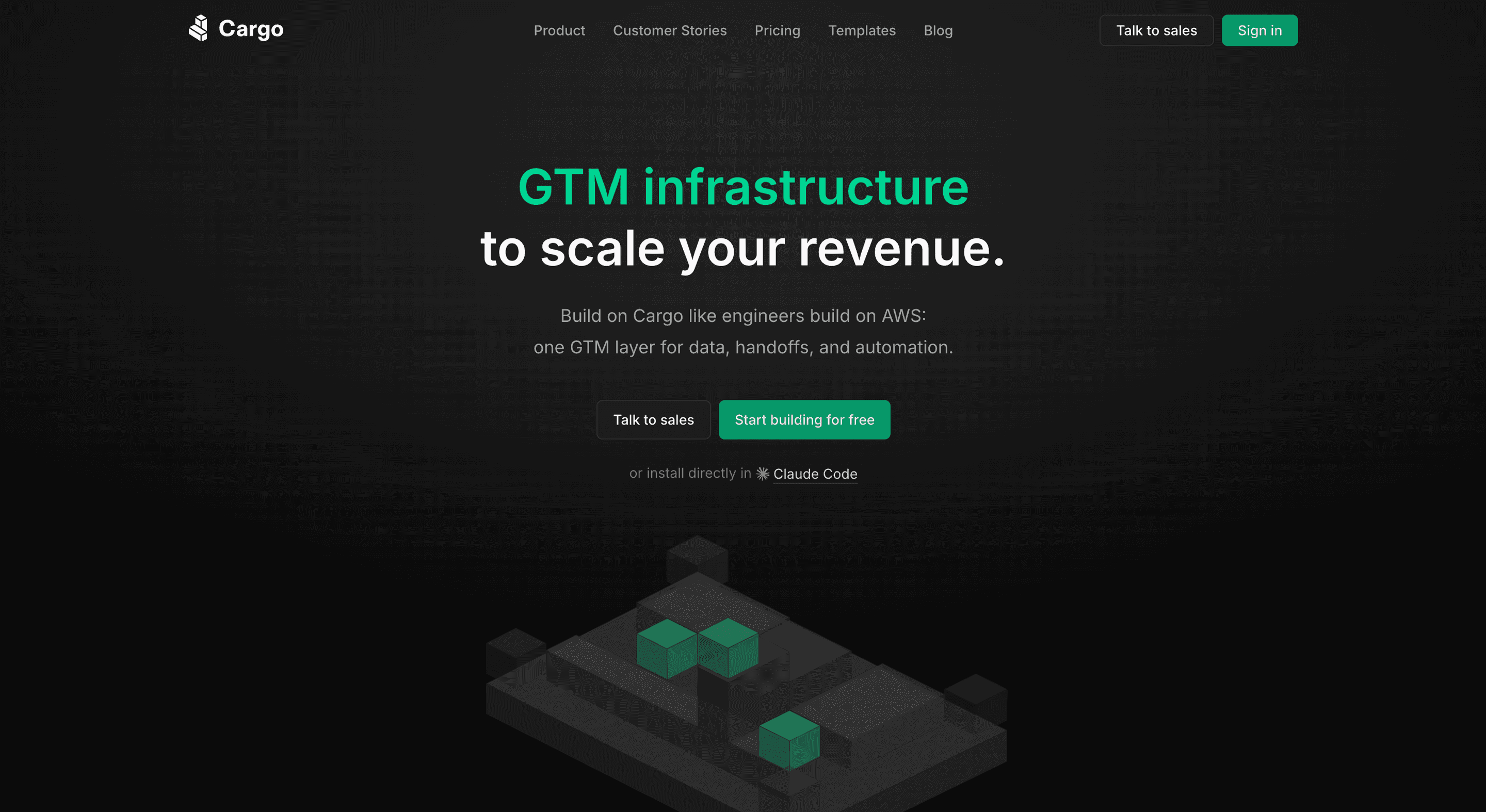
Cargo treats research as one step inside a larger GTM workflow: it researches prospects across the web, news, and LinkedIn, then qualifies, scores, and routes them automatically [17].
It misses per-row website extraction, model choice, and result transparency, and its free tier covers up to 10,000 orchestration steps [18].
Considerations:
- Entry price is $165/mo at $0.25 per credit [19], the priciest option here
- No per-row website extraction, model choice, or result transparency
🆚 Cargo's Claygent Alternative Score
- Score: 5/9
- Pricing: Free tier (10,000 orchestration steps); realistic entry from $165/mo at $0.25/credit
- Best for: Enterprise teams that want research embedded inside qualification and routing workflows
- Skip if: you just want to prompt a list directly for research
The Cost Problem: Why GTM Teams Look For A Clay Alternative
Every criterion above points back to the same root cause: Claygent's cost model punishes exactly the kind of scale it's supposed to enable.
The Dual-Currency Meter That Punishes Scale
Since March 2026, every Claygent run consumes Data Credits AND an Action at the same time, so cost climbs even faster than before, which forces you to buy more and more Action Credits over time, and these credits are not cheap.
If you plan to use frontier models like GPT-5.1 and Claude 4.6 Sonnet, you’ll be billed by actual token consumption [4], so identical prompts can cost different amounts depending on the row.
Clay’s $185/mo Platform Fee and No-Top-Up Options
Clay's Launch plan costs $185/mo before a single research run happens [1], and Clay credits expire at the end of the billing cycle. There's no one-time top-up either: running a single large list still means upgrading your plan and monthly spend, not just buying extra credits for that run.
Launch plan, price per action credit:
- 15,000 actions/mo for $60/mo → $0.0040/action ($4.00 per 1,000)
- 40,000 actions/mo for $150/mo → $0.00375/action ($3.75 per 1,000)
- 60,000 actions/mo for $200/mo → $0.00333/action ($3.33 per 1,000)
- 100,000 actions/mo for $290/mo → $0.0029/action ($2.90 per 1,000)
- 200,000 actions/mo for $540/mo → $0.0027/action ($2.70 per 1,000)
On top of that, you’ll pay at least $125/month for the platform (and data credits), which means that your 40k action credits plan will be billed at $275/month.
Compare that to Datablist's top-up credits, which carry volume discounts and never expire, and realize quickly that Datablist’s AI Research Agent is the best and most cost-effective Claygent alternative.
Bottom Line: Datablist Is The Best Full-Scope Claygent Alternative
If you want to run Claygent-style research without the Clay platform tax, Datablist is the clearest pick. It's the only tool here that matches Claygent's full research scope and still earns the cost point, for a perfect 9/9 on the same benchmark Claygent's own feature set defines.
SyncGTM, Databar.ai, Persana AI, and Cargo each replace part of what Claygent does, but none matches the full scope at a comparable price.
Frequently Asked Questions About Claygent Alternatives For AI Research At Scale
Which Claygent Alternative Replaces The Most Of What Claygent Does?
Datablist replaces most of what Claygent does. It matches all eight of Claygent's research capabilities and also earns the cost point, for a 9/9 score against the fixed benchmark.
What Is The Cheapest Way To Run AI Research At Scale?
Datablist's Starter plan starts at $25/mo with 5,000 credits, and a free tier of 500 credits lets you test it first. Top-up credits never expire and carry volume discounts up to 35% [7], versus Clay's $185/mo Launch plan before a single research run [1].
What Is The Difference Between Datablist's AI Research Agent And Claygent?
Both run agentic web research row by row on a list. Datablist ships every result with a 0-100 confidence score and caps cost with a configurable Maximum Iterations setting; Claygent has neither and bills Data Credits plus an Action on every run.
Can I Run Claygent-Style Research On 10,000+ Rows?
Yes. Datablist, SyncGTM, Persana AI, and Cargo all support 10,000+ rows per run, and Datablist's ceiling is the highest at 100,000 records [5]. Databar.ai caps entry-plan batches at 10,000 rows, and only on its $99/mo Build plan [13].
How Much Does Claygent Cost At Scale?
Claygent requires the Clay platform starting at $185/mo (Launch) or $495/mo (Growth) [1], and since March 2026, every run also consumes an Action on top of Data Credits. Frontier models bill by token, so cost varies from row to row.
Is There A Free Claygent Alternative?
Not fully free, but several offer a no-cost starting point. Datablist gives 500 free credits to test the AI Research Agent, and Persana AI's free tier includes 50 credits with Quantum Agent access, before either requires a paid plan.
What Is Claygent?
Claygent is Clay's built-in AI research agent. It runs bulk, row-by-row web research on a table, browses and extracts from real websites, and returns structured, typed outputs with model choice and visible reasoning.
What Is An AI Research Agent?
An AI research agent runs live web research row by row across a list instead of answering one prompt at a time. It searches the web, visits pages, and returns structured results, unlike a static database or a single-query chatbot.
Why Is Claygent So Expensive At Scale?
Cost climbs because Claygent bills two currencies at once, Data Credits and an Action, on every run since March 2026. Frontier models add token-based pricing on top, so the same prompt can cost different amounts depending on the row.
How Do I Avoid Hallucinations When Running AI Research On A List?
Look for a tool that scores its own results. Datablist attaches a 0-100 confidence score to every row, so weak or likely-hallucinated answers get flagged for manual review instead of slipping into a clean-looking table.
What Is The Difference Between An AI Research Agent And An AI Processor?
An AI research agent searches the live web and browses pages to find new information; an AI processor works only with data you already have, like cleaning, formatting, or summarizing an existing column.
What Is The Difference Between An AI Agent And An AI Assistant?
An AI agent takes multistep actions toward a goal with little supervision, like researching and filling a whole table on its own. An AI assistant responds to prompts one at a time and waits for your next instruction. For a deeper breakdown, see AI agents vs. AI assistants.
Citations
- [1] Clay's own pricing page lists four tiers: Free, Launch, Growth, and Enterprise, with Launch at $185/mo (2,500 Data Credits, 15,000 Actions) and Growth at $495/mo.
- [2] Clay's Claygent product page describes the agent's bulk research, live web search, browsing and extraction, multistep tasks, structured outputs, model choice, and reasoning capabilities.
- [3] Clay's AI pricing docs confirm Claygent's own models (Helium, Neon, Argon) use fixed per-row credit pricing, with Helium at 1 credit per row and Argon at 3.
- [4] Clay's AI pricing docs list GPT-5.1 as a variable-priced model for web research, meaning cost is calculated from actual usage rather than a flat rate.
- [5] Datablist describes its AI Research Agent running searches, page visits, pagination, and API calls across spreadsheets with up to 100,000 records.
- [6] Datablist's own pricing page confirms Starter at $25/mo (5,000 credits) or $240/year, and Growth at $50/mo (20,000 credits) or $480/year.
- [7] Datablist's credits documentation confirms top-up pricing from $20 for 20,000 credits up to $650 for 1,000,000 credits (a 35% discount), and that extra credits never expire.
- [8] SyncGTM's pricing page confirms bring-your-own-API columns and 50,000 rows per table are available on every plan, including Starter.
- [9] SyncGTM's pricing page bills Starter at $1,010/year with a 15% saving versus monthly billing, which works out to $99/mo, plus credit rollover.
- [10] SyncGTM's pricing page lists 24,000 AI research agent credits per year on Starter, roughly 2,000 per month.
- [11] Databar's AI Research Agent page states the agent explains its results "with citations and reasoning."
- [12] Databar's pricing page lists access to 100+ data providers as a feature across its plans.
- [13] Databar's pricing page confirms the Build plan costs $99/mo and caps batch enrichment at 10,000 rows; there is no lower-priced entry tier.
- [14] Databar's pricing page lists the Scale plan at $495/mo, a 5x jump from the $99/mo Build plan.
- [15] Persana's pricing page confirms entry pricing at $85/mo.
- [16] Persana AI's official announcement confirms the team is joining forces with Rox.
- [17] Cargo's site describes its workflows researching prospects across the web, news, and LinkedIn, then scoring and routing leads automatically.
- [18] Cargo's pricing page confirms its free trial includes up to 10,000 orchestration steps.
- [19] Cargo's pricing page lists its 1.5K-credit tier starting at $165/mo, with a $0.25 per credit rate shown on the same page.