
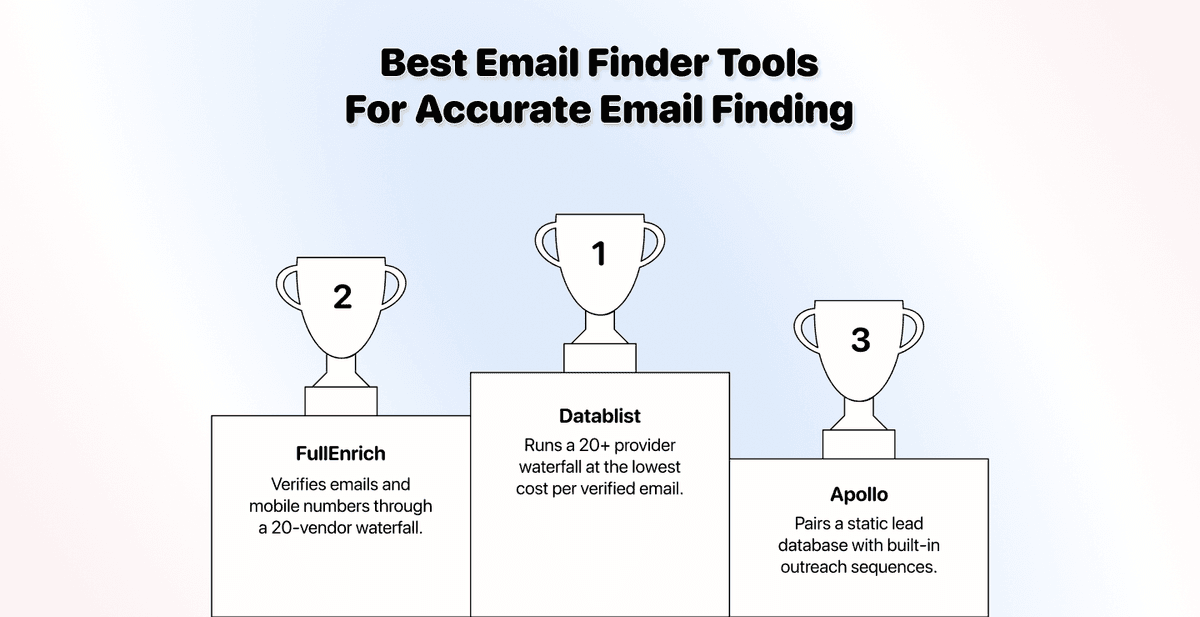
Email finder tools do not all do the same job. Some search company domains, some provide access to a contact database, and others enrich an existing list by checking several data sources.
For this article, we compiled the 9 best email finder tools and split them into five categories: single-source databases, domain search tools, waterfall enrichment tools, sales intelligence platforms, and CRM-native enrichment tools.
That distinction matters because coverage, pricing, and the required workflow change by category. For teams that need to find emails at scale, email enrichment tools that run a waterfall are the recommended path because they query multiple providers sequentially instead of relying on one database.
📌 Summary For Those In a Rush
The pick: Datablist.com is the best choice for sales teams, recruiters, and growth marketers looking for flexible, budget-friendly waterfall enrichment.
If you want a high match rate, Datablist.com is the clearest fit among all email finder tools because it chains 20+ B2B data providers inside a no-code spreadsheet workspace with built-in deduplication and cleaning at self-serve pricing.
Also listed: Clay, Apollo, FullEnrich, BetterContact, Hunter.io, Cognism, ZoomInfo, and HubSpot Breeze Intelligence (formerly Clearbit), each with trade-offs covered in the body.
Bottom line: Choose Datablist.com for flexible multi-source waterfalls and spreadsheet cleaning; choose Clay for advanced integrations; choose Apollo for engagement.
The 9 Best Email Finder Tools at a Glance
The email finder tools below cover different parts of the email-finding workflow, from domain searches and static databases to multi-provider waterfalls. This table gives you the basic differences before the full list.
| Tool | Primary Use Case | Data Approach | Starting Price | Main Constraint |
|---|---|---|---|---|
| Datablist.com | Email enrichment, sourcing, and cleaning | 20+ provider waterfall | $25/month | 100,000 enrichment rows per sheet |
| Clay | Complex enrichment workflows | 150+ integrations | $185/month | Higher cost and learning curve |
| Apollo | Lead search and sales engagement | Proprietary database | $59/month | Contact data can be outdated |
| FullEnrich | Email and phone enrichment | 20+ provider waterfall | $29/month | Requires an existing lead list |
| BetterContact | Waterfall enrichment | 20+ provider waterfall | $15/month | Limited sourcing and cleaning features |
| Hunter.io | Domain-based email searches | Single-source index | $49/month | No multi-provider waterfall |
| Cognism | European contact and mobile data | Proprietary database | Quote-only | Enterprise contract |
| ZoomInfo | Enterprise sales intelligence | Proprietary database | Quote-only | High annual commitment |
| HubSpot Breeze Intelligence | Native HubSpot enrichment | HubSpot-integrated data | HubSpot required | Not available as a standalone tool |
All Email Finder Tools Compared on CPME (Cost Per 1000 Emails)
The comparison uses month-to-month pricing and normalizes each public plan's included email capacity to 1,000 found emails, where the credit rules allow it. It assumes full use of the included credits; actual CPME can be higher if credits expire or results are unusable.
| Tool | CPME | Credits Used | Charged If Not Found? | Pricing Context |
|---|---|---|---|---|
| Hunter.io | $24.50 Lowest overall CPME | 1,000 of 2,000 included | No | One found email costs one credit |
| Datablist.com | $45 Lowest waterfall CPME | 25,000 | No | $25 subscription plus a $20 one-time top-up 25 credits / email found |
| BetterContact | $49 | 1,000 | No | One verified email costs one credit |
| FullEnrich | $55 | 1,000 | No | One verified work email costs one credit |
| Apollo | $59 | Up to 1,000 | No | Monthly Basic plan; allowances and fair-use limits vary |
| Clay | $74 | 2,000 | No | Email cost varies from 2 to 5 data credits by provider. We calculated based on the minimum amount |
| Cognism | Quote-only | 1,000 | Not applicable | One credit reveals one contact; prices are not public |
| ZoomInfo | Quote-only | 1,000 | Not applicable | One credit exports one contact; prices are customized |
| HubSpot Breeze Intelligence | Not comparable | Not comparable | Not applicable | CRM record enrichment, not a standalone verified email finder |
Findings of Our Cost Per 1000 Emails Analysis:
- Hunter.io has the lowest overall CPME at $24.50 per 1,000 emails.
- Datablist has the lowest CPME among the waterfall email enrichment tools at $45, while also combining waterfall enrichment with list sourcing and cleaning.
- Clay has the highest CPME in this listing at $74 per 1,000 emails.
9 Best Email Finder Tools in 2026
The right email finder depends on whether you need to source leads, enrich a lead list, find mobile numbers, or manage the results in the same workspace.
1. Datablist: Waterfall Email Enrichment, Sourcing, and Cleaning
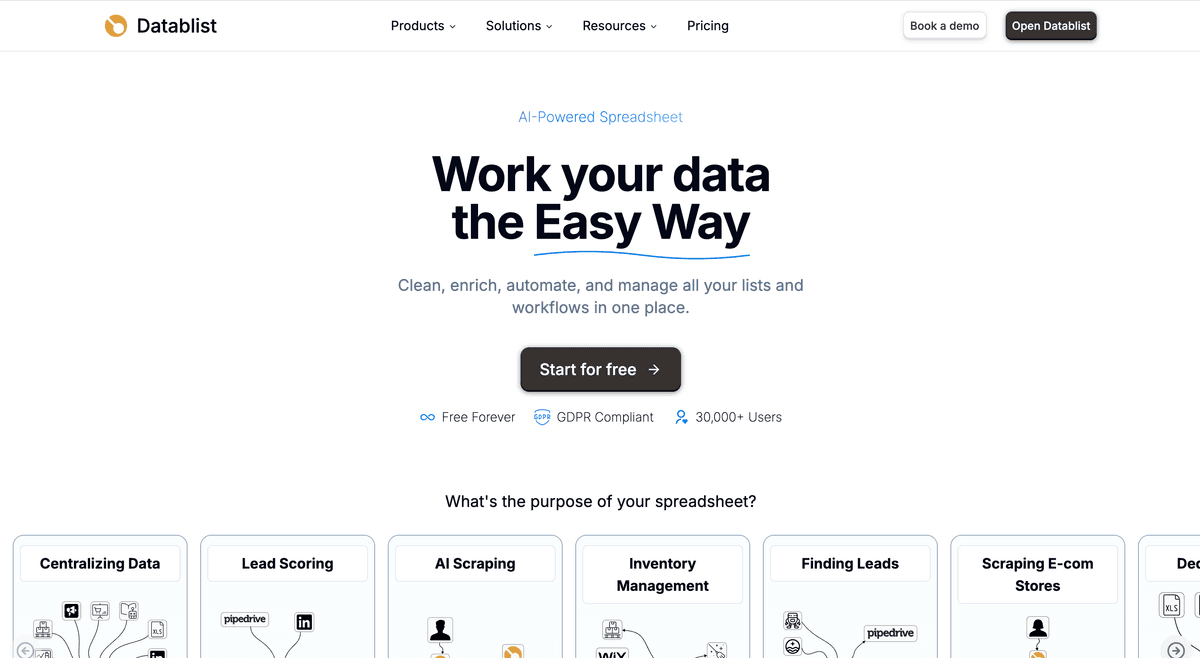
Datablist.com is the AI spreadsheet where you automate data sourcing, cleaning, and enrichment, all in one place. It pairs a multi-provider waterfall search with cleaning features, giving you verified leads at scale.
The platform has a Waterfall Email Finder built into its core, which chains 20+ B2B data providers sequentially at the price of one. Instead of paying for failed searches, you only pay for successful finds.
Datablist Summary
- Strength: Runs a 20+ provider Waterfall Email Finder with an average coverage of 85% (30% higher than the single-source email providers), and you can bring your own API keys.
- Starting price: $25/ month and 5,000 credits[1]
- Constraint: 100,000 enrichment row limit per sheet[2]
- Fit: Teams that want to automate lead scraping and data enrichment in one simple AI spreadsheet
- CPME: $45 - Lowest CPME among the waterfall email enrichment tools on this list.
- Payment terms: Bills only for emails found
Unique Features of Datablist
Datablist's main advantage is not one enrichment feature; it combines the steps that usually require separate sourcing, research, enrichment, and cleaning tools.
- Sales Navigator Scraper: The platform allows you to collect clean names, roles, companies, and profile data without risking your account.
- LinkedIn to Email: Datablist is one of the few tools that lets you find an email from a LinkedIn profile URL
- AI Research Agent: Run AI searches and collect custom data points that standard databases do not provide.
- Data cleaning: Standardize fields and deduplicate lists of up to 2 million rows[2] before they reach your CRM.
Because these features run in the AI spreadsheet workspace, a list can move from sourcing to enrichment and cleaning without repeated exports or additional data tools, which makes your lead generation workflow simpler and more cost-effective.
The cost efficiency becomes obvious when you compare the CPME: Datablist charges $45 for 1,000 found emails, the lowest verified rate among Waterfall Enrichment tools, and credits are used only when an email is found.
2. Clay: Complex Workflows For Technical RevOps Teams
Clay is a B2B data enrichment platform designed for complex outbound workflows. It integrates with over 150 data sources and includes AI research agents that can scrape websites, parse profiles, and draft personalized messages.
- Strength: Broad integration coverage for advanced workflows
- Starting price: $185 per month for 2,000 credits[3]
- Constraint: A steep learning curve and high per-credit costs
- Fit: Large organizations with a technical RevOps team and complex integration needs
- CPME: From $185
- Payment terms: Bills only for emails found, but each result can cost 2 to 5 data credits, depending on the provider[3]
3. Apollo: Lead Search and Sales Engagement
Apollo combines a large lead database with built-in email sequences and dialers. Their Starter plan costs $59 per month for 2,500 credits[5], offering a simple way to find and contact leads in one interface.
- Strength: Lead search and engagement in one platform
- Data approach: A proprietary static database
- Constraint: Contact details can become outdated, especially in niche or fast-changing segments
- Fit: Teams that want list building and outbound engagement together
- CPME: $59
- Payment terms: Bills only for verified email addresses, subject to plan allowances and fair-use limits
Apollo can provide the initial list; then a waterfall tool can verify and complete the records. This combination keeps the convenience of Apollo's database while improving coverage and deliverability.
4. FullEnrich: Email and Phone Number Waterfalls
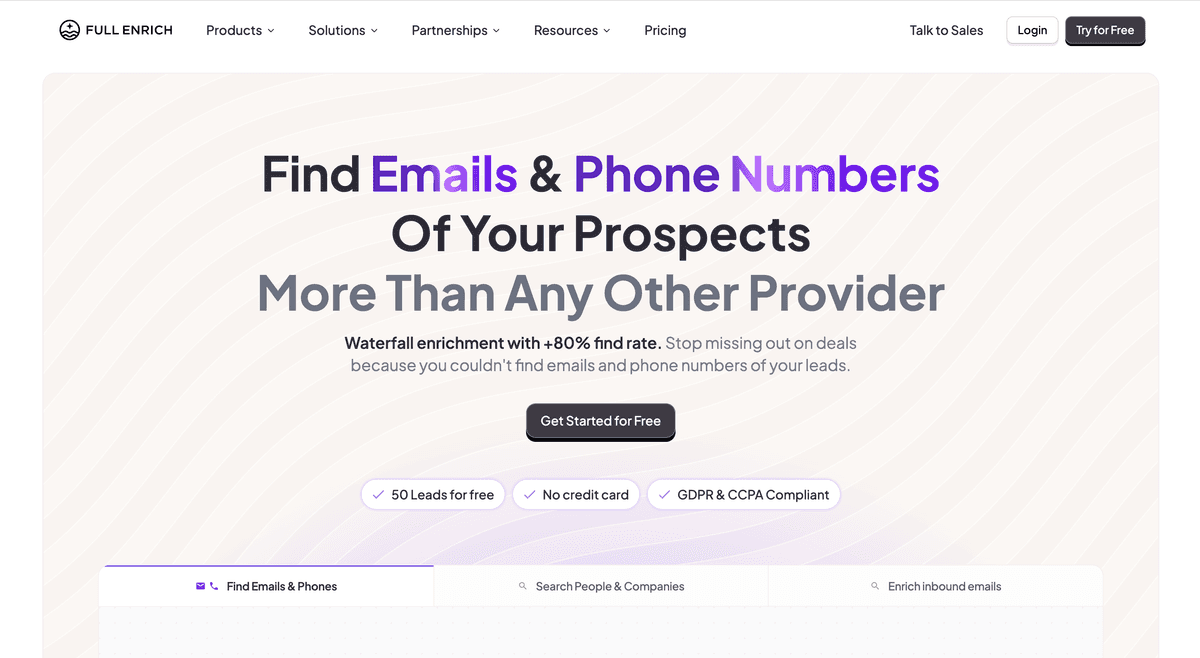
FullEnrich queries over 20 data vendors sequentially[4] to find verified B2B contacts. Starting at $29 per month for 500 credits[4], it focuses on data coverage rather than CRM sequences or list building.
- Strength: Verified emails and direct mobile phone numbers
- Coverage: Strong mobile verification for the United States and Canada
- Constraint: You need to bring a lead list from another source
- Fit: Sales teams that rely heavily on cold calling and multi-channel outreach
- CPME: $55
- Payment terms: Bills only when verified data is found
5. BetterContact: Waterfall Email Enrichment
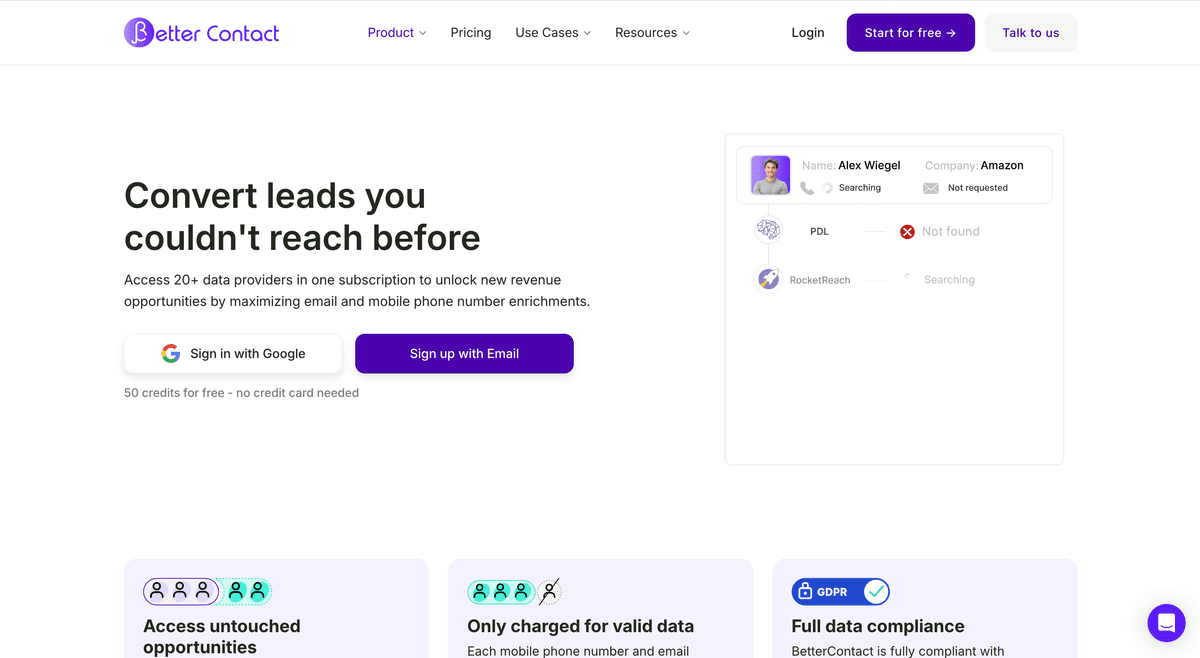
BetterContact checks 20+ data sources in sequence[6] to find verified B2B emails. Their cheapest tier starts at $15 per month for 200 credits[6], making it accessible to small teams and solo founders.
- Strength: Pay-per-result enrichment with CRM integrations
- Billing: Credits are used for successful matches
- Constraint: No built-in lead scraping or advanced spreadsheet cleaning
- Fit: Teams that already have a clean list of company and contact names
- CPME: $49
- Payment terms: Bills only after an email is found and successfully verified
6. Hunter.io: Domain-Based Email Search
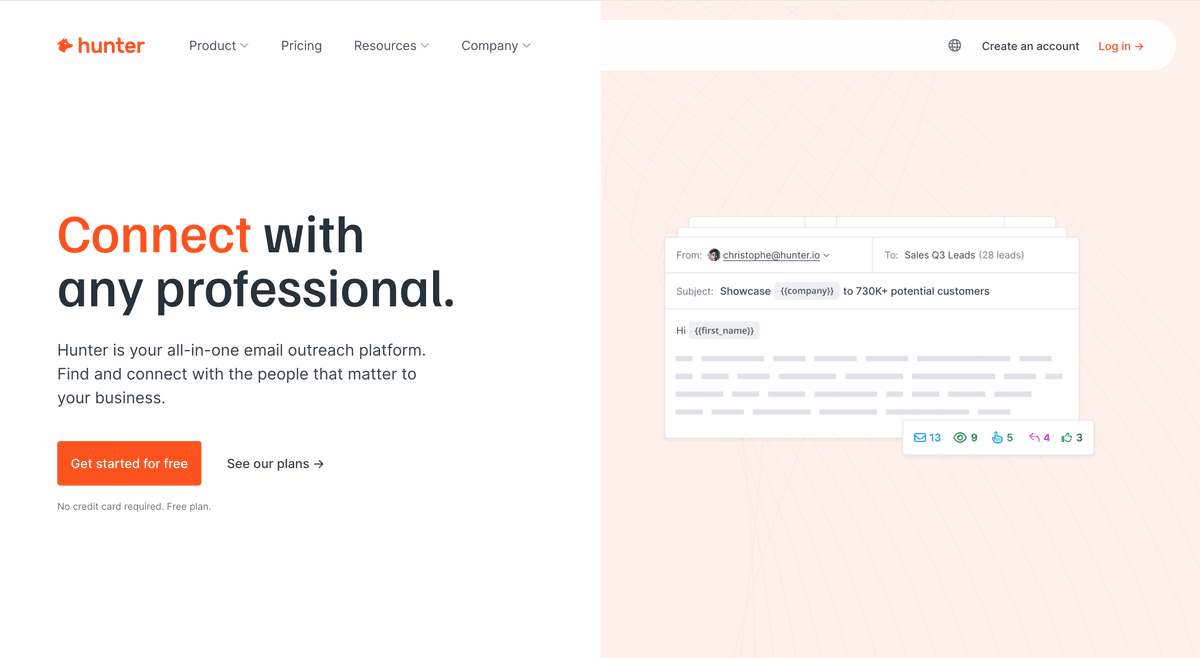
Hunter.io specializes in finding and verifying professional email addresses from company domains. Its paid plans start at $49 per month for 2,000 credits, with a free plan offering 50 monthly credits.[7]
- Strength: Domain searches, email patterns, and verification
- Data approach: A single-source index
- Constraint: No mobile phone data or multi-provider waterfall
- Fit: Basic professional email lookups and domain-wide searches
- CPME: $24.50 - Lowest overall CPME on this list
- Payment terms: Bills only when an email is found; unsuccessful searches do not use credits
7. Cognism: European B2B Contact Data
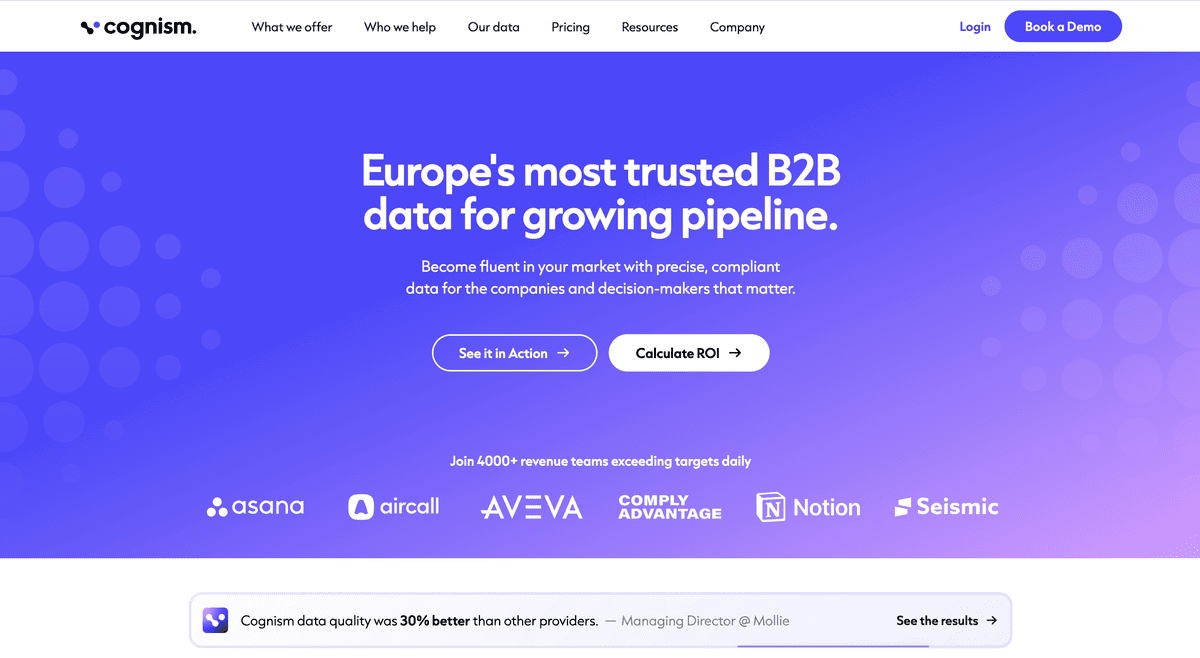
Cognism focuses on contact accuracy in European markets and compliant mobile phone numbers. It is quote-only, with enterprise contracts typically running between $15,000 and $40,000 annually.[8]
- Strength: European contact data and direct mobile numbers
- Data approach: A proprietary database
- Constraint: High annual contracts and no self-serve waterfall
- Fit: Enterprise sales teams focused on European cold calling
- CPME: Not publicly calculable
- Payment terms: Bills per contact revealed, not per newly found email
8. ZoomInfo: Enterprise Sales Intelligence
ZoomInfo is a B2B sales intelligence database aimed at large organizations. The platform is quote-only, requiring annual contracts that typically range from $15,000 to $40,000.[8]
- Strength: A large US-focused database with firmographic profiles and org charts
- Data approach: A proprietary static database
- Constraint: High contract costs and limited self-serve flexibility
- Fit: Enterprise sales organizations with large budgets and broad intelligence needs
- CPME: Not publicly calculable
- Payment terms: Bills per exported contact or company record, not per newly found email
9. HubSpot Breeze Intelligence (Formerly Clearbit)
Clearbit was a popular B2B enrichment option, but it has since been rebranded as HubSpot Breeze Intelligence[9]. Access now requires an active HubSpot subscription[9], removing it from the standalone market.
- Strength: Firmographic profiles and website visitor data inside HubSpot
- Data approach: Native CRM enrichment and database synchronization
- Constraint: Not suitable as a standalone B2B email finder
- Fit: Teams whose sales stack already runs entirely on HubSpot
- CPME: Not directly comparable
- Payment terms: Bills for CRM record enrichment through HubSpot, not only when a new verified email is found
Waterfall Email Finders vs. Single Source Email Finders
No single B2B database covers the entire web. Static contact records start aging immediately, while different providers specialize in different regions, industries, and company sizes.
The Coverage Limit of Single-Source Databases
When you run a search using a single B2B email finder, you typically hit a coverage ceiling of 50% to 60%. This leaves sales teams with two options: accept missing contacts or copy names across several databases manually.
The gap is especially visible in niche industries and international markets. A database that works well for US corporate leads can return few results for European or Asian contacts.
Waterfall Email Enrichment: The Solution to The Coverage Issues
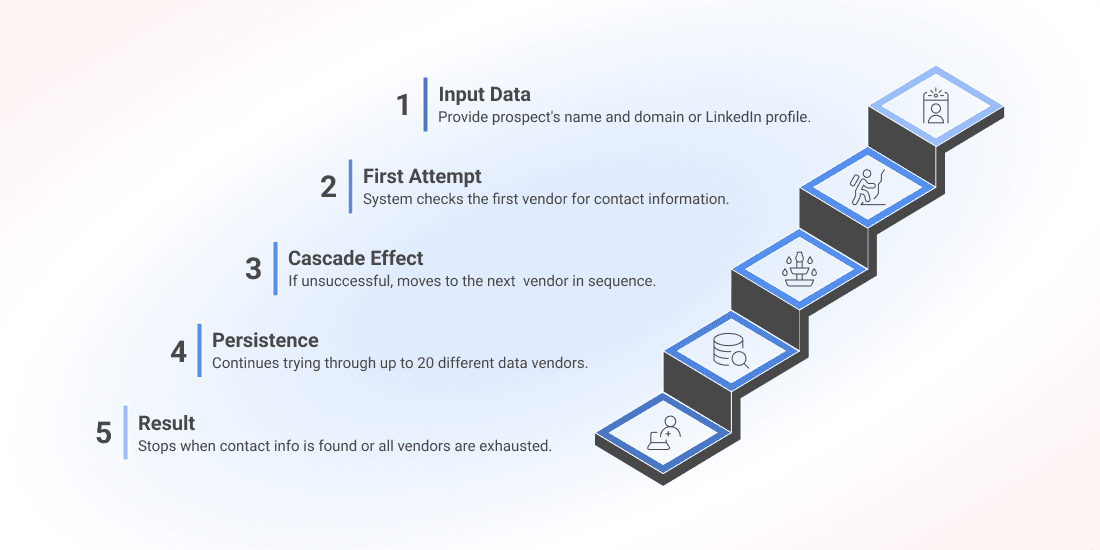
Waterfall enrichment works like an automated search loop:
- The request starts with Vendor A.
- If Vendor A has no verified result, the tool queries Vendor B.
- The sequence continues across the prioritized providers.
- The cascade stops when it finds a verified email.
This replaces multiple subscriptions, browser tabs, and manual matching with one bulk email finder workflow. It also reaches specialized databases that a general business database may miss.
Paying for Successful Results Instead of Empty Searches
Single-vendor tools may charge for the attempt, even when the search returns nothing useful. In a success-based waterfall, unsuccessful searches do not consume the same budget as verified results.
The difference becomes clear with a list of 1,000 leads:
- A 55% match rate returns 550 verified contacts.
- An 80% match rate returns 800 verified contacts.
- The same source list produces 250 additional outreach opportunities.
📘 Financial Impact of Waterfall Verification
A 25% increase in verified contacts means that from a list of 1,000 leads, you get 800 valid targets instead of 550. This improvement yields 250 more outreach opportunities without increasing your initial sourcing costs.
How to Choose the Right Email Finder Tool
Selecting the right email finder comes down to lead volume, credit costs, target regions, and the data you need. A tool built for domain searches solves a different problem than a waterfall, a sales database, or a full enrichment workspace.
Match the Tool to Your Workflow
Start with the part of the workflow you need to improve:
- Choose Datablist for flexible waterfalls, lead scraping, data cleaning, and CRM-ready lists.
- Choose Clay for complex integrations and custom enrichment workflows.
- Choose Apollo for lead search and built-in outbound engagement.
- Choose FullEnrich for mobile phone waterfalls.
- Choose BetterContact if you want an alternative to FullEnrich
- Choose Hunter.io for simple domain searches and email verification.
- Choose Cognism or ZoomInfo for enterprise contact data and sales intelligence.
- Choose Breeze Intelligence when HubSpot already controls the workflow.
Compare Self-Serve and Enterprise Pricing
Modern email lookup tools range from self-serve plans under $30 per month to enterprise contracts requiring five-figure annual commitments.
- Success-based credits: Better when match rates vary because failed searches do not consume the same budget as verified results.
- Standard credit plans: Suitable when usage is predictable and the provider covers your target market well.
- Enterprise contracts: Useful when a large organization needs seats, firmographic data, and sales intelligence under one agreement.
For growing teams, a success-based self-serve plan keeps upfront costs low and lets you scale your workflow without an annual commitment.
Start With a Smart List
A test list is only useful when it reflects the leads you actually target. Build a representative sample across your main regions, industries, company sizes, and job functions rather than choosing 100 random contacts.
Then measure the information that pricing pages and provider claims cannot give you:
- Coverage: Calculate the percentage of contacts for which the tool finds an email. Review coverage by segment because a strong overall match rate can hide poor results in specific markets.
- Data quality: Track bounced emails, undeliverable addresses, and false positives connected to the wrong person or company. Finding more emails only matters when those emails are usable.
- True CPME: Divide your total spend by the number of correct, deliverable emails, not the number of addresses returned. This shows what 1,000 usable emails would actually cost.
The best email finder is not necessarily the one with the highest advertised match rate. It is the one that produces the most correct, deliverable emails at the lowest true CPME for your target market.
Conclusion: Datablist Is the Best Overall Email Finder Tool
For most B2B teams, Datablist.com offers the strongest balance of coverage, cost, and workflow flexibility among email finder tools:
- 20+ provider waterfall: Searches providers sequentially to improve coverage without requiring separate subscriptions, and bills only when an email is found.
- Lowest waterfall CPME: At $45 for 1,000 found emails, Datablist is the cheapest waterfall email enrichment tool in this comparison. Hunter.io has the lowest overall CPME at $24.50.
- Complete workflow: Source leads with the Sales Navigator Scraper, enrich them, run custom AI research, and clean or deduplicate the results in the same workspace.
Instead of combining separate scraping, enrichment, and cleaning tools, teams can move from raw leads to CRM-ready data in one place. That makes Datablist the clearest overall choice for scalable B2B email finding.
Frequently Asked Questions About Email Finder Tools
How Does Datablist's Waterfall Email Finder Compare to Apollo or Clay?
Apollo relies on a single static database, which can contain outdated info. Clay integrates with multiple APIs but has high credit costs and a steep learning curve. Datablist runs 20+ vendors sequentially in a simple AI spreadsheet with built-in verification.
Can I Use My Own Email Finder API Keys Inside Datablist?
Yes. Datablist allows you to connect your own API keys for supported email finder tools. This feature gives you the flexibility to use your existing subscriptions and custom pricing plans directly inside your spreadsheet workspace.
Which Email Finder Has the Lowest CPME?
CPME means cost per 1,000 emails found. Based on the public month-to-month pricing in this comparison, Hunter.io has the lowest overall CPME at $24.50 as of July 2026. Datablist has the lowest CPME among the waterfall email enrichment tools at $45. True CPME can be higher after accounting for bounces, false positives, and unusable results, while quote-only tools cannot be compared reliably.
Do Email Finder Tools Charge for Unsuccessful Searches?
It depends on the billing model. Datablist, FullEnrich, BetterContact, and Hunter charge for found or verified results rather than empty searches. Apollo charges for verified contact data subject to plan limits, while Clay's successful results can use two to five credits depending on the provider. Cognism, ZoomInfo, and HubSpot charge for contact reveals, exports, or record enrichment rather than only for newly found emails.
What Should I Look for in an Email Finder Tool?
Compare four things: coverage across your target segments, data quality, true CPME, and whether the tool bills for unsuccessful searches. You should also consider workflow fit, including whether you need only email discovery or a broader workspace for sourcing, research, enrichment, and cleaning.
Which Type of Email Finder Should I Choose?
Choose a domain search tool for company-specific lookups, a sales database for sourcing and engagement, a waterfall tool for multi-provider coverage, or a Waterfall enrichment workspace like Datablist when you also need lead scraping, AI research, and data cleaning.
What Is the Difference Between a Single-Source and a Waterfall Email Finder?
A single-source tool searches one database or index, so its coverage is limited to the records available there. A waterfall email finder checks multiple providers sequentially and stops when it finds a verified result. This can improve coverage across different markets, although actual performance still depends on your target list.
Is B2B Email Enrichment Legal Under GDPR and CCPA?
It can be, but compliance depends on how the data is sourced, your lawful basis for processing it, notice requirements, data handling, and how you use it for outreach. Publicly available business information is not automatically unrestricted. Respect opt-out and deletion requests, document your legal basis, and obtain professional guidance for your specific markets.
Can Email Verification Guarantee Deliverability?
No. Verification can check formatting, domain records, and mailbox signals to reduce bounce risk, but it cannot guarantee delivery. Catch-all domains, blocked verification requests, stale data, and changing mailbox conditions can still produce bounces or false positives.
What Are Email Finder Tools?
Email finder tools are software applications that help you locate and verify professional contact details for B2B prospects. They search public sources, company websites, and professional databases to compile deliverable email addresses.
How Does Datablist Keep LinkedIn Sales Navigator Scraping Safe?
Datablist's LinkedIn Sales Navigator Scraper runs in the cloud and does not require you to share your LinkedIn login credentials, protecting your account from flags or restrictions.