
B2B databases are great if you're targeting mid-market companies, but when you go after small business owners, the data just isn't there.
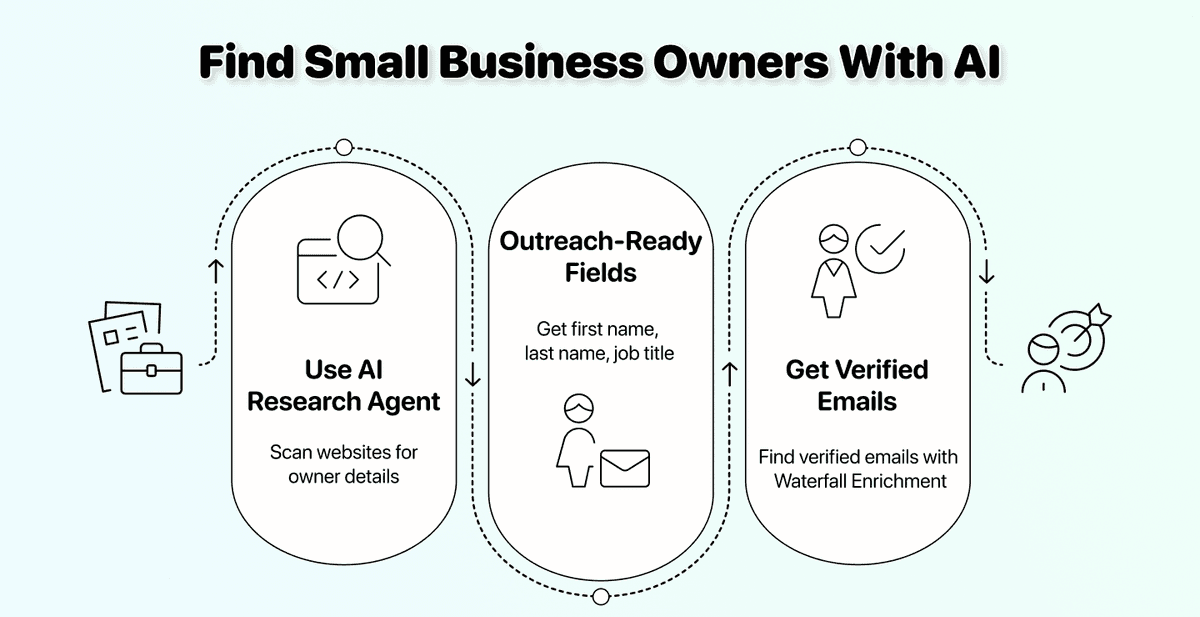
Most databases miss the majority of small business contacts because these owners simply don't exist in structured records. But many of them put their name right on their own website. About pages, team sections, even footers. The data is there; you just need a way to extract it at scale.
This guide shows you how to find small business owners using Datablist's Business Owner Finder, an AI agent that lets you find business owners by company name and website, pulling out owner information automatically. By the end, you'll have a full small business owner list with names, titles, and emails.
📌 Summary For Those In a Rush
This article shows how to find small business owners that aren't in traditional B2B databases, using Datablist's Business Owner Finder AI agent. Here is a summary:
Problem: B2B databases miss most small business owner contacts because these owners don't exist in structured records.
Solution: Use Datablist's Business Owner Finder AI Agent template to extract owner names, titles, and LinkedIn URLs directly from business websites using AI.
Why Datablist:
- AI reads business websites and identifies owners in context, not just blind scraping
- Chain enrichments in one platform: owner info to email to outreach-ready exports
- Finds hundreds of business owners in less than 10 minutes
What This Guide Covers
- Why small business owners are hard to find in traditional databases
- Where small business owner data actually lives (and where it doesn't)
- How to find small business owners at scale using AI (full step-by-step)
- How to get verified email addresses once you have the owner's names
- What to do after you have your list
Why Small Business Owners Are Hard To Find
Legacy Databases Have a Big (and Known) Gap
B2B databases like Apollo, ZoomInfo, and Lusha are built around mid-market and enterprise companies. They work well for that segment. But small businesses, especially local ones, rarely have LinkedIn company pages that these platforms can scrape and index.
Even when a business is listed, the owner's name and contact info are almost never attached. You get a business name, maybe a generic info@ email, and that's it. If you're trying to find small business owner contact info for outreach, these databases leave you with more gaps than contacts.
This isn't a flaw in the database. It's a structural limitation. Small business owner data doesn't live where these platforms look for it.
Why Manual Research Breaks Down Fast
The alternative most people try is manual research. Open Google, search the business, find the About page, and copy the owner's name into a spreadsheet. Repeat.
This works when you need 10 or 20 contacts. But the moment you try to find who owns a local business across hundreds of companies, the math stops working:
↳ 5 minutes per company = 40+ hours for a list of 500
↳↳ By the time you finish, a chunk of it is already outdated
↳↳↳ Copy-pasting from About pages or directories is error-prone and slow
No agency or sales team can justify the hours vs. the return. And anyone doing this manually is spending time on research that should go toward outreach.
Where Small Business Owner Data Actually Lives
Business Websites Are the Most Underused Source
About pages, team sections, and even footers often name the owner directly. Many local business websites include a founder bio, a "meet the owner" section, or a staff page where the owner is listed with their title.
Some even list direct emails or phone numbers right on the page.
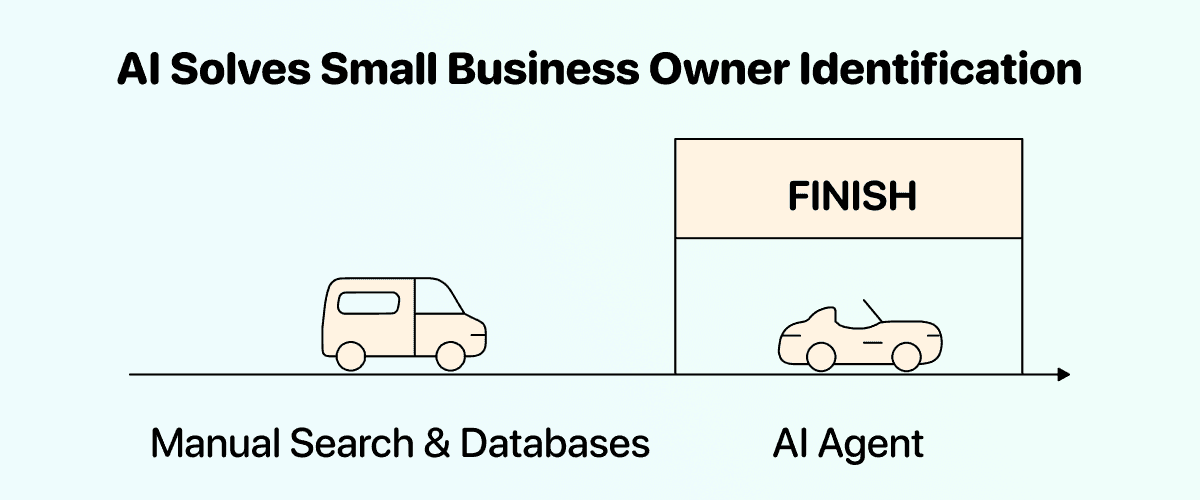
The data is there. It's public. It's up to date. The problem isn't access, it's the ability to find small business owners at scale. Reading through 500 business websites manually isn't practical. That's where AI changes the equation.
How To Find Small Business Owners - Take Advantage of AI Agents
Other Sources Worth Knowing (And Their Limits)
Business websites are the most reliable source, but they're not the only place where you can find who owns a small business. Here's what else is out there:
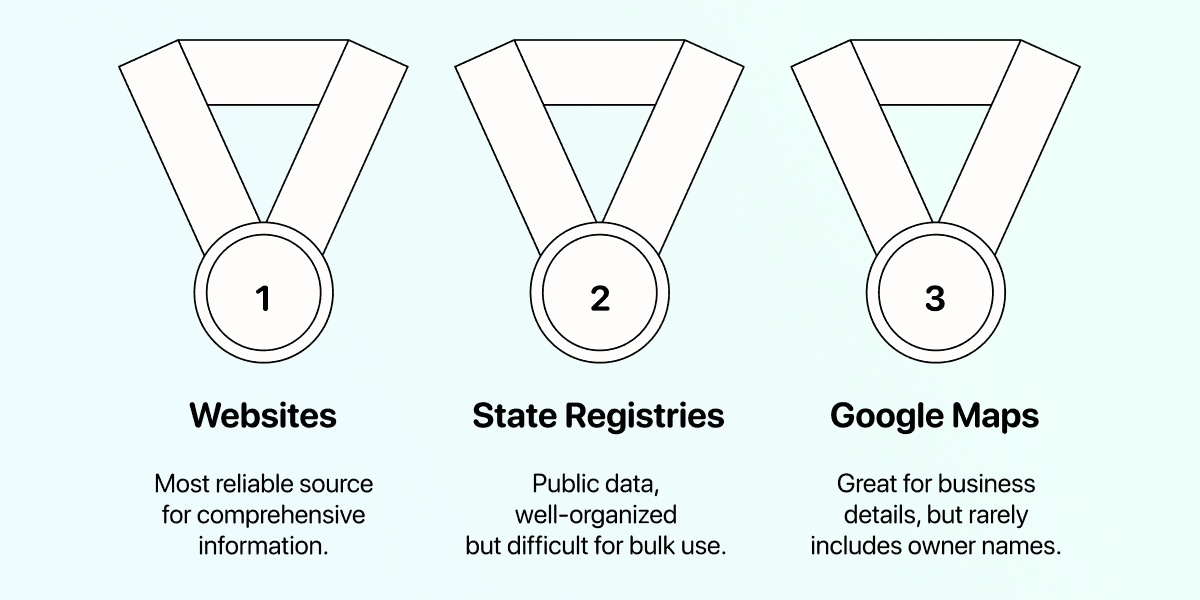
- Google Maps and local directories: Great for business name, address, and phone number. But they almost never include owner names
- State and government business registries: Public data, usually well organized, but hard to filter and difficult to use in bulk. Data formats vary by state and are rarely enrichment-ready
- LinkedIn: Works for some, but many small business owners aren't active or don't have company pages. Coverage is inconsistent and very weak
- Facebook business pages: Some local businesses list their owner in the page info or About section. Useful for individual lookups, but extracting this data at scale isn't straightforward
- Industry associations and niche directories: Can be useful for specific verticals, but coverage is low, and the data is often outdated
No single source is complete. That's why AI-powered extraction from business websites is the most reliable way to find who owns a small business: it goes where the data actually lives and reads it in context.
How To Find Small Business Owners at Scale Using AI
What You Need Before You Start
To find small business owners with Datablist's AI Agent, you need the following:
- A list of company names, their website URLs, or domains. If you only have company names without websites, Datablist.com has a Find Company Domain from Company Name enrichment that can bridge that gap first.
- A Datablist.com account. Signing up takes less than a minute.
If you need a list of companies to start with, read our guide on Google Maps Scraping 👈🏽
What is Datablist?
Datablist is a platform for building lead generation workflows that allows 30,000 users to find, enrich, and clean data using over 60 different tools from AI Agents to Email Finders, AI processors, Technology enrichments, and more.
Additionally, Datablist allows you to set up automated workflows that run on schedule or demand. Here are a few practical use cases that Datablist users love:
- Building lead lists
- Personalizing emails with AI
- Cleaning and deduplicating CRMs
- Scraping job postings from 19 boards at once
- Scraping leads from Sales Navigator without getting banned
The point is clear: if you need to get, clean, or automate workflows with data involved and you need it to be easy, fast, and reliable, Datablist is built for that.
💡 Datablist Summarized in 35 Words
Datablist is a platform for automating lead generation workflows, which offers a suite of over 60 tools, including AI Agents, Waterfall Enrichment to find emails and phone numbers, data cleaning tools for deduplication, and more.
Step-by-Step: Finding Business Owners With Datablist's Business Owner Finder
The Business Owner Finder is an AI agent template that helps you find small business owners by visiting their websites and identifying the owner or founder. It reads About pages, team sections, and other relevant areas of the site, then returns the owner's name and title where found.
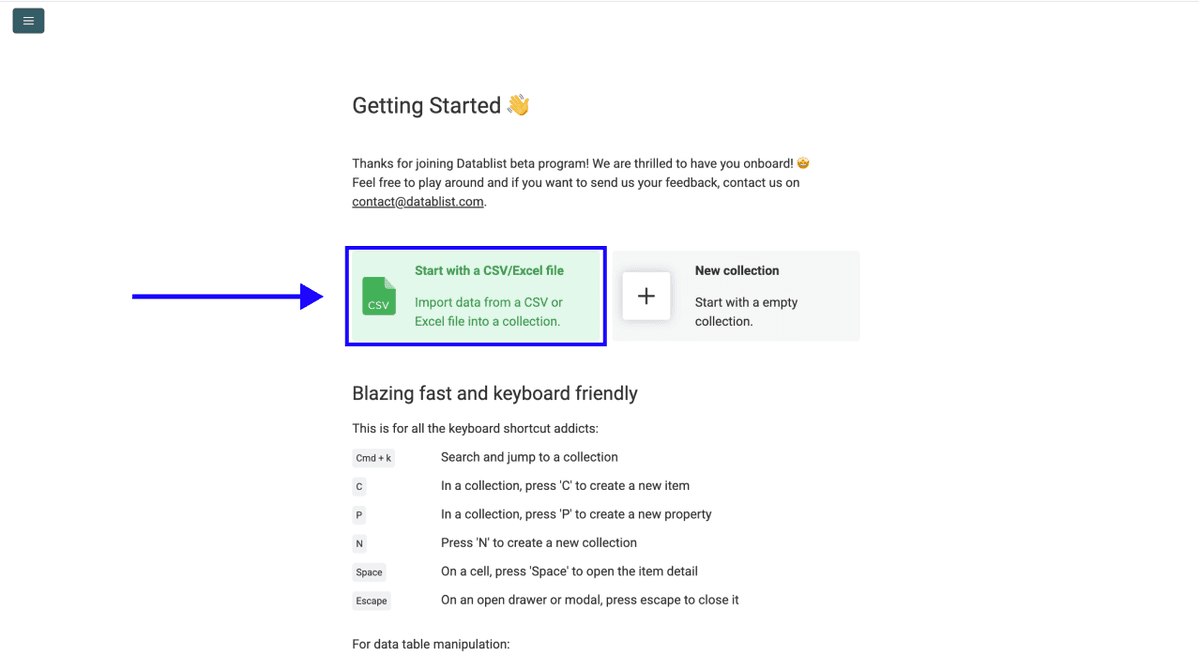
Step 1: Sign Up & Upload Your Data
First, Sign up for Datablist.com
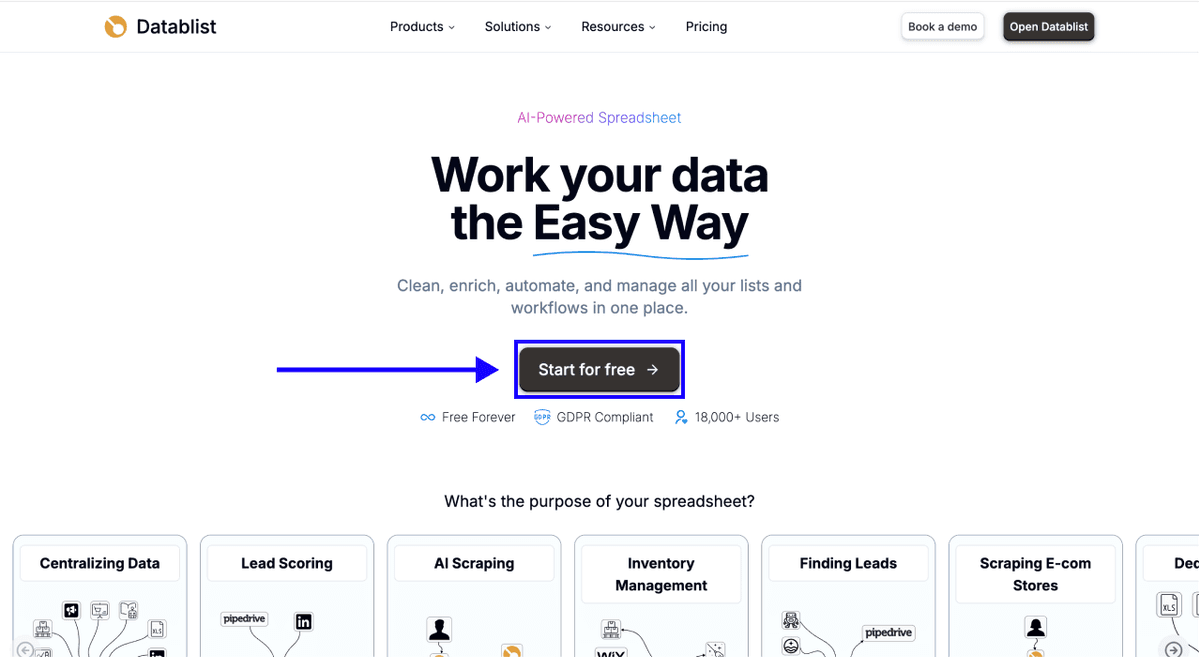
Then, Upload your CSV or Excel file containing your company names and website URLs
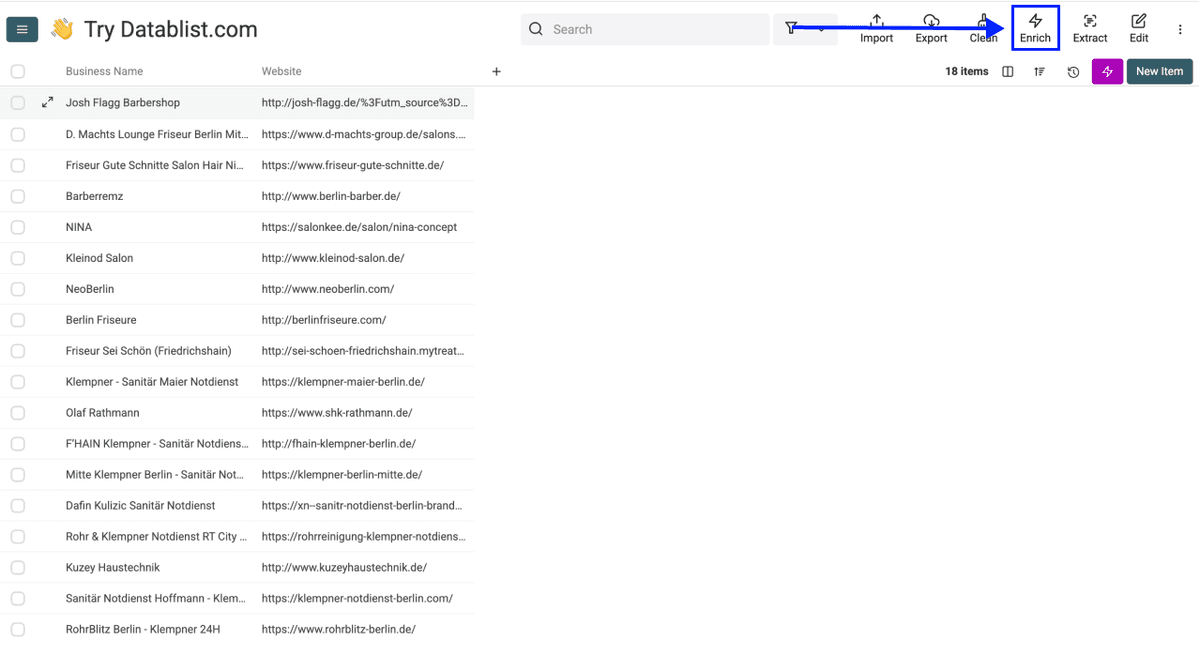
Step 2: Navigate to the Enrichment
- Click on Enrich in the top menu
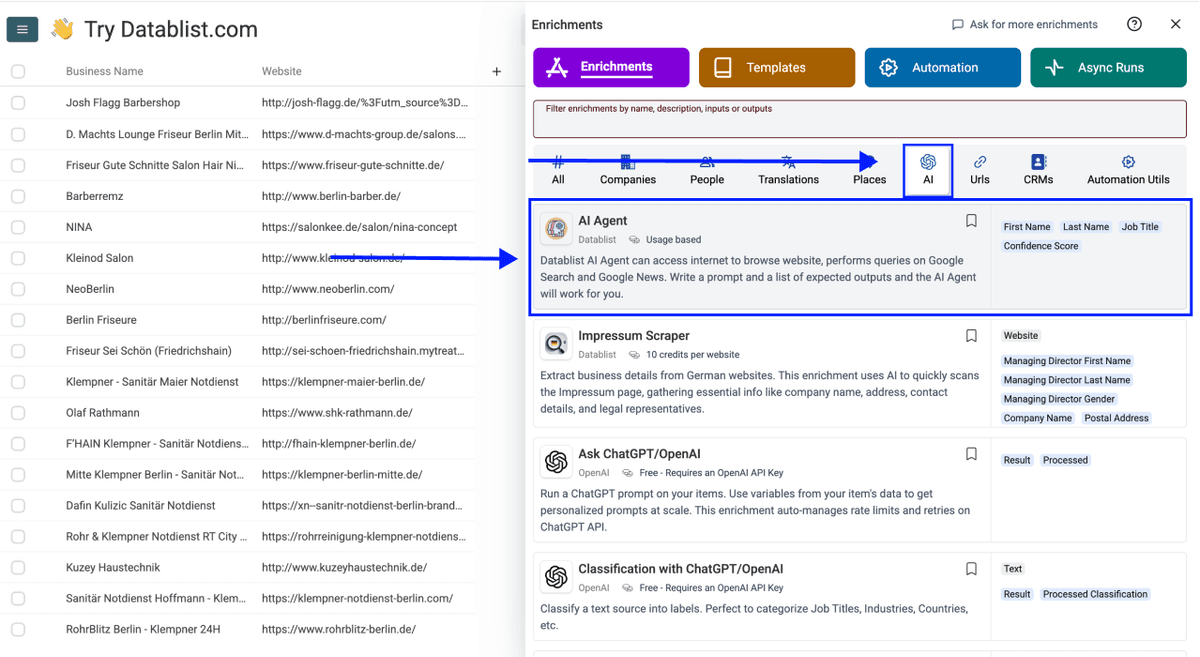
- Go to the AI tab
- Select AI Agent
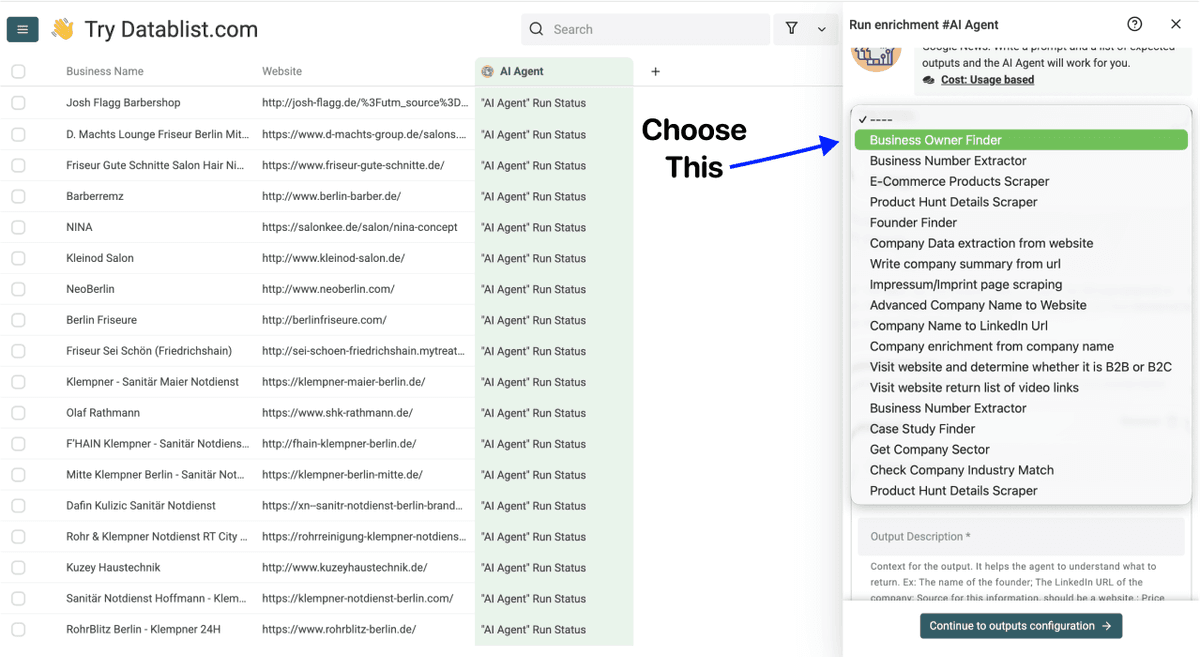
Step 3: Select the Business Owner Finder Template
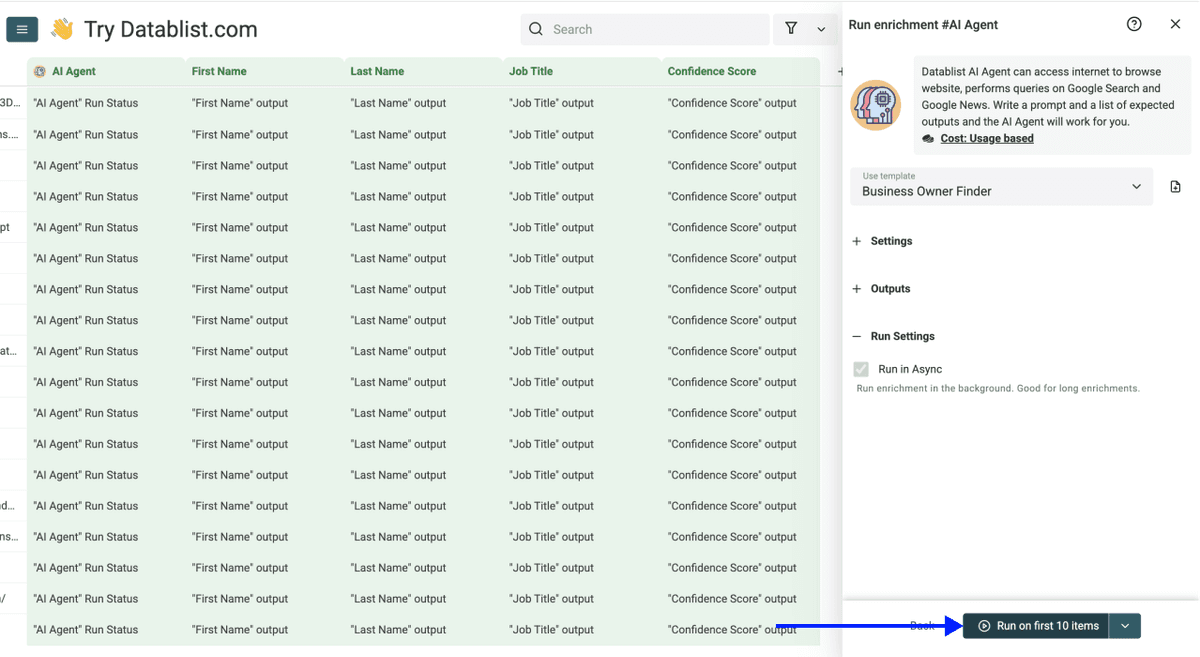
Click on the Template Drop-Down and select "Business Owner Finder".
💡 No Prompting Required
You don't have to write a single prompt. The Business Owner Finder template is ready to use out of the box. Just select it, put your variable in, and Datablist handles the rest. If you ever want to customize what the AI looks for, you can edit the template in plain English.
Step 4: Map Your Input Property
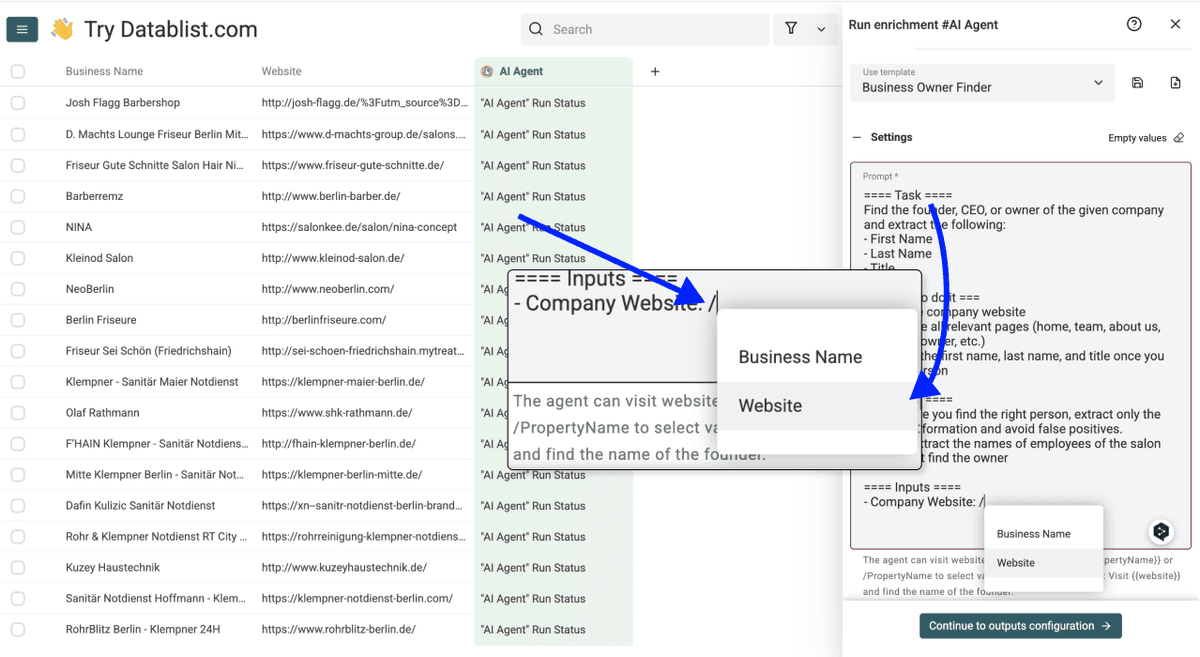
Scroll down and insert the website URL as your Input Property. You can do this by typing / and selecting the column that contains your website URLs.
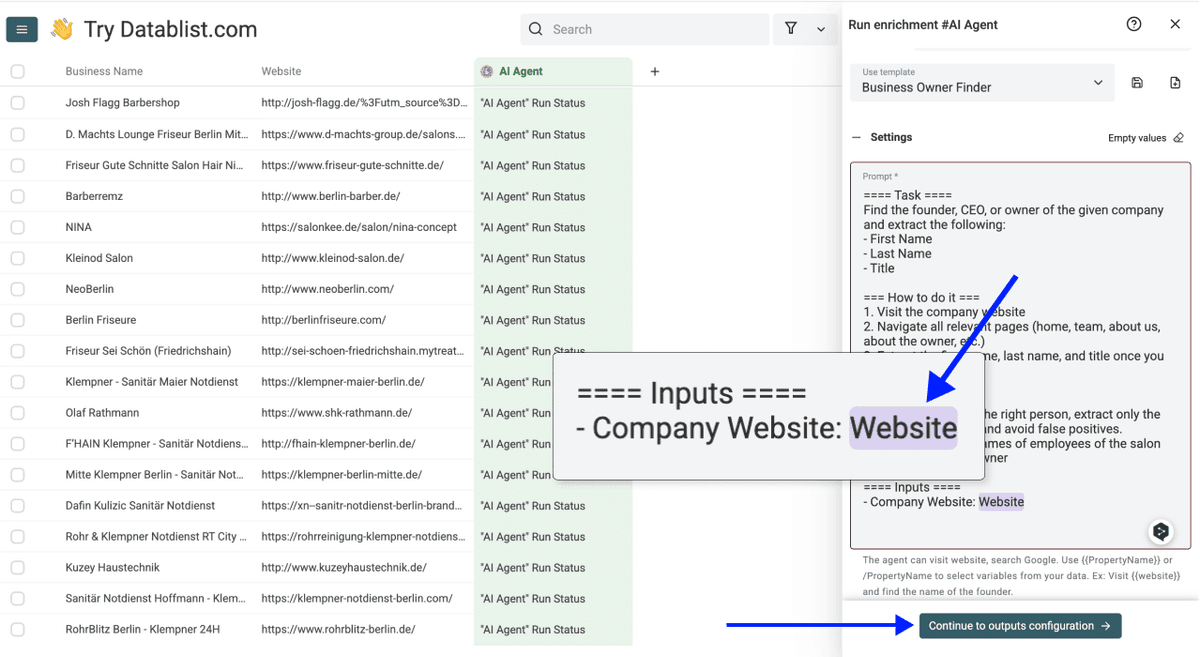
Once the variable appears in purple, click on Continue to outputs configuration
Step 5: Select Outputs
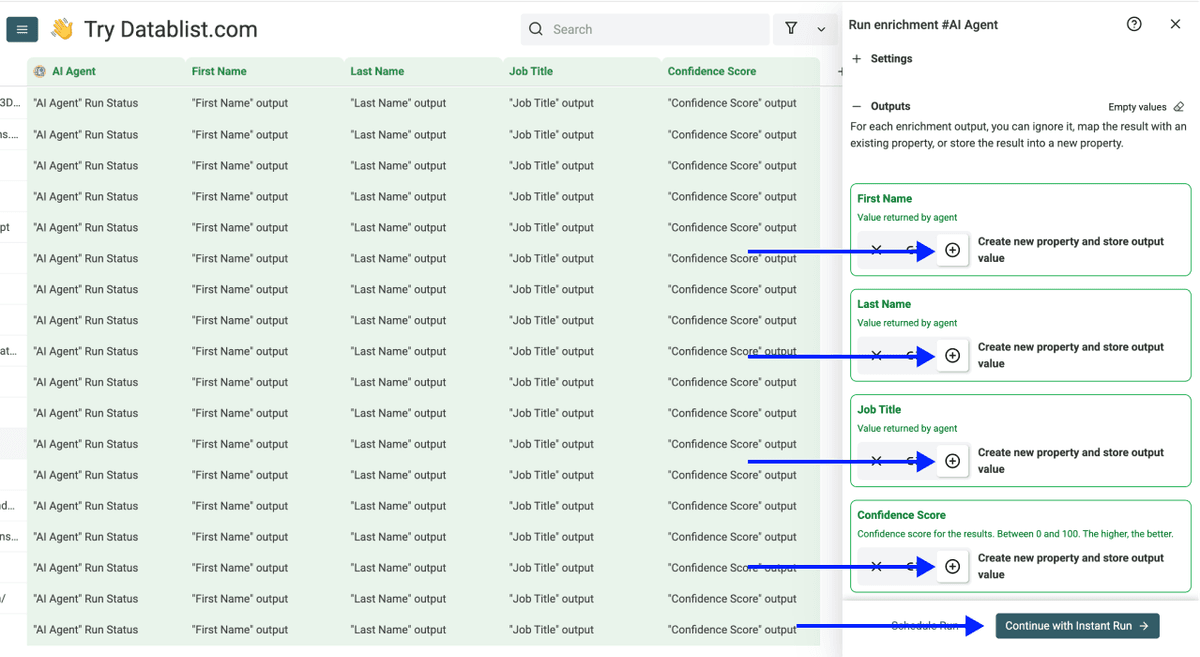
The Business Owner Finder returns the following data points:
- First Name - The business owner's first name
- Last Name - The business owner's last name
- Job Title - Their role at the company
Click the icons to add them to your collection, then click Instant Run
Step 6: Run the Enrichment
Configure your run settings by clicking on the chevron on the right side of the button:
- Run on first 10 items: Good for checking results before committing
- Run on first 100 items: Useful for validating larger samples
- Run on first {X} items: Choose exactly how many to process
- Run on all view items: Process your entire list (or view if you've enabled filters)
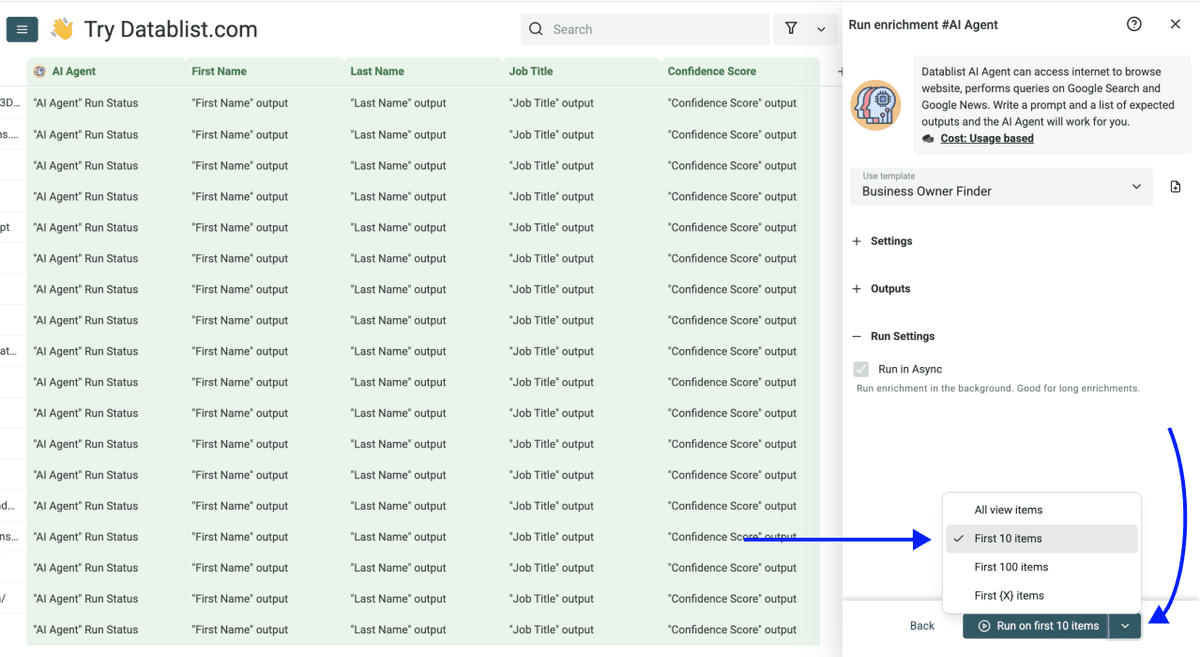
Once you have chosen your preferred option, click Run on X items
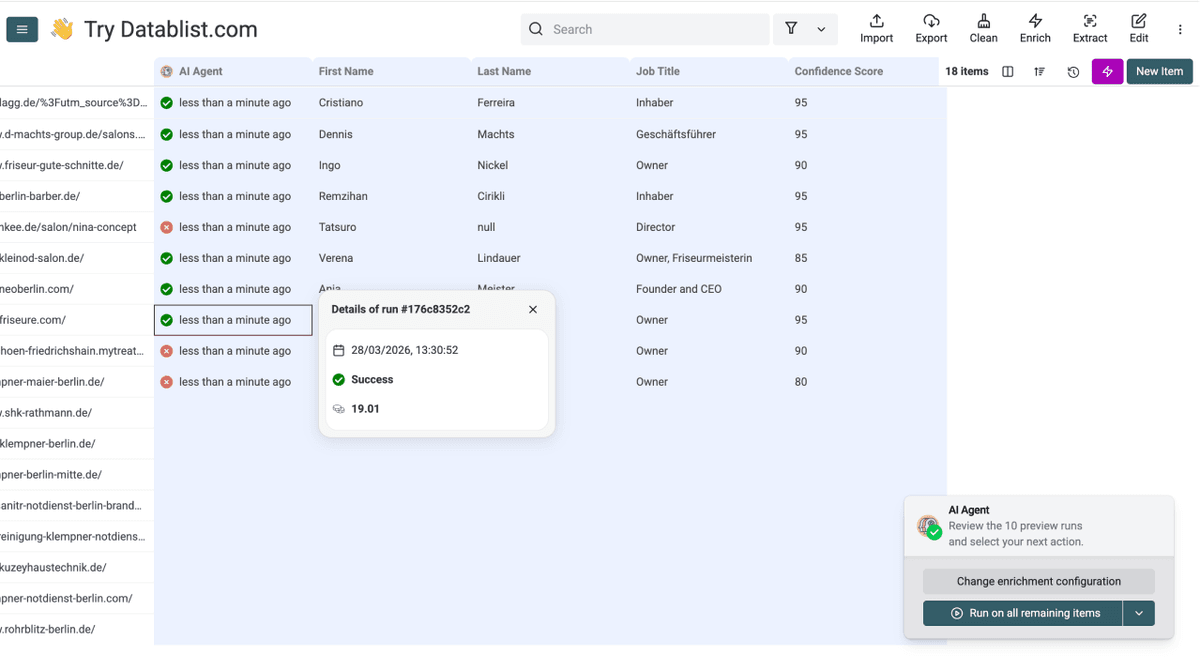
Within minutes, you'll have owner names, titles, and LinkedIn URLs populated in your collection.
Find Small Business Owners With AI: Pricing Explained
Datablist's AI Agent uses a credit system where you pay based on what the agent does, not just what it returns. Credits are consumed every time the agent runs on a row, even if it doesn't find a result. It costs between 3 and 25 credits to find a local business owner.
That's because behind the scenes, the agent is doing real work. It opens the website, reads through the content, looks for the owner's name, pulls out the data, and brings it back into your collection. All of that costs compute. The more steps involved, the more credits it uses, which is what "usage-based" means in practice.
You can start with a small test batch to see what it costs before scaling up. For a full breakdown of plans and included credits, see Datablist's pricing page.
Getting Verified Email Addresses
Once you have owner names, the next step to completing your small business owner list is getting their email addresses. For that, run Datablist's Waterfall Email Finder on the same collection. No exporting or re-uploading needed.
The Waterfall Email Finder cascades through multiple email providers, which gives you 75%+ coverage compared to the typical 40% from a single provider. It costs 25 credits per email found, and you only pay when an email is actually returned.
Learn how to find emails at scale 👈🏽
What To Do After You Have Your List
A small business owner list is only useful if you act on it. Here are the most common next steps:
Clean and deduplicate your data
Before any outreach, remove duplicates and fix formatting issues. Datablist has built-in data cleaning tools that handle this in minutes.
Personalize your outreach
Generic emails get ignored. Use the data you got from the websites on your small business owner list to write relevant messages. Datablist's AI processors can generate personalized email copy based on the data in your collection.
Export and launch
Once your list is clean and enriched, export it as CSV and load it into your outreach tool. The full pipeline from company names to outreach-ready contacts happens in one platform.
Your Key Takeaways
- Small business owners are the hardest B2B segment to find in databases. That's exactly why most competitors ignore them.
- The data exists on their websites. About pages, team sections, and bios contain the information you need.
- AI agents like Datablist's let you find small business owners at scale without technical skills or hours of manual work
- Chain your data enrichment workflows for a complete pipeline: company name to website to owner info to verified email, all in one platform.
- If you sell to small businesses, this workflow gives you an edge that database-dependent competitors don't have.
Frequently Asked Questions (FAQ) About Finding Small Business Owners
How Much Does It Cost To Find Small Business Owners Using Datablist.com?
The Business Owner Finder uses a usage-based credit system, meaning credits are consumed each time the agent runs on a row (even if it does not find an owner). With Datablist's Starter Plan ($25/month), you get 5,000 credits monthly, and the Growth Plan ($50/month) includes 20,000 credits. If you need more credits, top-up packages start at $20 for 20,000 credits, and credits do not expire.
How Fast Can I Find 1,000 Small Business Owners With AI?
The Business Owner Finder typically processes 1,000 companies in under 10 minutes. The setup (uploading your list, configuring inputs, selecting outputs) takes another 2-3 minutes. Total time from start to results: under 15 minutes for a full small business owner list.
Is There a Limit To How Many Small Business Owners I Can Find at Once?
Datablist.com supports up to 100,000 rows per collection. If your list is larger, split it into multiple collections and run the bulk enrichment on each one separately. For most use cases, there's no practical limit.
What Data Do I Need To Start Finding Small Business Owners?
You need a list of company names and their website URLs or domains. If you only have company names, Datablist has a Find Company Domain enrichment to get the websites first. The Business Owner Finder then visits each website and returns the owner's name, title, LinkedIn URL, and email, where found.
Do I Need Coding Skills To Use AI for Finding Business Owners?
Not at all. The entire process is no-code. You upload a file, select the enrichment, map your columns, and click run. If you can use a spreadsheet, you can use Datablist.com.
Can I Also Find Their Email Addresses and Phone Numbers in Bulk?
Yes. Once you have owner names and LinkedIn URLs in your collection, you can run Datablist's Waterfall Email Finder or Waterfall Phone Finder on the same data. No re-upload needed, just pick the next enrichment and run it. Everything stays in one collection.
Can I Find Small Business Owners Without AI?
Yes, but it's slow. You can manually search Google for each business, visit their website, and look for the owner's name on the About page. This works for 10-20 companies. For anything beyond that, the time investment makes it impractical. 5 minutes per company means 40+ hours for a list of 500.
What's the Difference Between Using a B2B Database and an AI Agent To Find Small Business Owners?
B2B databases pull from structured records like LinkedIn and company filings. They work well for mid-market and enterprise, but miss most small businesses. An AI agent like Datablist's Business Owner Finder reads actual business websites, which is where most small business owner information lives. The AI approach finds contacts that databases structurally can't reach.
How Accurate Is AI at Finding Small Business Owners Compared To Manual Research?
The Business Owner Finder reads websites the same way a human researcher would, but at scale. It checks About pages, team sections, and other relevant areas. Accuracy is comparable to manual research for businesses that publish owner information on their site. The only difference is speed: For a human, it takes 5 minutes per company; the AI can find hundreds of small business owners in 10 minutes.
Can I Find Small Business Owners in a Specific Industry or Location?
Yes. The Business Owner Finder works on whatever company list you provide. If you want to target local business owners in a specific industry or location, build your company list using those filters first. Datablist's Google Maps Scraper or Job Board Scraper can help you create a filtered company list, then run the Business Owner Finder on that list.