Export data table
To download a file containing your data table items, click Export in your collection header.
Note: Exported data represents your current data table items. If your collection is filtered, for example with a search term, the export file contains the matching items. Clear the filters before exporting if you need the whole collection.
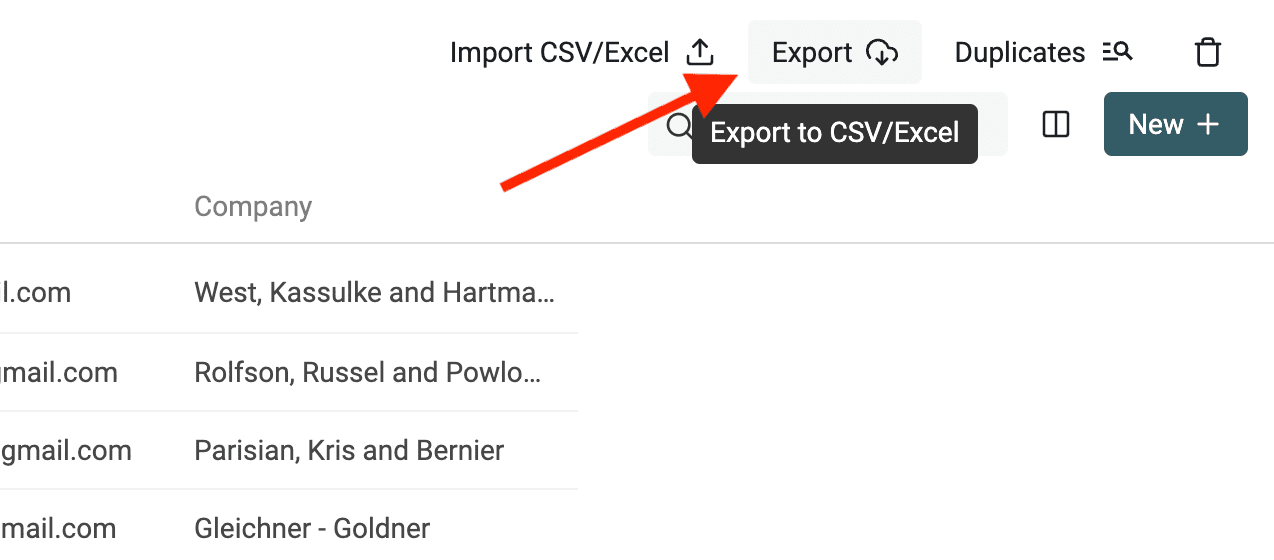
A modal will open to select the Export format and the properties to export.
CSV and Microsoft Excel (.xlsx) formats are available. When at least one of your properties is hidden from the Data Table, an option is shown to export only visible properties or all your properties.
If Excel export fails on a long cell, see the 32,767-character limit and CSV workaround before shortening any source text.
To prepare a specific CSV schema, follow the column reorder and omission walkthrough. It distinguishes changing property order from hiding values, then checks the downloaded header and visible-only export.
For CSV format exports, an option to select the column delimiter is available. Comma and Semicolon delimiters are available. Exported CSV files use UTF-8 for encoding.
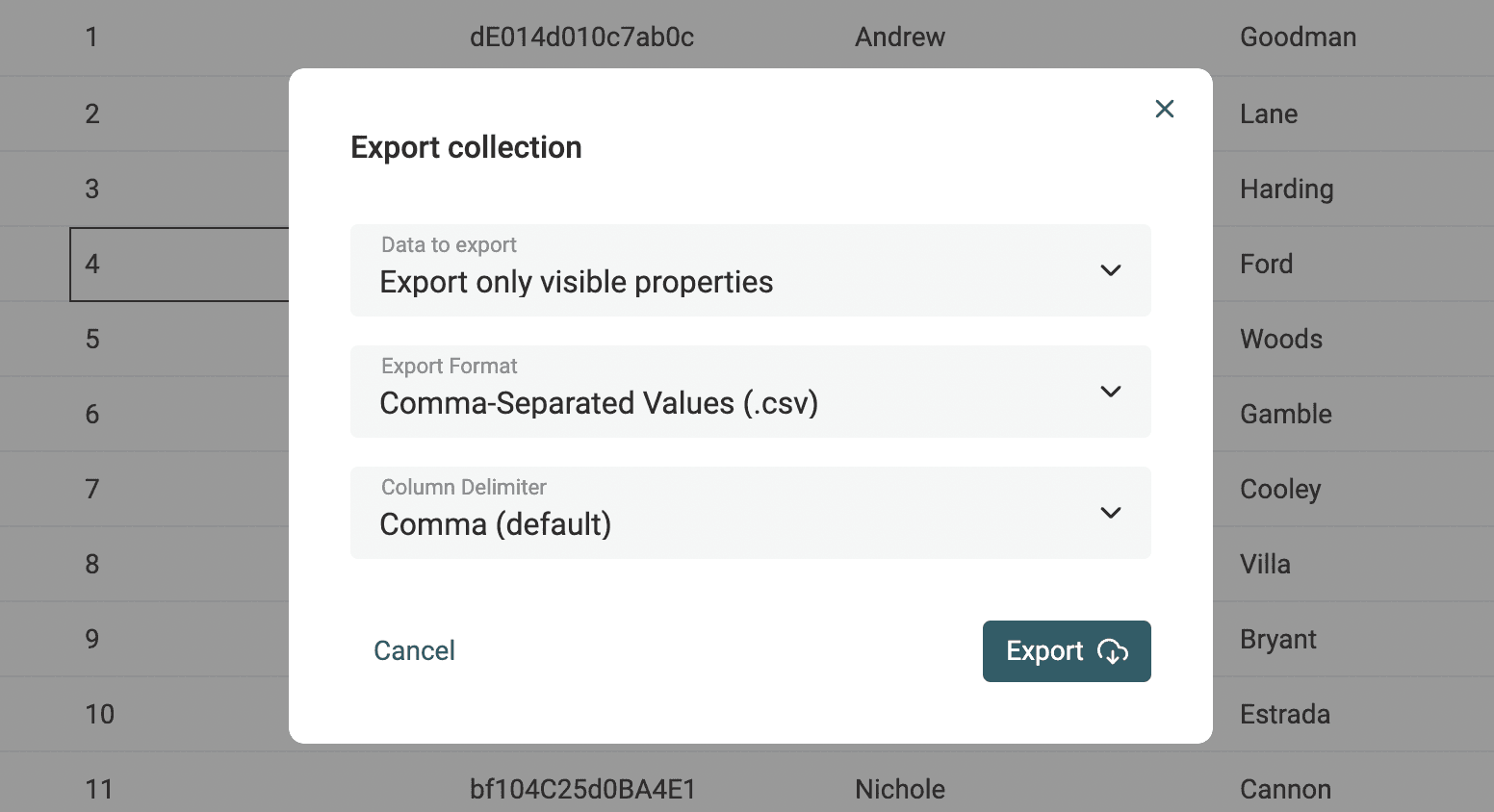
Export data in the current sort order
When you sort your collection by a property, the export modal displays an Order By "Property Name" option. This option is checked by default, so rows in the exported file follow the same ascending or descending order as your data table.
I recommend keeping it checked when you plan to review or share the exported file. The rows will appear in the order you already verified in Datablist. Uncheck it to export rows in the collection's default order.
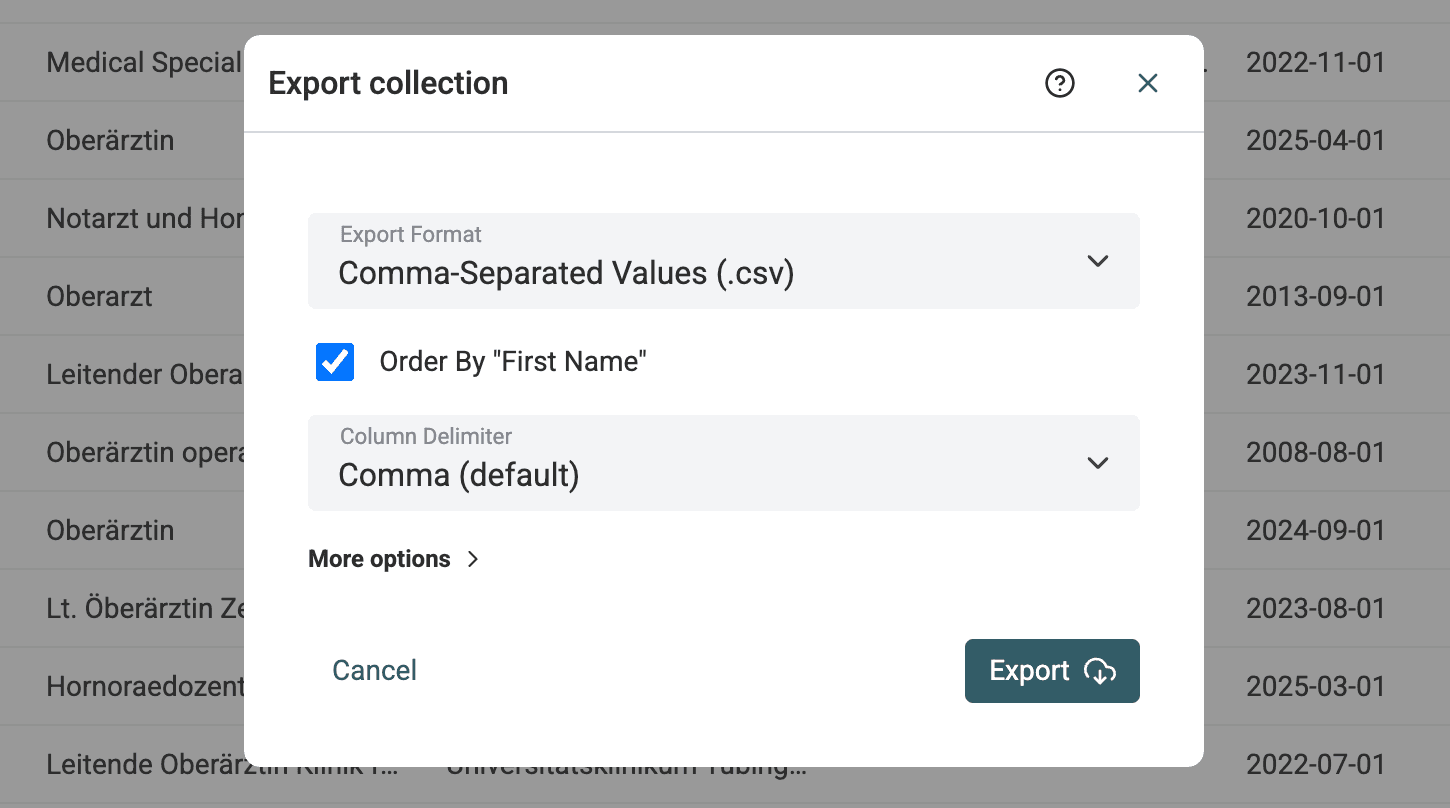
Export a large collection in several CSV files
For a full collection CSV export, open More options to set Max count and Export offset. Leave the count empty to export all matching items. The offset skips that many items before starting the export.
For example, to split 25,000 matching records into files of up to 10,000 records:
- Set Max count to
10000and Export offset to0for the first file. - Keep the same count and set the offset to
10000for the second file. - Set the offset to
20000for the final 5,000 records.
Keep the same filters and ordering for each export. Avoid adding, removing, or editing rows between exports, since a changing result set can create gaps or overlaps. If you sort by a property, use unique values for an unambiguous order and keep Order By "Property Name" enabled.
The count and offset options apply to CSV full collection exports. For a selection of specific records, use the selected-items export below.
Export enrichment run statuses
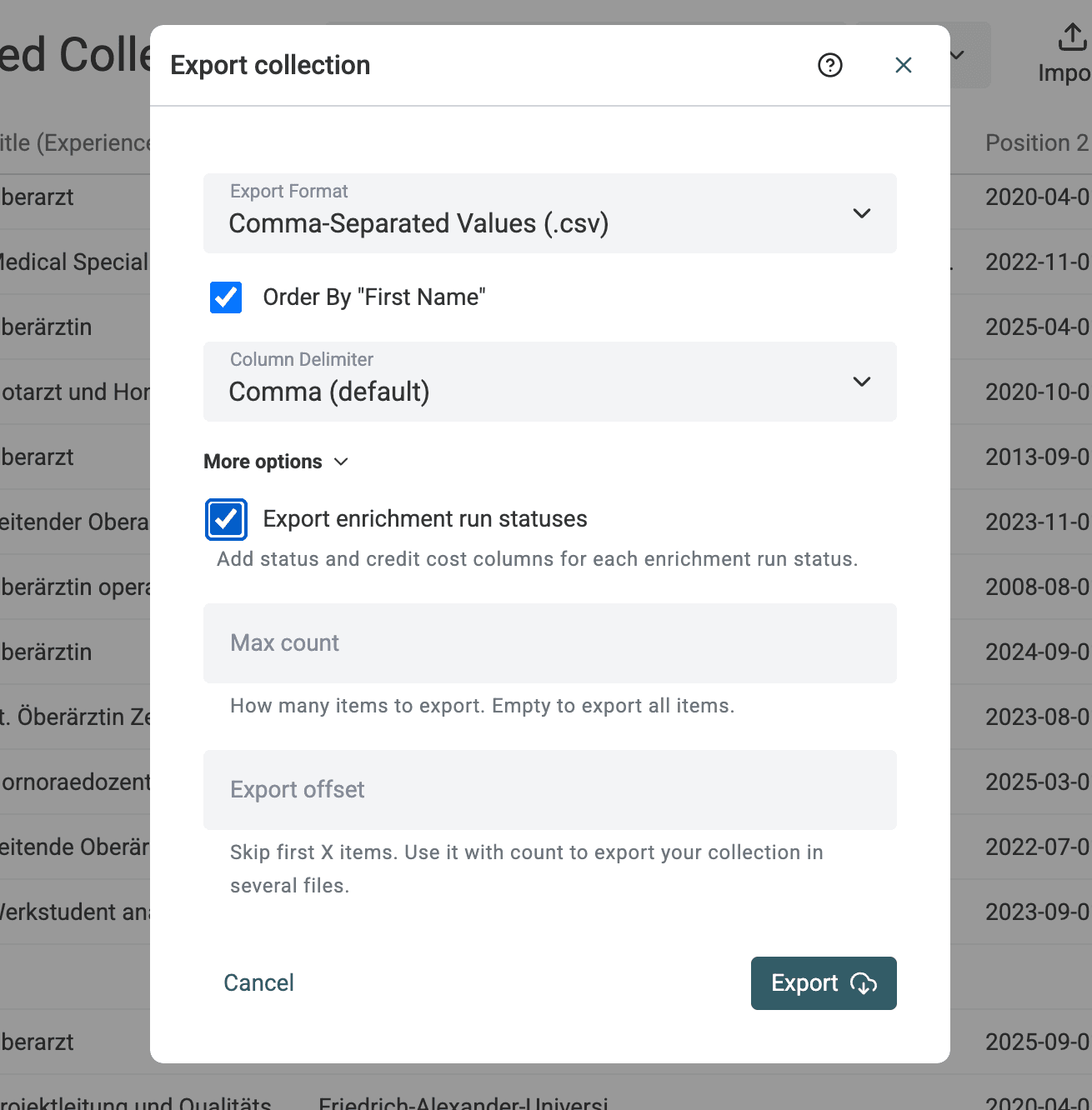
Enrichment run status properties contain structured data, so Datablist excludes them from exports by default. To include them, open More options and check Export enrichment run statuses. This option is available for full collection exports in CSV and Excel formats.
Datablist adds two columns for every enrichment run status property:
- Property Name - Status contains
Success,Warning, orError. - Property Name - Credit Cost contains the credits used for the enrichment run.
For example, an enrichment property named Waterfall Email Finder creates Waterfall Email Finder - Status and Waterfall Email Finder - Credit Cost columns. This split keeps each exported cell compatible with spreadsheet tools instead of placing the run status object in one cell.
You can open the generated file with Microsoft Excel, Google Sheets, Apple Numbers, or any CSV editors.
If you later open the downloaded file in Excel and need to share only part of it, use the selected-cells CSV export workflow. Excel exports an active worksheet, so isolate the intended cells first.
Export selected items
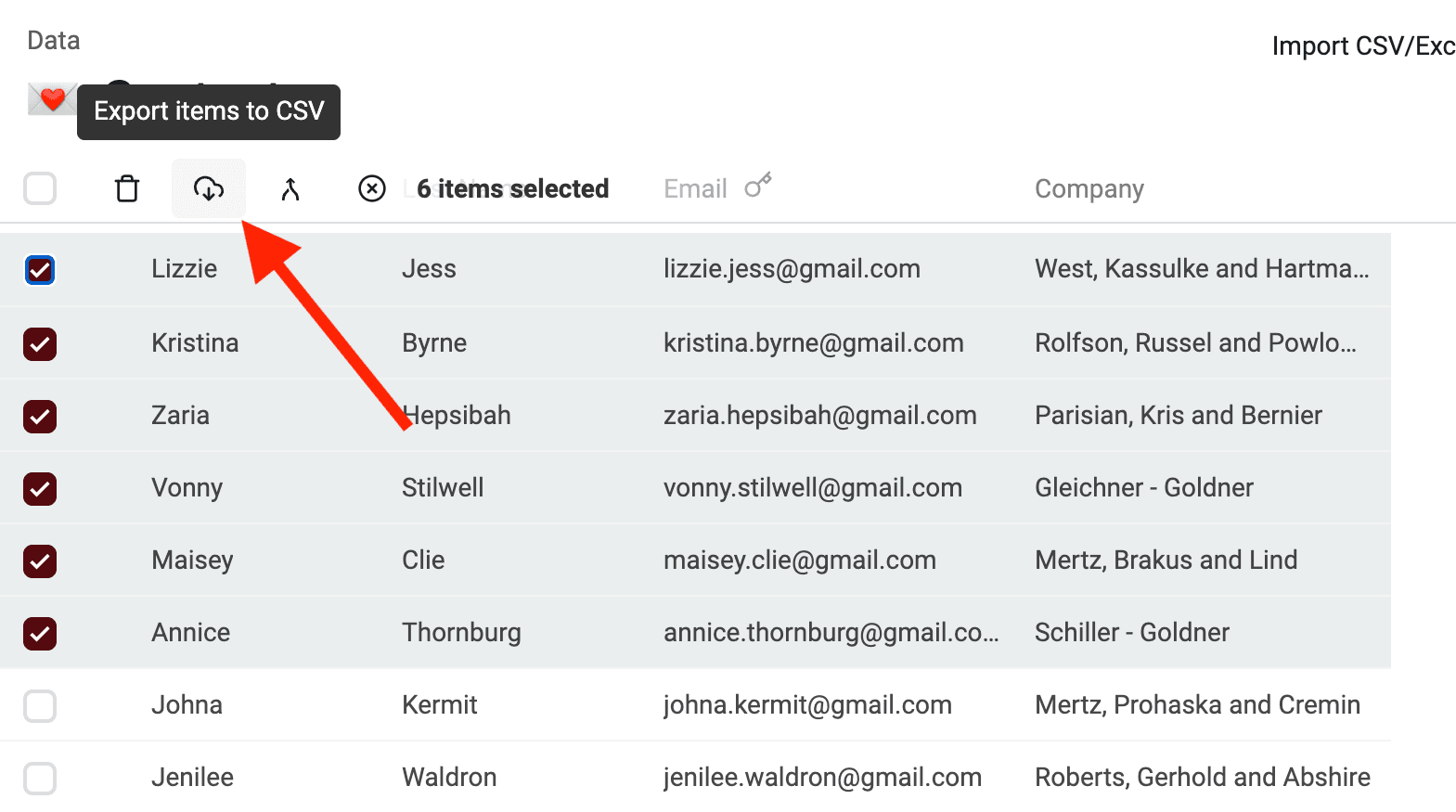
To export only some items from your collection, select items and click the "Export items to CSV/Excel" button in the top bar.
The export modal will open to perform an export with your selected items.
Export with copy/pasting
Another simple way to export items or cells is to use copy/pasting. Select items or cells and click "Edit -> Copy" in your browser or use the keyboard shortcut Ctrl + c to copy the data in your clipboard.
Clipboard data is compatible with any spreadsheet tools, data editors, or text editors.
Data Types export formats
CSV exports serialize property values as text:
- Checkbox data is exported with
TRUEandFALSEvalues. - DateTime data is exported using ISO 8601 format, including the UTC timezone.
- Date data is exported as
YYYY-MM-DD. - Empty values become empty fields. Commas, quotes, and line breaks inside values are protected by CSV quoting.
Check the downloaded file before importing it elsewhere
Open the file and compare its record count with the filtered collection or selected items. Verify that required properties are present, including any hidden properties you chose to export. If you are exporting before troubleshooting a browser storage error, verify the backup before clearing Datablist site data so unsynced work is not lost.
If an identifier contains leading zeros, import that column as text in your spreadsheet or destination tool. CSV quotes protect delimiters inside values; they do not stop another application from interpreting values as numbers or dates. Review accented text, multiline descriptions, and a few date values before using the file for a CRM or catalog import.