
Need to classify thousands of rows with ChatGPT?
Datablist's Classification with ChatGPT/OpenAI enrichment labels text from a CSV or Excel file. You define the labels, choose the text column, and run the classification in bulk.
Use it to sort leads, tag support tickets, group reviews, classify companies, or turn messy text into clean categories.
What This Enrichment Does
This enrichment sends your text to OpenAI and asks ChatGPT to return one label from your list.
You control:
- The input column to classify
- The allowed labels
- The OpenAI API key
- The model used for the run
- The cache setting
- Flex mode for supported models
For each row, Datablist returns:
- Classification result - The label selected by ChatGPT.
- Confidence - High, Medium, Low, or Very Low.
- Run status - Success, no result, missing data, or API error.
- Processed flag - A field to avoid reprocessing the same rows.
This helps when your spreadsheet has open text, notes, descriptions, or comments and you need a clean category column.
Good Use Cases
Classify Leads by Intent
Upload a list of form submissions, demo requests, or LinkedIn messages. Ask ChatGPT to classify each row as:
- High intent
- Medium intent
- Low intent
- Not relevant
This helps sales teams focus on the rows worth a reply.
Segment Companies by Industry
If your CSV contains company descriptions or scraped website text, classify each company into a short list of industries.
Example labels:
- SaaS
- Ecommerce
- Agency
- Manufacturing
- Consulting
- Other
Use the result to build segments before outreach or analysis.
Tag Support Tickets
Classify support messages by topic:
- Billing
- Bug report
- Feature request
- Account access
- Cancellation
- Other
This gives you a quick view of what customers ask about without reading every ticket.
Sort Reviews and Survey Answers
Run classification on customer reviews, NPS answers, or survey comments.
Example labels:
- Pricing
- Product quality
- Onboarding
- Support
- Performance
- Missing feature
Use the labels to find patterns before writing a report.
Detect Sentiment or Tone
Classify text as positive, neutral, negative, angry, confused, or satisfied. This works well for reviews, replies, comments, and chat transcripts.
Example Classifications
Here are simple examples you can run in Datablist.
Lead intent
Input text:
We are comparing tools and need to export 50,000 contacts this week.
Labels:
- High intent
- Medium intent
- Low intent
- Not relevant
Expected result: High intent
Support topic
Input text:
I cannot log in after resetting my password.
Labels:
- Billing
- Bug report
- Feature request
- Account access
- Other
Expected result: Account access
Company segment
Input text:
We sell hosted analytics software for finance teams.
Labels:
- SaaS
- Ecommerce
- Agency
- Consulting
- Other
Expected result: SaaS
Why Use Datablist for Bulk Classification?
ChatGPT works well for classification, but running it row by row is slow. Datablist handles the spreadsheet workflow around the API call.
You can:
- Import CSV and Excel files
- Map the text column once
- Classify many rows in one run
- Reuse cached answers for duplicate text
- Keep results next to your source data
- Filter rows by label after the run
- Export the final file
This is useful when you need repeatable classification, not a one-off prompt in ChatGPT.
Built-In Cache for Duplicate Text
Datablist caches identical classification requests by default for 48 hours.
If your CSV or Excel file contains duplicate text, Datablist reuses the first classification result instead of calling OpenAI again. This avoids paying OpenAI twice for the same text with the same labels, model, and settings.
Example:
- 1,000 rows contain the same company description
- Datablist classifies the first matching row
- The other matching rows reuse the cached label
You can disable this in the enrichment settings with Disable Cache.
Step-by-Step Guide
Step 1: Import Your CSV or Excel File
Create a free account and import your file into Datablist.
Your file should contain one column with the text you want to classify. This can be a company description, customer message, review, lead note, website text, or any other text field.
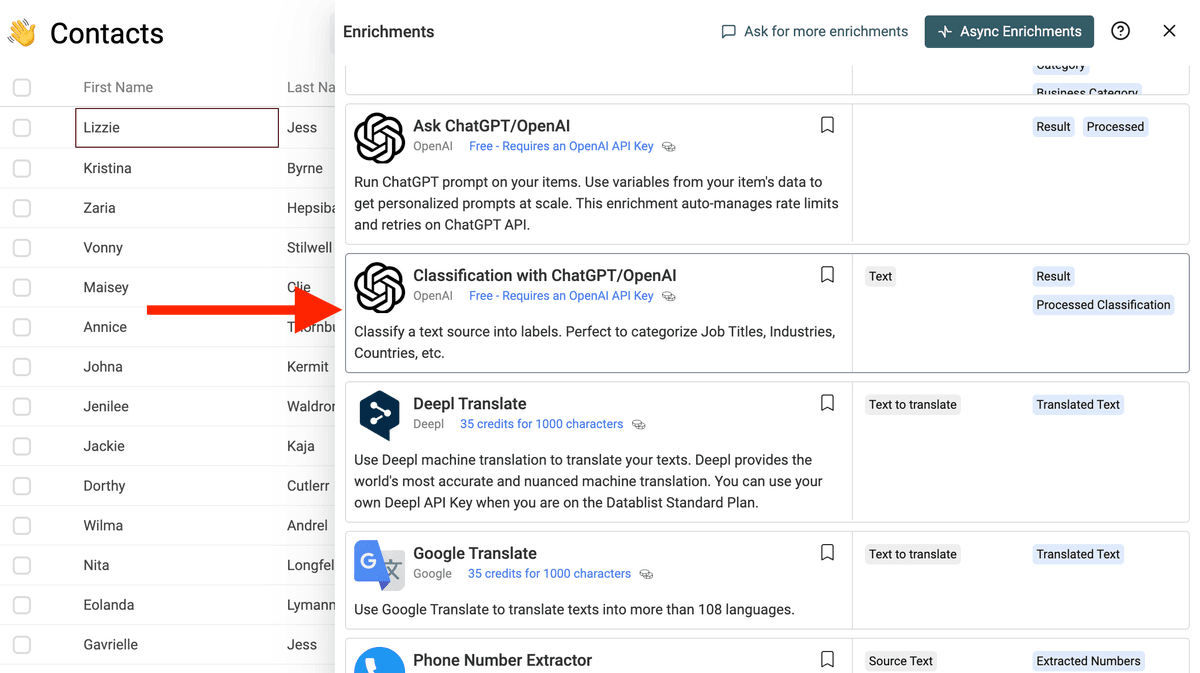
Step 2: Select "Classification with ChatGPT/OpenAI"
Click Enrich and search for Classification with ChatGPT/OpenAI.
Step 3: Add Your Labels
Enter the labels ChatGPT can return.
Keep labels short and clear. For example:
- Sales
- Marketing
- Engineering
- Finance
- HR
- Other
Add an Other label when some rows may not fit. It prevents ChatGPT from forcing a bad category.
Step 4: Choose Optional Settings
By default, Datablist caches identical classification text. Leave the cache enabled unless you need OpenAI to process every row again.
You can also choose the GPT model. Some models support Flex Mode. Flex mode can reduce OpenAI costs, but responses may take longer. Use it for large classification runs when speed matters less than cost.
Flex mode only appears when the selected model supports it.
Step 5: Map the Text Column
Select the column containing the text to classify.
For better results, use the most useful text column. A full company description often works better than a short company name.
Step 6: Run the Enrichment
Launch the run. Datablist processes the rows and writes the selected label into a new column.
When ChatGPT returns a label, Datablist also writes a confidence level. Use it to review low-confidence rows before using the result.
Rows with missing text or no matching label are marked with an error status, so you can filter them later.
Tips for Better Results
- Use 3 to 12 labels when possible.
- Keep labels distinct.
- Add
OtherorUnknownfor weak matches. - Avoid labels with overlapping meanings.
- Use enough source text to make a decision.
- Test on 20 rows before running a large list.
- Keep cache enabled when your file may contain duplicate text.
- Use flex mode on supported models when cost matters more than speed.
- Review rows with Low or Very Low confidence.
- Filter and review a sample after the run.
If two labels overlap, ChatGPT may switch between them. For example, SaaS and Software can conflict. Use one or make the difference clear.
Pricing
This enrichment is free to run in Datablist.
You need your own OpenAI API key, and OpenAI charges your account for API usage.
Datablist caches identical classification requests by default, so duplicated text does not trigger duplicate OpenAI calls during the cache window.
For supported models, flex mode can lower OpenAI costs. It may take longer to return results.
Warning
You must have credits in your OpenAI account. This enrichment will not work with an OpenAI account that has no API billing or credits.
FAQ
Can I classify a CSV file with ChatGPT?
Yes. Import your CSV into Datablist, select the text column, define your labels, and run the Classification with ChatGPT/OpenAI enrichment.
Can I classify Excel rows with ChatGPT?
Yes. Datablist supports Excel files. Upload the file, run the enrichment, then export the results.
Do I need an OpenAI API key?
Yes. This enrichment uses your OpenAI API key. You can create one from the OpenAI API keys page.
Can I choose the labels?
Yes. You write the labels before running the enrichment. ChatGPT must choose one of those labels.
Does the enrichment return confidence?
Yes. When ChatGPT returns a label, Datablist also returns a confidence level: High, Medium, Low, or Very Low.
Does Datablist cache duplicate classifications?
Yes. Cache is enabled by default. If two rows use the same text, labels, model, and settings, Datablist reuses the cached result for 48 hours. You can turn this off with Disable Cache.
What is Flex Mode?
Flex mode is an OpenAI setting for supported models. It can reduce cost, but responses may take longer. Datablist shows the setting only when the selected model supports it.
What happens when the text is empty?
Datablist marks the row with an error status. This makes missing input easy to filter.
Should I add an "Other" label?
Yes, in most cases. It gives ChatGPT a safe label when the row does not match your main categories.
How many rows can I classify?
You can classify large CSV and Excel files. For large runs, test a small sample first, then run the full list once your labels work.
Is ChatGPT classification always correct?
No. ChatGPT can make mistakes, especially when labels overlap or the input text is vague. Review a sample of the results before using them in a campaign, report, or workflow.
What workflows does bulk text classification fit?
Use it to classify CSV rows with ChatGPT, label spreadsheet data, score leads, classify reviews, and tag support tickets. Match the labels to the exact text problem your file contains.