
Need to translate a CSV or Excel file without copying rows into ChatGPT one by one?
Datablist's Translate with ChatGPT/OpenAI enrichment translates text from a spreadsheet column in bulk. You select the source column, choose the target language, and Datablist writes the translated text into a new column.
Use it for product catalogs, customer reviews, support tickets, app content, marketing copy, and any list with text to translate.
What This Enrichment Does
This enrichment runs ChatGPT translations on rows from your CSV or Excel file.
You can:
- Translate one text column at a time
- Choose the target language
- Let ChatGPT detect the source language
- Set a source language when you know it
- Choose the GPT model
- Add instructions for HTML, XML, JSON, or custom rules
- Track row status for missing text or failed translations
- See the credits used for each translated row
For each row, Datablist returns:
- Translated Text - The translated version of your input text.
- Run status - Success, missing input, no result, or API error.
- Credits used - The cost for that row.
Translate Only the Columns You Choose
Many online CSV translation tools translate the whole file. They process every column and every cell, including IDs, SKUs, URLs, tags, codes, and fields that should stay unchanged.
Datablist lets you translate one selected column at a time.
You choose the input column and the output column. Your original data stays untouched.
This gives you more control:
- Translate only the column that needs work
- Keep IDs, URLs, tags, and internal notes unchanged
- Translate filtered rows only, such as one product category or one language segment
- Use ChatGPT for columns that need instructions, tone, HTML, XML, or JSON rules
- Use another engine for another column, such as Google Translate for short labels or DeepL for long descriptions
For example, you can translate product descriptions with DeepL, then use ChatGPT on SEO titles with a custom instruction to keep brand names and local keywords.
Why Use ChatGPT for Bulk Translation?
ChatGPT works well when context matters.
It can handle short labels, long paragraphs, product descriptions, support messages, and copy with tone or formatting rules. You can also add instructions, such as keeping HTML tags or preserving JSON keys.
This is useful when you need more control than a basic find-and-translate workflow.
Good Use Cases
Translate Product Catalogs
Translate product titles, descriptions, bullet points, and specifications from an ecommerce CSV.
Use extra instructions when your product descriptions contain HTML.
Translate Customer Reviews
Turn multilingual reviews into one language before analysis, tagging, or sentiment classification.
Translate Support Tickets
Translate customer messages before routing, tagging, or replying.
Translate Website or App Content
Translate labels, snippets, help text, landing page copy, or app strings stored in a spreadsheet.
Use the JSON option when your content comes from a localization file.
Translate Sales and Recruiting Lists
Translate notes, company descriptions, LinkedIn snippets, job descriptions, or outreach context before sending them to another workflow.
Keep HTML, XML, or JSON Structure
Some translation jobs need more than plain text.
In advanced settings, you can tell ChatGPT to:
- Keep HTML or XML tags
- Keep JSON structure
- Follow custom instructions
Examples:
- Translate only text inside HTML tags.
- Keep product JSON keys unchanged.
- Keep placeholders such as
{first_name}or{{company}}. - Translate only a specific field inside a block of text.
This helps when you translate ecommerce descriptions, website copy, localization files, or templated messages.
Source and Target Languages
You must choose a target language.
The source language is optional. If you leave it empty, ChatGPT detects the source language from the text.
Set the source language when:
- All rows use the same source language
- The text is short
- The text contains names, codes, or industry terms
- You want fewer language-detection mistakes
The enrichment supports many target languages, including English variants, French, German, Spanish, Italian, Portuguese, Dutch, Polish, Chinese, Japanese, Korean, Arabic, and many more.
Pricing
Datablist charges credits based on token usage.
The default model is GPT-4o mini, estimated around 1.5 credits per 1,000 characters.
Model estimates shown in the enrichment:
- GPT 5: about 20 credits per 1,000 characters
- GPT 5 mini: about 5 credits per 1,000 characters
- GPT 5 nano: about 0.9 credits per 1,000 characters
- GPT 4.1: about 15 credits per 1,000 characters
- GPT 4.1 mini: about 1 credit per 1,000 characters
- GPT 4.1 nano: about 0.9 credits per 1,000 characters
- GPT-4o: about 20 credits per 1,000 characters
- GPT-4o mini: about 1 credit per 1,000 characters
Use smaller models for large translation files when cost matters. Use larger models when tone, context, or difficult text matters more.
Learn more about the Datablist Credits System.
Step-by-Step Guide
Step 1: Import Your CSV or Excel File
Create a free account and import your file into Datablist.
Datablist works as a CSV editor, so you can open large CSV and Excel files with many text rows.
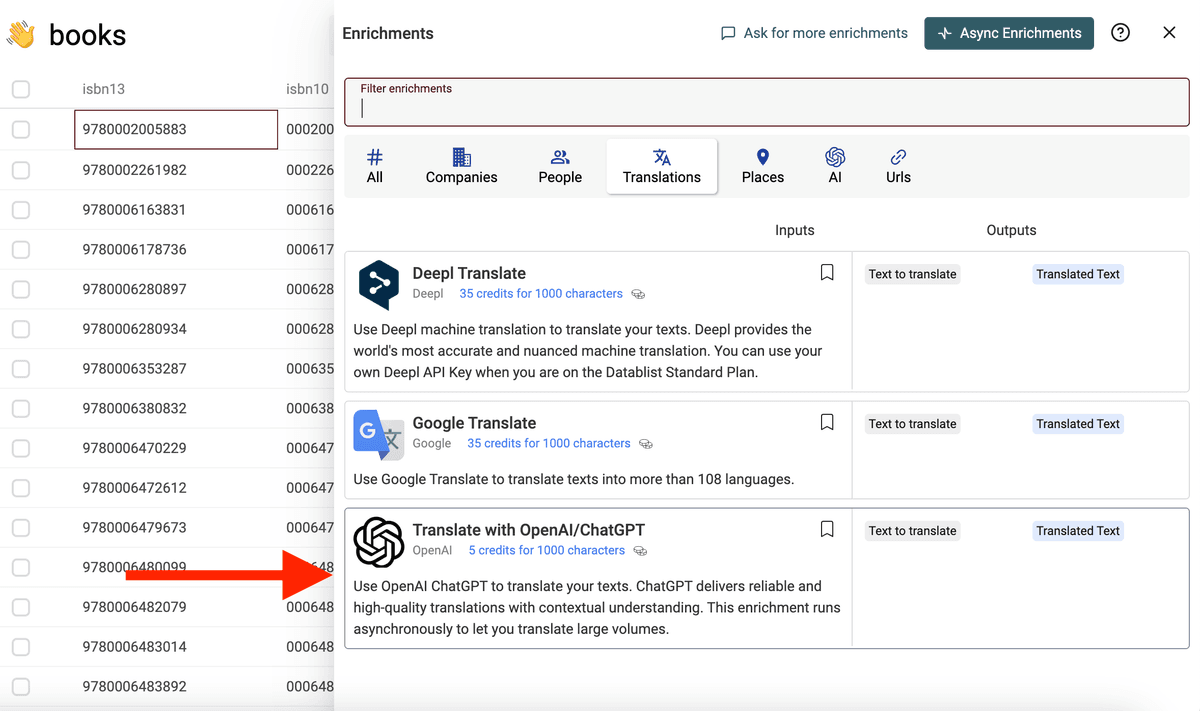
Step 2: Select "Translate with OpenAI/ChatGPT"
Click Enrich and search for Translate with OpenAI/ChatGPT.
Step 3: Choose Languages and Input Column
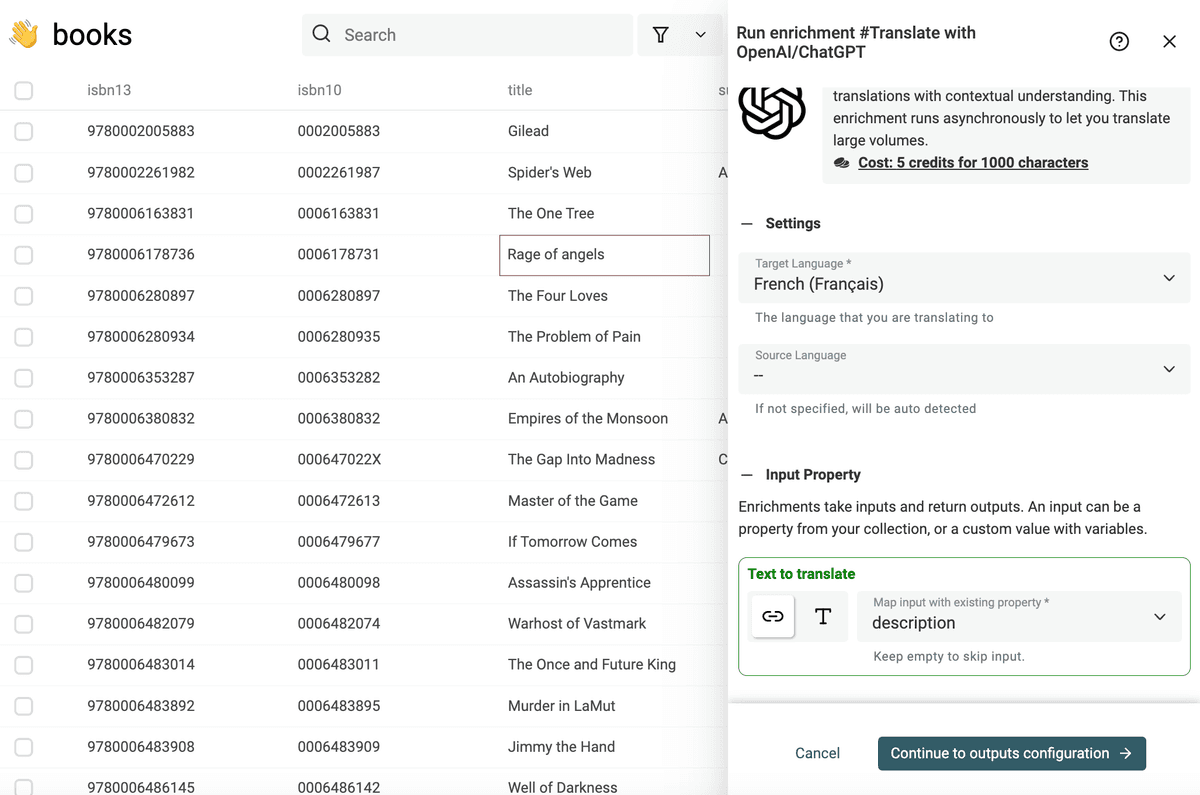
Select the target language for your translations.
Optionally select the source language. If you leave it empty, ChatGPT detects the source language.
Then map Text to translate to the column containing your source text.
Note
This enrichment translates one column at a time. To translate several columns, run the enrichment once per column.
Step 4: Choose Advanced Settings
Open advanced settings when you need more control.
You can choose the GPT model and add extra instructions:
- Keep XML or HTML structure
- Keep JSON structure
- Add custom instructions
Step 5: Store the Translation
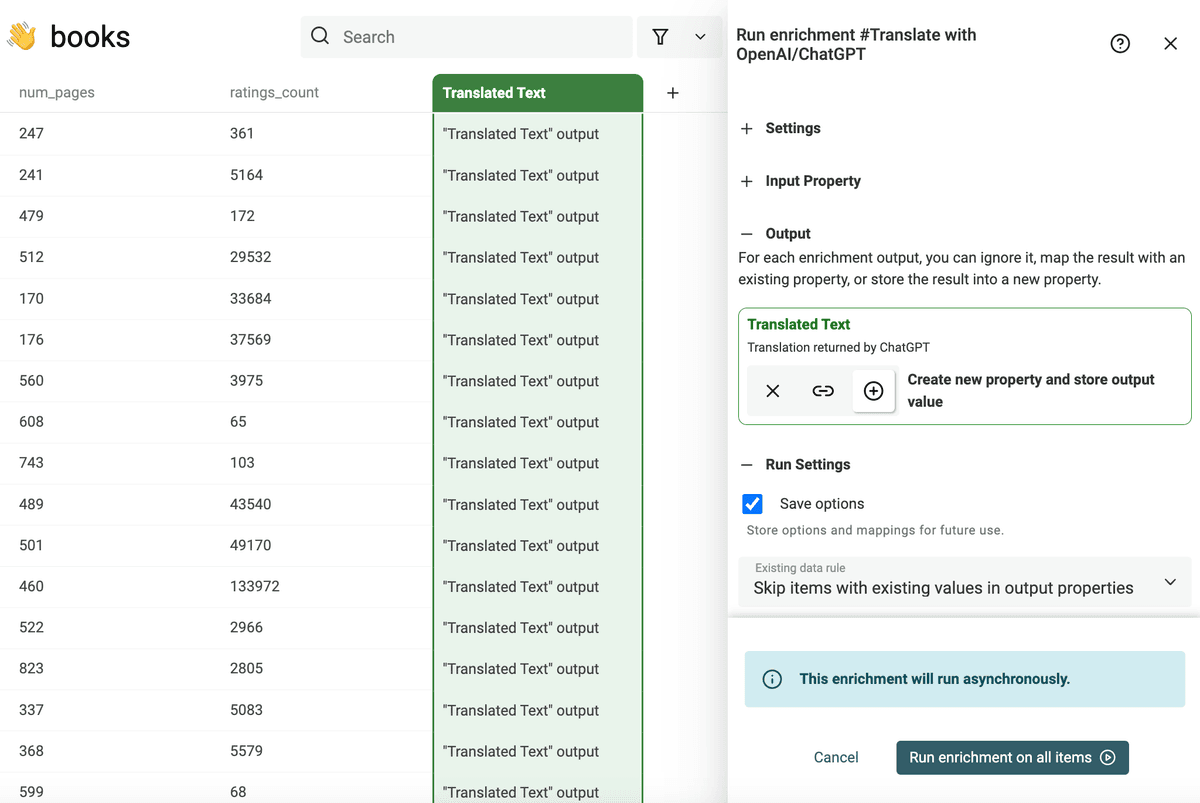
Create or select the output field where Datablist should save the translated text.
Using a new column keeps the original text unchanged.
Step 6: Run the Translation
Run the enrichment. Datablist processes rows in parallel and stores the translated text next to your source data.
Rows with empty text are marked with an error status and cost 0 credits.
Tips for Better Translations
- Set the source language when the text is short.
- Use custom instructions for brand tone or formatting rules.
- Use the HTML/XML option when text contains tags.
- Use the JSON option for localization files.
- Translate one column at a time.
- Test a small sample before translating a large file.
- Keep the original column and write translations to a new column.
FAQ
Can I translate a CSV file with ChatGPT?
Yes. Import your CSV into Datablist, select the text column, choose a target language, and run the translation enrichment.
Can I translate an Excel file with ChatGPT?
Yes. Datablist supports Excel files. Upload the file, translate the text column, then export the result.
Does it detect the source language?
Yes. If you do not set a source language, ChatGPT detects it from the text.
Can I translate several columns?
Yes, but run the enrichment once per column. Each run translates one input column into one output column.
Can it preserve HTML tags?
Yes. In advanced settings, choose Keep XML or HTML structure.
Can it preserve JSON structure?
Yes. In advanced settings, choose Keep JSON structure. Use this for localization files or structured product content.
How much does it cost?
Cost depends on text length and the selected model. The default model is GPT-4o mini, estimated around 1.5 credits per 1,000 characters.
What happens when a row is empty?
Datablist marks the row as missing input and charges 0 credits.
Is ChatGPT slower than Google Translate or DeepL?
Often, yes. Datablist runs translations in parallel and handles the job asynchronously, so you can start the run and come back later.
Can I give ChatGPT glossary or tone rules for translation?
Yes. Add instructions to keep product names, placeholders, HTML tags, or brand terms unchanged. This is the main reason to use ChatGPT translation instead of a direct translation API.