
Extract phone numbers from messy text, CSV files, or Excel spreadsheets.
Datablist scans your rows, finds phone numbers, and returns them in international format. When possible, it also returns the country, the phone number type, and the carrier name.
Use it to clean lead lists, CRM exports, scraped websites, support tickets, or any file where phone numbers are mixed with text.
What the Phone Number Extractor Returns
The enrichment can return:
- Phone numbers in international format, such as
+33 6 56 56 67 24 - Country names from the country code
- Phone number type, such as mobile, fixed line, toll free, VoIP, or fax
- Carrier name, when the phone metadata includes one
The type and carrier outputs help you sort lists before calling, texting, or routing leads.
A Cheap Way to Extract Phone Numbers in Bulk
The Phone Number Extractor costs 0.01 Datablist credits per row.
With the free signup credits, you can process 50,000 rows.
With a $20 credit pack, you get 20,000 credits, enough to process up to 2,000,000 rows.
With a $150 credit pack, you get 200,000 credits, enough to process up to 20,000,000 rows.
You can test the enrichment on a few rows before running it on your full file.
How Phone Type and Carrier Detection Works
Datablist relies on phone number patterns and phone metadata. It does not query a live carrier database.
This keeps the enrichment fast and cheap, but it also creates limits.
Some countries use number ranges for mobile, landline, toll-free, or premium numbers. In those cases, the type is clear.
Other countries use ranges where fixed line and mobile numbers overlap. In those cases, the enrichment can return FIXED_LINE_OR_MOBILE.
Datablist also checks nearby text. If the source text says mobile, cell, office, landline, or fax near the number, the enrichment can infer a better type.
Examples:
Mobile: +1 650-253-0000returnsMOBILE_INFERREDOffice: +1 650-253-0000returnsFIXED_LINE_INFERRED
For guaranteed line type data, use a live telecom lookup service. For bulk extraction and cleanup, this enrichment gives you a low-cost first pass.
Step-by-step Guide
Step 1: Load your CSV or Excel file on Datablist
Create a free account and import your file. Datablist works as a CSV editor for large CSV and Excel files.
Create a new collection and import your file.
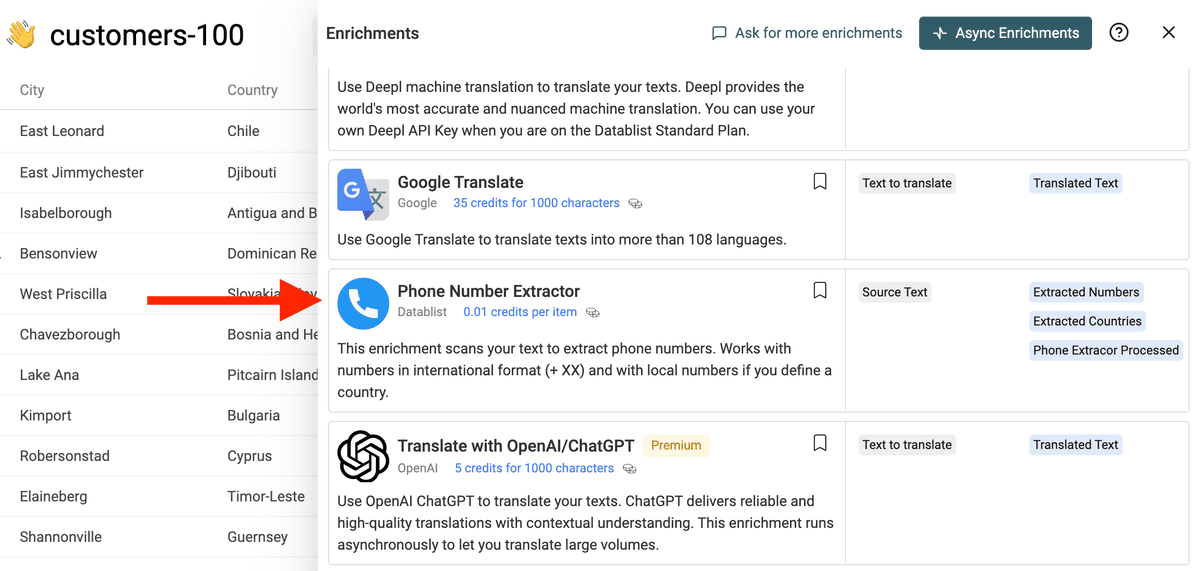
Step 2: Select the "Phone Number Extractor" enrichment
Click the "Enrich" button in the header, then search for "Phone Number Extractor".
Step 3: Configure settings
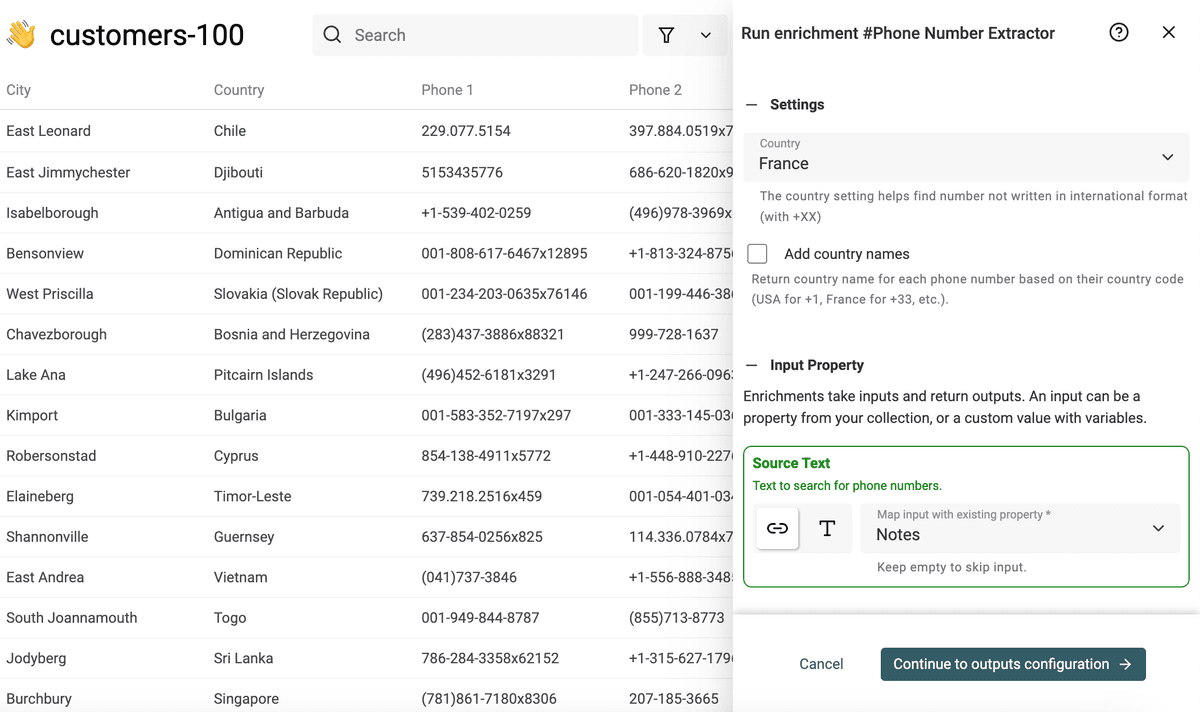
Choose the column with your text.
Then configure a country if your data contains local phone numbers without an international code.
If you leave the country setting empty, the enrichment extracts numbers written in international format, such as numbers starting with +33, +44, or +1.
If you set a country, Datablist can parse local numbers and add the country code. For example, with France selected, 06 56 56 67 24 becomes +33 6 56 56 67 24.
You can also enable extra outputs:
- Add country names
- Add phone number type
- Add carrier names
Step 4: Define where to store the results
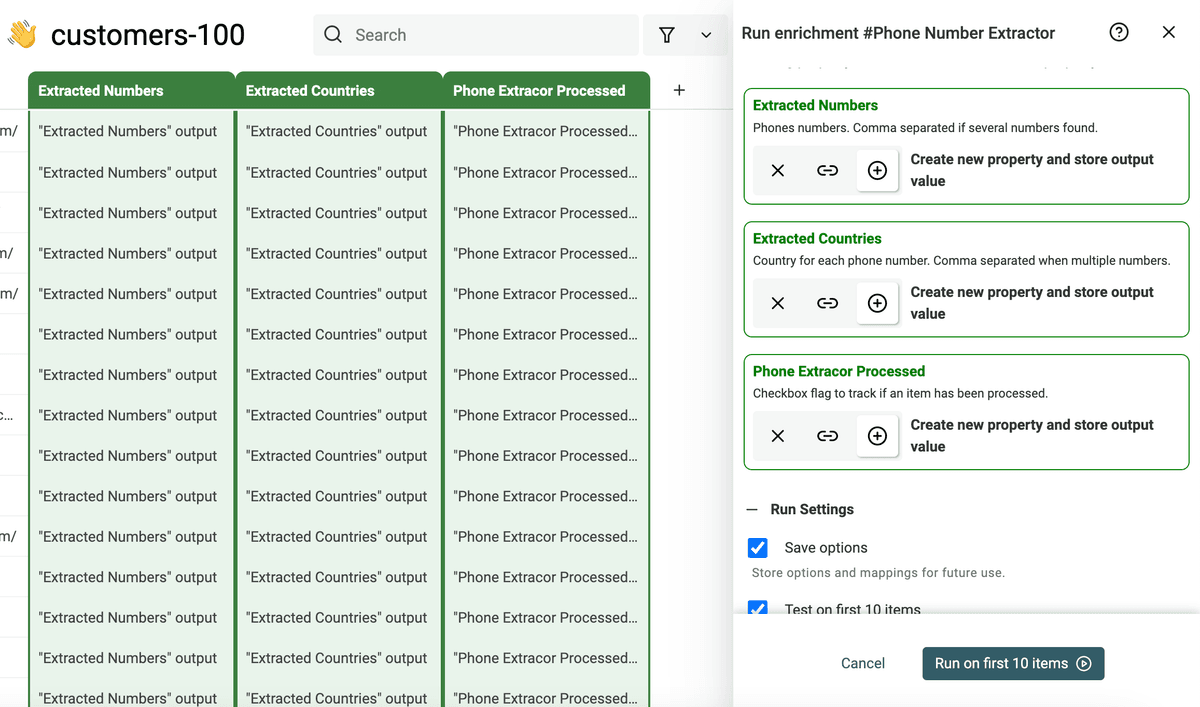
Choose where Datablist should store each result.
If a row contains several phone numbers, Datablist returns comma-separated values in the same order.
For example:
phoneNumbers:+33 6 56 56 67 24,+33 1 42 68 53 00phoneNumberTypes:MOBILE,FIXED_LINEphoneNumberCarriers:e*Message,
If your calling workflow needs one phone number per row, export the result and use the CSV Rows Splitter on the phone number column.
You can create new properties or map existing ones.
Use Cases
Clean CRM Exports
Extract phone numbers from notes, descriptions, and raw contact fields. Store clean phone numbers in a dedicated column before importing data back into your CRM.
Prepare Calling Lists
Use phone number type to split mobile numbers from office numbers when the data allows it.
Clean Scraped Website Data
Web pages often mix phone numbers with addresses, opening hours, and labels. Datablist extracts the numbers and keeps the source rows aligned.
Normalize Local Numbers
Add a default country to convert local numbers into international format.
FAQ
Can Datablist extract phone numbers from Excel files?
Yes. Import your Excel file, select the text column, and run the Phone Number Extractor enrichment.
Can it extract phone numbers from CSV files?
Yes. Datablist opens CSV files and runs the enrichment on each row.
Does it support local phone numbers?
Yes. Set a country in the enrichment settings. Datablist uses it to parse local numbers and add the international code.
Does it return mobile or landline type?
Yes, when the phone number pattern supports it. For some countries, the pattern cannot separate fixed line and mobile numbers.
Why do I get FIXED_LINE_OR_MOBILE?
Some countries use numbering ranges where fixed and mobile numbers overlap. Datablist cannot know the line type from the number alone.
Does Datablist use a live carrier database?
No. Datablist uses phone number metadata and patterns. This keeps the enrichment cheap, but carrier and type data may be missing or ambiguous.
Can Datablist infer the type from text?
Yes. If the text near the number includes words like mobile, cell, office, or fax, Datablist can infer a better type.
Does it return carrier names?
Yes, when the metadata includes a carrier name. Some numbers return an empty carrier field.
How much does it cost?
It costs 0.01 credits per row. Free signup credits let you process 50,000 rows.
Can I test it before running the full file?
Yes. Run a small preview first, check the output columns, then process the full list.
Can I extract phone numbers from scraped website text?
Yes. Put the scraped text or HTML-derived text in a column, run Phone Number Extractor, and save normalized phone numbers, type, carrier, and country fields in new columns.