
Need to detect the language of thousands of texts in a CSV or Excel file?
Datablist's Language Detection enrichment reads a text column and returns the detected language name, ISO language code, and confidence level. It works in bulk, so you can process customer messages, product reviews, support tickets, scraped pages, survey answers, and long text fields without writing code.
This enrichment does not use an LLM. It is cheaper and faster than sending each row to ChatGPT, Claude, Gemini, or another AI model.
What You Get
For each text, Datablist returns:
- Language Name - English, French, Spanish, German, etc.
- Language Code - ISO 639 code such as
en,fr,es, orde. - Language Confidence - High, Medium, Low, or Very Low.
When the text is empty, Datablist marks the row as invalid. When the language is too uncertain, Datablist marks the row as no result. Use these statuses to filter rows needing a manual check.
Why Use This Instead of an LLM?
LLMs can detect languages, but they are not the right tool for most bulk language detection jobs.
Language detection is a classification task. You do not need a generative model to answer "What language is this text?" for every row in a file.
Use this enrichment when you need:
- Lower cost - Run language detection for large lists without paying AI-token prices.
- Fast processing - Process rows faster than an LLM prompt per item.
- Bulk scale - Work with large CSV or Excel files, including hundreds of thousands of items.
- Long text support - Detect language from descriptions, emails, reviews, article extracts, and scraped webpage text.
- Manual review control - Use the confidence level to filter low-confidence results.
Common Use Cases
Segment Leads by Language
Detect the language used in form submissions, LinkedIn messages, website inquiries, or lead notes. Then split your list by language before sending email campaigns or assigning sales reps.
Example:
| Text | Language Name | Language Code | Confidence |
|---|---|---|---|
| Hello, I would like more information about your product. | English | en | High |
| Bonjour, je souhaite recevoir plus d'informations. | French | fr | High |
| Hola, quiero saber mas sobre sus servicios. | Spanish | es | Low |
Route Support Tickets
Run language detection on incoming support messages and route tickets to the right team.
You can create views such as:
- French tickets for the French support team
- German tickets for your DACH team
- Low-confidence tickets for manual review
Prepare Texts for Translation
Before translating a list of texts, detect the source language. This helps you:
- Skip texts already written in the target language
- Group rows by source language
- Send each group to the right translation workflow
- Avoid translation errors caused by wrong source language settings
Analyze Reviews and Survey Answers
Customer feedback often mixes languages in the same file. Detect the language first, then run sentiment analysis, keyword extraction, or manual review per language.
This is useful for:
- Product reviews
- NPS comments
- App store reviews
- Survey answers
- Customer interviews
Clean Scraped Web Data
When you scrape websites, directories, job posts, or article snippets, the result may contain several languages. Use bulk language detection to keep only the languages you need.
Example workflows:
- Keep only English pages from a scraped URL list
- Remove non-target language content before analysis
- Split scraped descriptions by market
Step-by-Step Guide
Step 1: Load Your CSV or Excel File
Create a free account and import your file into Datablist. Datablist is a CSV editor built for large files, so you can open lists too large for spreadsheets.
Create a new collection and import your file.
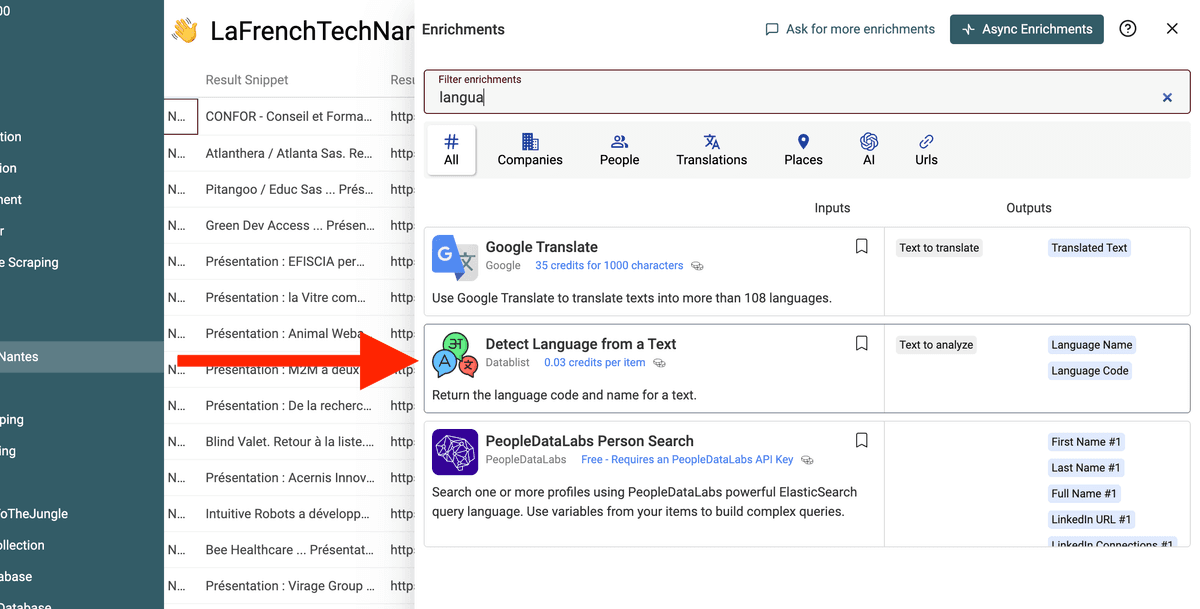
Step 2: Select the "Detect Language from a Text" Enrichment
Click the "Enrich" button and search for "Detect Language from a Text".
Step 3: Map the Text Column
Select the column containing the text to analyze. It can be a short message, a review, an email body, a product description, or a long text field.
Datablist creates output columns for the language name, language code, and confidence level.
Step 4: Review Low-Confidence Rows
After the run, filter the confidence column.
Use this workflow:
- Keep High and Medium confidence results for automated workflows.
- Review Low confidence rows when accuracy matters.
- Check rows with no result. They may contain numbers, URLs, names, short fragments, or mixed languages.
Example Inputs and Outputs
| Input Text | Language Name | Language Code | Confidence |
|---|---|---|---|
| Thanks for your help. I will send the file today. | English | en | High |
| Merci pour votre aide. Je vous envoie le fichier aujourd'hui. | French | fr | High |
| Gracias por la informacion, te contacto manana. | Spanish | es | Medium |
| Guten Tag, ich habe eine Frage zu meiner Bestellung. | German | de | High |
| 12345 / www.example.com / Paris | No result |
Tips for Better Results
- Use a full sentence when possible. Language detection works better with more words.
- Keep useful text. Do not remove accents if you can keep them.
- Detect language before translation, classification, or sentiment analysis.
- Filter by confidence when you use the results in automation.
- For mixed-language texts, the enrichment returns the main detected language.
FAQ
Can I detect language in a large CSV file?
Yes. Datablist can process large lists, including hundreds of thousands of rows. Import your CSV or Excel file, select the text column, and run the enrichment in bulk.
Does it work on long texts?
Yes. You can run it on long descriptions, email bodies, reviews, scraped webpage text, and article extracts.
Is this cheaper than using ChatGPT for language detection?
Yes. This enrichment is built for language detection only. It does not send each row to an LLM, so it avoids token costs and runs faster.
What does the confidence level mean?
The confidence level tells you how clear the language match is. Use it to decide which rows can move to the next step and which rows need review.
What happens with empty text?
Empty input is marked as invalid data. Text with no clear language is marked as no result.
Which languages are supported?
The enrichment supports many common languages, including English, French, Spanish, German, Italian, Portuguese, Dutch, Chinese, Japanese, Arabic, Russian, and more. The result includes the language name and ISO code.
Can I use language detection before translation?
Yes. Run language detection first when your CSV contains mixed languages. Then filter rows by detected language and translate only the rows that need it.